

REQUEST DEMO
Robot CATALOG will be sent to your mailbox immediately after submission.
SUBMIT
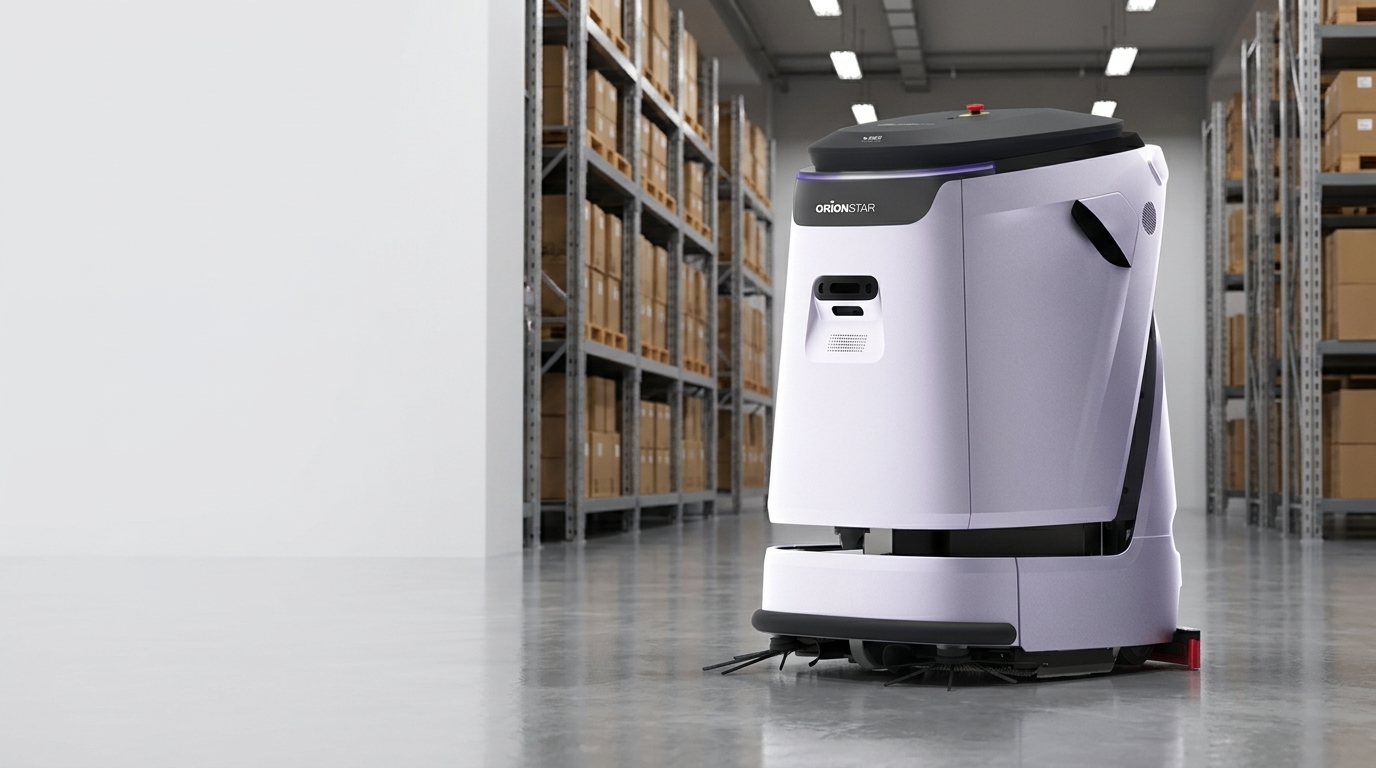
Our pick, where the aisle passes 800 mm, the ramp stays within 2%, and a docking station can be plumbed off the forklift lane, is the CleaniBot C5. A warehouse ramp that can reach 6% is a different machine: Kärcher KIRA B 50 publishes max 6% and leads the warehouse score at 7.00, with the C5 at 6.20. A ride-on aisle is Tennant T16AMR or Avidbots Neo 2W, and 5,890 m²/h on the T16AMR is theoretical manual. Those scores are on the scored page. They are not the large-floor 7.90.
Disclosure. OrionStar publishes this page and sells CleaniBot. Figures are manufacturer-published or from the product manual, accessed 5 November 2026. We did not lab-test the other machines.
Match the opening and the ramp before the brochure rate. An 800 mm pass fits a narrow aisle and fails a dock leveler the manual does not allow. A 1.45 m pass fits a wide aisle and does not fit a tight service corridor. Office floors are a different page: commercial buildings.
| Model | Opening | Grade | Tanks | Rate, with the label | Falls short |
|---|---|---|---|---|---|
| CleaniBot C5 | pass 800 mm, 215 kg | ≤2% | 45 L / 45 L tanks | 1,980 m²/h maximum theoretical | 3 h scrub. Noise ≤70 dB(A). Not a 190 L ride-on |
| Kärcher KIRA B 50 | pass 900–1,000 mm, 228 kg empty | max 6% | 55 L / 55 L tanks | 2,365 m²/h theoretical autonomous | Full docking station is optional. About 3.5 h. 69 dB(A) |
| Avidbots Neo 2W | turn about 3.05 m, 688 kg | 3% | 109 L / 135 L tanks | 3,941 m²/h theoretical | Home Base charges. It is not a water dock. 75 dB(A). 4–6 h |
| Tennant T16AMR | pass 1.45 m, U-turn 3.43 m | not published | 190 L / 225 L tanks | 5,890 m²/h theoretical manual | No water dock. 71 dB(A). 4 h, or 5.5 h lithium |
| ICE RS26 | pass not published, about 417 kg | 0% autonomous | 110 L / 110 L tanks | 2,687 m²/h autonomous | Do not send it up a ramp in autonomous mode. 68 dB(A) |
| Pudu BG1 | path 85 cm, about 344 kg | not published | 75 L / 60 L tanks | 2,000 m²/h covered max | Not the 6,000 m²/h spot figure. Max 7.5 h |
Use the C5 when the docking station can charge, refill, drain and self-clean, and every ramp on that route is within 2%. The 45 L tank is a between-dock figure, not a 90 L tank. Use the KIRA B 50 when the ramp is the reason the C5 fails and the optional dock is actually on the order. Use the Neo 2W when the aisle already takes a 3.05 m turn and the published 3% grade is enough. Use the T16AMR when the tank has to be 190 L / 225 L, and write “theoretical manual” next to 5,890 m²/h. Brain Corp BrainOS on that machine still needs the route driven once.
Three measurements: the narrowest opening, the steepest ramp, and whether a docking station has water and a drain off the lane. Profiles are on the model page. Zones are on the zone page.
A theoretical manual rate is the scrubber driven by a person. An autonomous rate is the one the sheet labels autonomous. The C5 line is maximum theoretical, and the manual does not call it manual-mode. The ICE line is autonomous, and the autonomous grade is 0%. Gausium Scrubber 50 Pro is 1,987 m²/h theoretical and 500–1,300 m²/h practical, pass 800 mm, with the grade given as 4.6°, not a percent. No KIRA B 200 productivity rate is included because that model is outside this comparison. LionsBot R3 Scrub Pro at 800–1,200 m²/h practical is a compact machine. Nilfisk Liberty SC50 publishes 2% autonomous grade and names CSA/ANSI C22.2 No. 336. The C5 manual does not name a robotic certificate.
No price, no lease price and no payback. Lines a quote should split are on the quote page.
IEC 63327 and IEC 60335-2-72 cover this machine class. IEC 60529 is the IP code. A wet aisle is a slip risk (HSE slips). In the EU the employer duty is the OSH Framework Directive. Keep the robot off an accessible route (Access Board, chapter 4) and out of an exit (NFPA 101). 47 CFR Part 15 on the C5 is the radio claim.
Teach the aisle while the forklifts are stopped. The dock does not sit in the travel lane. A mezzanine is another map. The order of work is the deployment page. The general scrubber steps stay on the implementation guide.
The C5 station self-cleans the sewage tank. The weekly check remains. Neutral or alkaline detergent only. Warehouse dust and a damaged squeegee are on the maintenance page.
C5 if the ramp is within 2% and a docking station fits. KIRA B 50 if the ramp is why the C5 fails. T16AMR or Neo 2W if the aisle is already a ride-on.
No. The KIRA leads because max 6% and an autonomous label are each 20% of this rubric. The T16AMR tank score is 10. Its total is 5.20 because the big rate is theoretical manual and no water dock is published.
Not on the published autonomous grade. That figure is 0%.
Pudu BG1 is the 2,000 m²/h covered machine at about 344 kg. Gausium’s warehouse-relevant option is the Scrubber 50 Pro, grade in degrees. LionsBot R3 Scrub Pro is the compact option. Nilfisk is the named-certificate check. Brain Corp is the system on the Tennant and ICE machines.
Not on this page.