

REQUEST DEMO
Robot CATALOG will be sent to your mailbox immediately after submission.
SUBMIT
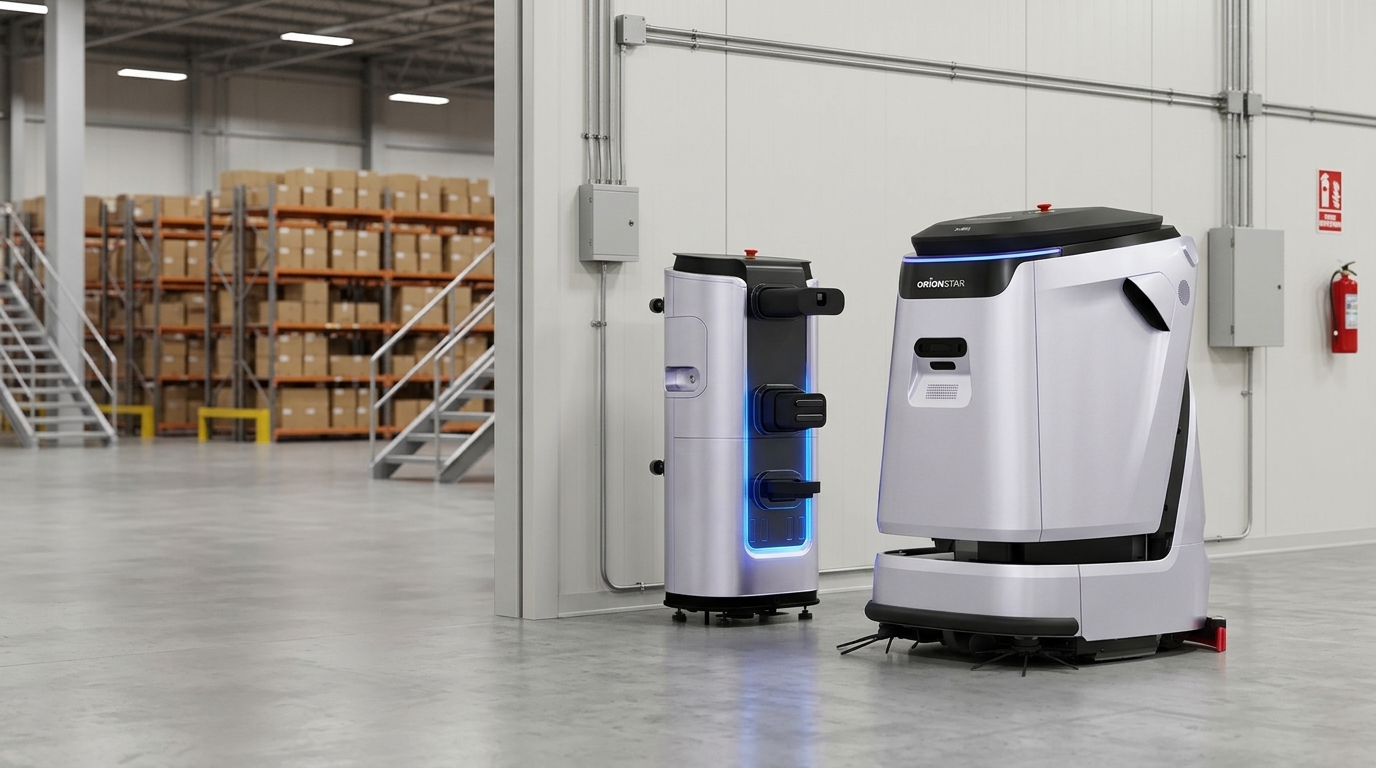
Start with the ramp, then an empty aisle, then a docking station off the forklift lane. Our pick for that aisle, when it passes 800 mm and the ramp is within 2%, is the CleaniBot C5. A warehouse is usually one floor. A mezzanine is a second map, not an office-building elevator project. The general scrubber steps stay on the implementation guide. This page is the warehouse constraint. Which machine belongs on the aisle is the comparison.
Disclosure. OrionStar publishes this page and sells CleaniBot. Figures are manufacturer-published or from the product manual, accessed 5 November 2026. We did not lab-test the other machines.
Pick the aisle whose ramp you have measured. If any ramp on the route is over 2%, the C5 is the wrong first install. Kärcher KIRA B 50 publishes max 6%. ICE RS26 publishes 0% autonomous. Tennant T16AMR’s grade is not published, so leave it out of the method statement. The machine is 635 kg with the lithium pack, pass 1.45 m, U-turn 3.43 m.
| Model | Opening | Grade | Mass | Dock | First-run rule |
|---|---|---|---|---|---|
| CleaniBot C5 | pass 800 mm path | ≤2% | 215 kg | Docking station refills and drains | Push the map while forklifts are stopped |
| Kärcher KIRA B 50 | pass 900–1,000 mm | max 6% | 228 kg empty | Optional full dock | The option has to be on the order |
| Avidbots Neo 2W | turn about 3.05 m | 3% | 688 kg | Home Base charges | Not a water dock. 75 dB(A) |
| Tennant T16AMR | pass 1.45 m | not published | 635 kg lithium | No water dock | BrainOS route is driven once. 71 dB(A) |
| ICE RS26 | pass not published | 0% autonomous | about 417 kg | On-board charge | Do not teach a ramp |
| Pudu BG1 | path 85 cm | not published | about 344 kg | Refill, drain, charge | Keep it out of a live forklift lane |
| Model | Path | Rate, with the label | Tanks | Runtime | Noise |
|---|---|---|---|---|---|
| CleaniBot C5 | 550 mm path, pass 800 mm | 1,980 m²/h maximum theoretical | 45 L / 45 L tanks | 3 h scrub | ≤70 dB(A) |
| Kärcher KIRA B 50 | 550 mm path, pass 900 mm | 2,365 m²/h theoretical autonomous | 55 L / 55 L tanks | 3.5 h scrub | 69 dB(A) |
| Avidbots Neo 2W | 790 mm path | 3,941 m²/h theoretical | 109 L / 135 L tanks | 4–6 h | 75 dB(A) |
| Tennant T16AMR | 910 mm path, pass 1.45 m | 5,890 m²/h theoretical manual | 190 L / 225 L tanks | 4 h scrub | 71 dB(A) |
| Pudu CC1 Pro | 500 mm path, pass 700 mm | 700–1,000 m²/h all-covered | 15 L / 15 L tanks | 5 h scrub | <70 dB |
| Gausium Phantas | pass 650 mm path | 350–700 m²/h practical | 11.5 L / 10.5 L tanks | 4.5 h scrub | ≤60 dB |
The last two rows are compact machines. They are here so a warehouse quote does not silently substitute them for the aisle.
Install the C5 where 45 L / 45 L tanks are refilled by the docking station and the route never exceeds 2%. Do not install it because 1,980 m²/h is a large number. Install the KIRA B 50 when the ramp is the reason. Install the T16AMR when the aisle and the U-turn already match 1.45 m and 3.43 m, and label 5,890 m²/h as theoretical manual.
The C5 manual names the map as city + customer + floor. A single-storey warehouse is still one map, and the name can carry the aisle. Draw virtual walls at the dock leveler, the racking that is narrower than 800 mm, and the pedestrian door. LionsBot’s pass is not published, so do not mark an aisle “fits” from a body width. Nilfisk’s fact sheet names CSA/ANSI C22.2 No. 336. Install does not copy that number onto a C5.
The first pass happens with the forklifts parked. After go-live, the same window is the operating hour. A robot and a forklift do not share an unmarked aisle because the brochure says the robot stops. Brain Corp teach-and-repeat still needs a person who can drive the route again when the racking moves.
No price, no lease price and no payback. The quote should separate the machine, the docking station and the map. Those lines are on the quote page.
IEC 63327 and IEC 60335-2-72 are the machine standards. IEC 60529 is the IP code. A wet new aisle is a slip risk (HSE slips). The EU duty sits with the employer (OSH Framework Directive). Keep the path off an accessible route (Access Board, chapter 4) and clear of an exit (NFPA 101). 47 CFR Part 15 is the C5 radio claim.
The station self-cleans the C5 sewage tank. The weekly check remains. Neutral or alkaline only. A cut squeegee from pallet debris is a stop, not a setting. Details are on the maintenance page.
No. Teach it in a stopped window. Keep that window after go-live.
It is 215 kg, and the map is that floor. A second building is a second install.
No. It is another map, and the ramp onto it has to pass the grade check.
Where the pass and the U-turn already fit. Not in an 800 mm aisle.
A named person on that shift. The robot does not.