

REQUEST DEMO
Robot CATALOG will be sent to your mailbox immediately after submission.
SUBMIT
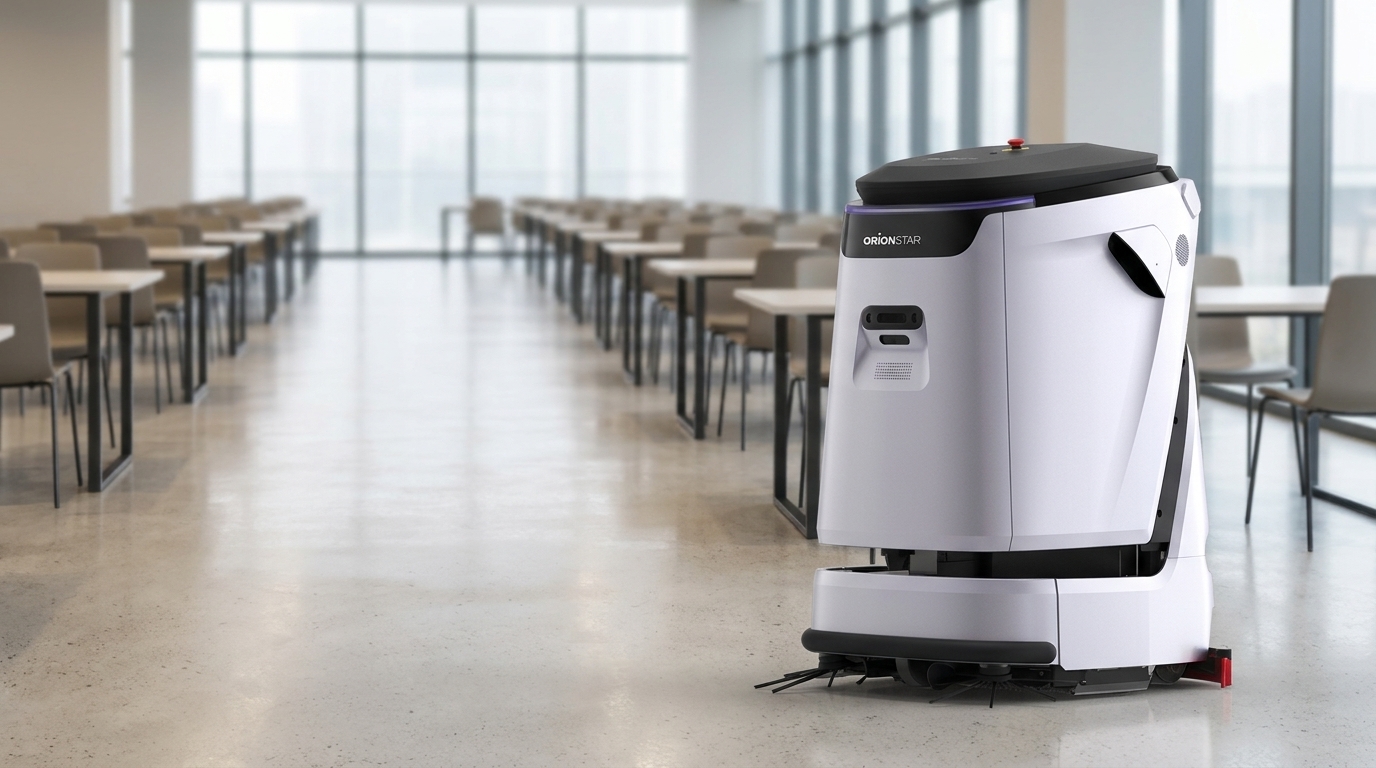
Our pick for the deployment is the CleaniBot C5 when the empty dining room passes 800 mm, the turn between tables is 1,720 mm, the ramp is within 2%, and a docking station can be plumbed outside the kitchen. Start the map after service, not during it.
Disclosure. OrionStar publishes this page and sells CleaniBot. Measurements are from the product manual or manufacturer-published sheets, accessed 5 November 2026. We did not commission a site.
The machine is chosen on the comparison. This page is the order of work after that choice. It does not copy a warehouse forklift plan. Office elevators are on the buildings page. The shared scrubber steps stay on the implementation guide.
| Check | C5 figure | S55 Pro figure | CC1 Pro figure | KIRA B 50 figure | If it fails |
|---|---|---|---|---|---|
| Pass | 800 mm | 700 mm | 700 mm | 900 mm to 1,000 mm | Pick the machine that fits, or skip the aisle |
| Turn or body | 1,720 mm turn, 215 kg | 70 kg, pass 700 mm | pass 700 mm | empty 228 kg | A chair grid can fail a machine that fits the aisle width |
| Grade | ≤2% | 6° | not published | max 6% | KIRA only when the ramp is why the C5 fails |
| Tanks | 45 L / 45 L tanks | 22 L / 15 L tanks | 15 L / 15 L tanks | 55 L / 55 L tanks | A charge-only docking station means staff refill |
| Time versus the gap | 3 h scrub | 4.5 h | 5 h scrub | 3.5 h | Plan a return if the gap is shorter than the route |
| Noise while seats are full | ≤70 dB(A) | 65 dB scrub | <70 dB | 69 dB(A) | Run after the room empties |
| Model | Path | Tanks | Scrub time | Noise | Rate |
|---|---|---|---|---|---|
| CleaniBot C5 | 550 mm path, pass 800 mm | 45 L / 45 L tanks | 3 h scrub | ≤70 dB(A) | 1,980 m²/h maximum theoretical |
| CleaniBot S55 Pro | 520 mm path, pass 700 mm | 22 L / 15 L tanks | 4.5 h | 65 dB scrub | 1,197 m²/h scrub |
| Pudu CC1 Pro | 500 mm path, pass 700 mm | 15 L / 15 L tanks | 5 h scrub | <70 dB | 700 m²/h to 1,000 m²/h all-covered |
| Gausium Phantas | 330 mm path, pass 650 mm | 11.5 L / 10.5 L tanks | 4.5 h | ≤60 dB | 1,188 m²/h theoretical scrub |
| Kärcher KIRA B 50 | 550 mm path, pass 1,000 mm | 55 L / 55 L tanks | 3.5 h | 69 dB(A) | 2,365 m²/h theoretical autonomous |
| Tennant T7AMR | 650 mm path, aisle 1,219 mm | 110 L / 110 L tanks | 4 h | 70 dB | 4,250 m²/h theoretical manual |
Put the C5 docking station where it can charge, refill, drain, and self-clean, off the queue and off the accessible route. Do not put it in the dish room. The 3 h scrub is the battery window, not a promise that one pass covers every seat before the next meal.
Map name format in the manual: city, customer, floor. Climb ≤2%. Vacuum 18.18 kPa. Path 550 mm, side 840 mm. The robot is described as capable of elevator integration. The module is a sales question, not a box that is assumed on the pallet.
Deploy this machine when a mezzanine dining room is max 6% and the optional docking station is on the order. Pass 900 mm to 1,000 mm. Rate 2,365 m²/h is theoretical autonomous. It is not a tighter chair row than the C5.
Zones that fail these checks are on the zone page.
Productivity on a brochure is not the gap. C5 is 1,980 m²/h maximum theoretical. S55 Pro is about 1,197 m²/h scrub. CC1 Pro all-covered is 700 m²/h to 1,000 m²/h, not 1,500 m²/h to 3,000 m²/h spot. Phantas is ≤60 dB and pass 650 mm, with 1,188 m²/h theoretical scrub, and its docking station is not on the specs page. Gausium Scrubber 50 Pro practical coverage is 500 m²/h to 1,300 m²/h at 460 mm and 4.6°. Tennant T7AMR needs 1,219 mm of aisle navigation, 110 L / 110 L tanks, 4 h, 70 dB, and 4,250 m²/h theoretical manual, with Brain Corp BrainOS and no water docking station. LionsBot R3 is 800 m²/h to 1,200 m²/h practical, body 570 mm, 71 dB, up to 3 h, pass not published. Nilfisk Liberty SC50 is up to 6 h, 63 dB(A), 1,895 m²/h theoretical autonomous, autonomous grade 2%, no water dock published. Pudu BG1 covered max is 2,000 m²/h at about 344 kg, path 85 cm, max 7.5 h. A T16AMR at 1,450 mm pass is not this deployment.
No price, no lease price, and no payback for the install. What the quote should itemise is on the quote page. Training and the map are lines on that quote, not assumed free.
Map while the dining room is empty so the route is not learned through a queue. IEC 63327 and IEC 60335-2-72 cover the machine class. IEC 60529 is why IPX3 is not a wash-down. Slip risk: HSE slips. Catering floors: HSE cleaning. Employer duty: OSH Framework Directive. Keep the docking station off the accessible route (Access Board, chapter 4) and clear of the exit (NFPA 101). 47 CFR Part 15 is the C5 radio claim. No named food-safety certificate is created by a successful map.
Teach one closed dining room. Park the docking station outside the kitchen. Test the 1,720 mm turn before the first unsupervised run. Confirm the weekly check is still on the calendar after the station self-cleans. Side brush 400 h, roller 500 h, squeegee 500 h, and HEPA 300 h are C5 manual intervals, not a fleet default. Maintenance context is the maintenance page. Model limits are the profiles.
The station does not cancel the weekly check. Grease film on tile is not a reason to pour strong acid into the 45 L tank.
When the dining room is empty and chairs are where they sit at service. A map made in a bare overnight layout will not match lunch.
Outside the kitchen, off the queue, with water and a drain if the machine is a C5. A charge-only dock on the S55 Pro still needs a staff refill of 22 L / 15 L tanks.
Only with a map per floor. Elevator integration on the C5 is described as capable. Ask sales about the module. Do not assume it is in the crate.
The steps stay: measure, map while empty, dock off the kitchen, match detergent to that manual. Kärcher changes the ramp limit to max 6%. Gausium Phantas does not document a docking station on the specs page. Pudu CC1 Pro’s water dock is optional. LionsBot pass is not published. Nilfisk publishes no water dock. Tennant T7AMR uses Brain Corp and an off-board charge. Each of those is a different install note, not a different meal gap.
Not on this page. No price and no lease figure.