

REQUEST DEMO
Robot CATALOG will be sent to your mailbox immediately after submission.
SUBMIT
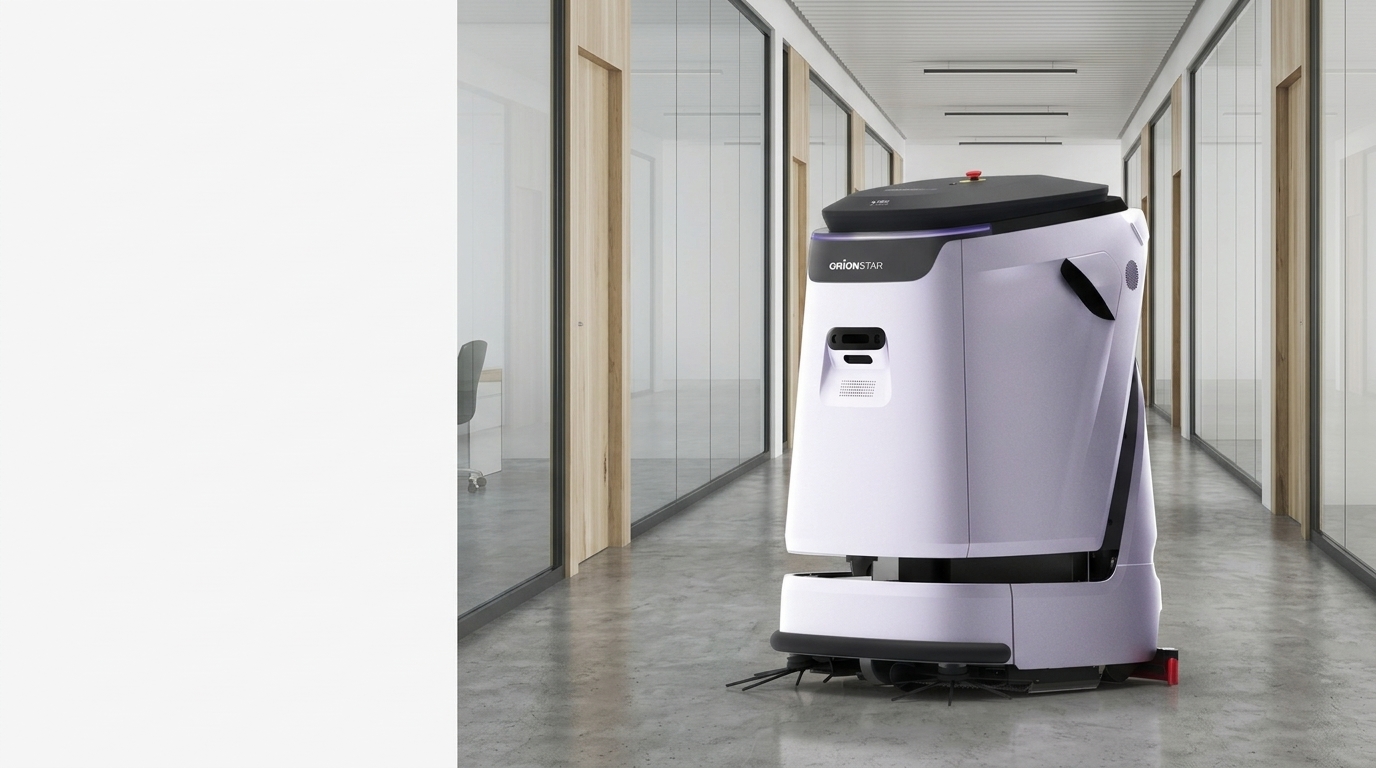
On this corridor rubric, Gausium Phantas scores 7.90 and the CleaniBot C5 scores 7.70. Our pick is still the C5 where the building needs a docking station that refills and drains. Phantas leads on the strength of its published 650 mm pass and ≤60 dB quiet mode, despite scoring only 3 for the dock because its specifications page does not list a workstation. The large-floor rubric is a different scale: there the C5 is 7.90, Avidbots Neo 2W is 7.55 and Tennant T16AMR is 7.20. Do not treat the two 7.90s as one result. The floor match is the comparison.
Disclosure. OrionStar publishes this page and sells CleaniBot. Figures are manufacturer-published or from the product manual, accessed 5 November 2026. We did not lab-test the other machines.
The question is a multi-floor building with corridors. Pass is 25%, noise 20%, the dock 20%, runtime 15%, and spec completeness 20%. A wide ride-on scores down on pass. A missing noise figure scores 2. A complete workstation scores 10. A charge-only dock scores 4. A workstation that is not on the specs page scores 3. Component scores are a reading of the published figure, not a lab test. The total is the weighted sum.
| Model | Pass | Noise | Dock | Runtime | Spec | Total |
|---|---|---|---|---|---|---|
| Gausium Phantas | 9 | 10 | 3 | 7 | 10 | 7.90 |
| CleaniBot C5 | 7 | 6 | 10 | 5 | 10 | 7.70 |
| Pudu CC1 Pro | 8 | 6 | 6 | 8 | 10 | 7.60 |
| CleaniBot S55 Pro | 8 | 8 | 4 | 7 | 10 | 7.45 |
| Kärcher KIRA B 50 | 5 | 7 | 6 | 6 | 10 | 6.75 |
| Pudu BG1 | 6 | 2 | 8 | 10 | 8 | 6.60 |
| Gausium Scrubber 50 Pro | 7 | 2 | 6 | 5 | 8 | 5.70 |
| Avidbots Neo 2W | 1 | 3 | 4 | 8 | 10 | 4.85 |
| Tennant T16AMR | 2 | 5 | 2 | 6 | 10 | 4.80 |
| Model | Path | Rate, with the label | Tanks | Runtime | Noise |
|---|---|---|---|---|---|
| CleaniBot C5 | 550 mm path, pass 800 mm | 1,980 m²/h maximum theoretical | 45 L / 45 L tanks | 3 h scrub | ≤70 dB(A) |
| CleaniBot S55 Pro | 520 mm path, pass 700 mm | about 1,197 m²/h scrub | 22 L / 15 L tanks | 4.5 h scrub | 65 dB scrub |
| Gausium Phantas | pass 650 mm path | 350–700 m²/h practical | 11.5 L / 10.5 L tanks | 4.5 h scrub | ≤60 dB |
| Pudu CC1 Pro | 500 mm path, pass 700 mm | 700–1,000 m²/h all-covered | 15 L / 15 L tanks | 5 h scrub | <70 dB |
| Kärcher KIRA B 50 | 550 mm path, pass 900 mm | 2,365 m²/h theoretical autonomous | 55 L / 55 L tanks | 3.5 h scrub | 69 dB(A) |
| Tennant T16AMR | 910 mm path, pass 1.45 m | 5,890 m²/h theoretical manual | 190 L / 225 L tanks | 4 h scrub | 71 dB(A) |
Rank and recommendation are not the same sentence. Phantas is first on this rubric. Choose the C5 when the order has to include a docking station that charges, refills, drains and self-cleans, on a hard floor that passes 800 mm, with a climb within 2%. The C5 figures under that choice are 550 mm path, 1,980 m²/h maximum theoretical, 45 L / 45 L tanks, 3 h scrub and ≤70 dB(A). Choose Phantas when the buyer will live with 350–700 m²/h practical, 11.5 L / 10.5 L tanks, 4.5 h scrub and no workstation on the specs page. Choose the S55 Pro, 7.45, for a 700 mm pass, 65 dB scrub, 22 L / 15 L tanks and 4.5 h, knowing the dock only charges.
An office floor punishes a 1.45 m pass and a 3.05 m turn. That is why the T16AMR and the Neo 2W sit at 4.80 and 4.85 here and near the top of the large-floor scores. Nilfisk Liberty SC50 scores 6.05 on this scale: 63 dB(A) and up to 6 h, then a 1,592 mm aisle turn and no published water dock. LionsBot is not in the ranked rows. The R3 Scrub Pro’s practical rate is 800–1,200 m²/h and the pass is not published. Brain Corp BrainOS is the system on the Tennant machines, not a separate score.
Pass uses the published opening: 650 mm is 9, 700 mm is 8, 800 mm is 7, 850 mm is 6, 900–1,000 mm is 5, 1.45 m is 2, a turn of about 3.05 m is 1. Noise unpublished is 2, which is why the Scrubber 50 Pro and the BG1 lose that column. Runtime uses 3 h = 5, 3.5 h = 6, 4 h = 6, 4.5 h = 7, 5 h = 8, 7.5 h = 10. The Neo figure uses the midpoint of 4–6 h. The T16AMR figure uses the 4 h pack, not the 5.5 h lithium option. Spec completeness is 2 points each for path, a labelled rate, tanks, an opening and noise.
No price, no lease price and no payback. A higher total is not a lower price.
IEC 63327, IEC 60335-2-72 and IEC 60529 are the standards named here. A wet floor is still a slip risk (HSE slips). The EU duty is the OSH Framework Directive. Keep the robot off an accessible route (Access Board, chapter 4) and out of an exit (NFPA 101). 47 CFR Part 15 is the C5 radio claim. The T16AMR spec row names a robotic certificate. The C5 manual does not. The score does not add a certificate that the manual does not name.
A map per floor, or an elevator module that sales has to scope, is an install. It is not a point on this table. Maintenance intervals stay in each manual. The C5 weekly check remains after the station self-cleans.
The rubric ranks a published 650 mm pass and ≤60 dB above a dock the specs page does not list. The pick is the machine whose dock actually refills water. Both sentences can stand.
No. Same digits, different weights. There, wide path and large tanks score up. Here they score down.
Max 7.5 h is the top of the runtime band. Noise is not published, so that column is 2. About 344 kg is a separate reason to keep it out of a live corridor. The score does not include the weight.
Not as an autonomous rate. The T16AMR total uses the pass, the noise, the missing water dock and the 4 h pack. 5,890 m²/h is not in the arithmetic as a productivity win.
They can. This page does not. The weights were set for corridors, then added up.