

REQUEST DEMO
Robot CATALOG will be sent to your mailbox immediately after submission.
SUBMIT
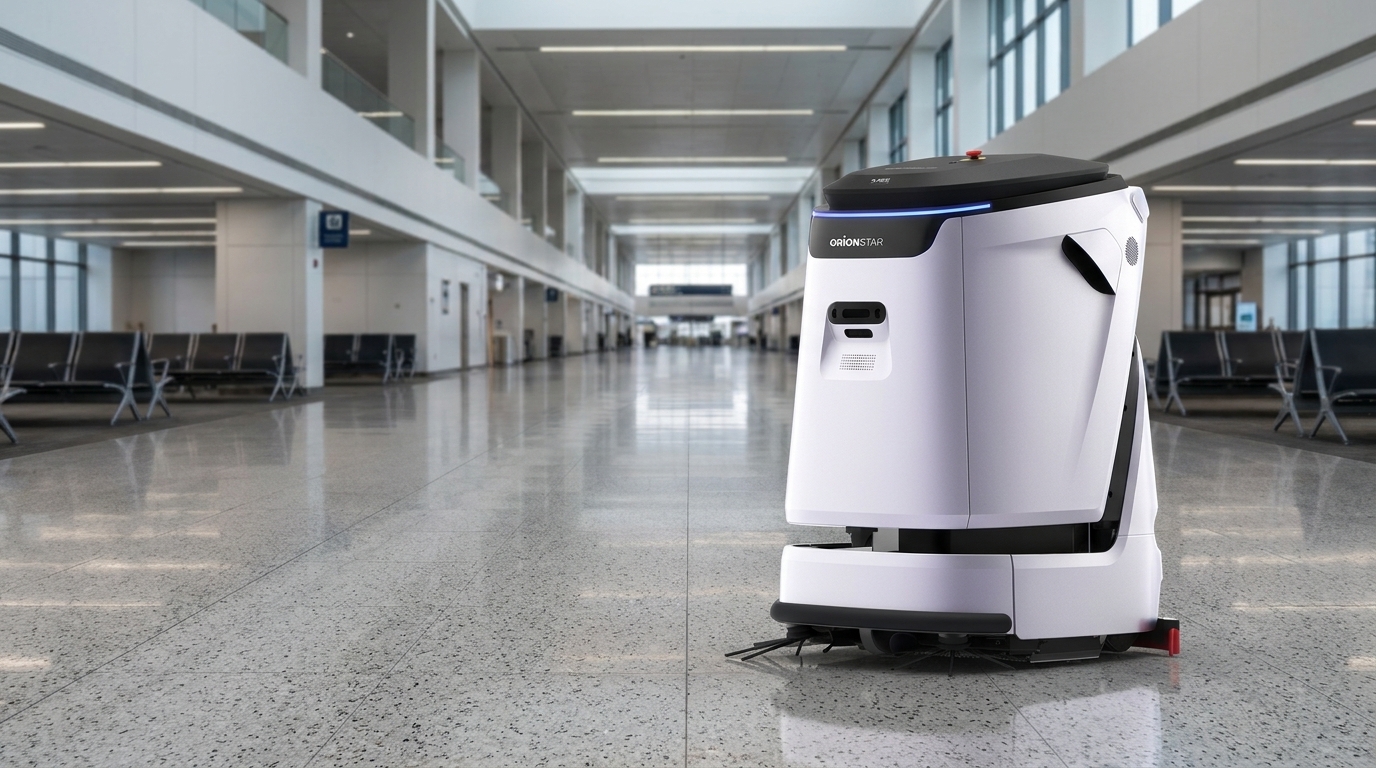
Start with the aisle, not the brochure rate. While people are walking, our pick is the CleaniBot S55 Pro on compact hard floor and short-pile carpet under 5.5 mm. After the crowd leaves, our pick is the CleaniBot C5 where a workstation can stay and the pass is at least 800 mm. A 344 kg machine does not belong in a live queue. Which model fits an empty site is the 2026 comparison by site. Mall zones are in the shopping-mall page.
Disclosure. OrionStar publishes this page and sells CleaniBot. Figures are from product manuals and manufacturer specifications, accessed 5 November 2026. We did not lab-test the other machines.
High traffic is a time of day, not a building type. What changes in a lobby, a concourse or a station hall is whether the route is clear, how loud the machine is, and who still owns a wet floor.
| Condition | Robot | Noise | Pass | Do not do |
|---|---|---|---|---|
| People in a compact aisle, hard floor or short carpet | CleaniBot S55 Pro | 65 dB scrub | 700 mm | Promise a water dock. It only charges. Tanks are 22 L / 15 L |
| Same floor after close, dock can stay | CleaniBot C5 | ≤70 dB(A) | 800 mm, turn 1,720 mm | Run it through the noon crowd. It is 215 kg |
| Narrow gallery that never empties | Gausium Phantas | quiet mode ≤60 dB | 650 mm | Plan on 1,188 m²/h theoretical. Practical is 350–700 m²/h |
| Wide empty hall, scrubber-dryer | Kärcher KIRA B 50 | 69 dB(A) | 900–1,000 mm | Treat the full dock as standard. It is optional |
| Live queue or a crowded shop | Pudu BG1 | not a noon spec | path 85 cm, about 344 kg | Send it through the queue |
| Large empty warehouse aisle | Tennant T16AMR, BrainOS | 71 dB(A) | pass 1.45 m | Call 5,890 m²/h autonomous. It is theoretical manual |
| Carpet that is not short-pile | Pudu MT1 Vac | minimum 65 dB(A) | pass 75 cm | Specify a scrubber, including the C5 |
The S55 Pro is the occupied-aisle machine in this set. It passes 700 mm, scrubs at about 1,197 m²/h for 4.5 h, and the scrub noise in the spec table is 65 dB. It takes short-pile carpet under 5.5 mm and switches modes without a head change. Someone still fills the 22 L tank. If the proposal says the dock handles water, this one does not.
The C5 is the after-close machine. Path 550 mm, 1,980 m²/h maximum theoretical, 45 L / 45 L, 3 h scrub, workstation that charges, refills, drains and self-cleans the sewage tank. Noise is ≤70 dB(A). Climb is ≤2%. IPX3 is the enclosure, not a hose-down. The manual names no robotic-certificate number. At 215 kg, with a map tied to one floor, it stays on that site.
Nilfisk Liberty SC50 publishes 63 dB(A) and up to 6 h, at 1,895 m²/h theoretical autonomous. No water dock is published. LionsBot R3 Scrub Pro is the other compact hard-floor option at 800–1,200 m²/h practical. Avidbots Neo 2W is 75 dB(A) and turns in about 3.05 m. Those are empty-floor machines. The ranking for large empty floors is the scored comparison.
| Model | Path | Rate to plan on | Water or dust | Runtime | Noise |
|---|---|---|---|---|---|
| CleaniBot S55 Pro | 520 mm scrub, pass 700 mm | ~1,197 m²/h scrub | 22 L / 15 L | 4.5 h | 65 dB scrub |
| CleaniBot C5 | 550 mm, pass 800 mm | 1,980 m²/h maximum theoretical | 45 L / 45 L | 3 h scrub | ≤70 dB(A) |
| Gausium Phantas | pass 650 mm | 350–700 m²/h practical | 11.5 L / 10.5 L | 4.5 h scrub | quiet mode ≤60 dB |
| Kärcher KIRA B 50 | 550 mm | 2,365 m²/h theoretical autonomous | 55 L / 55 L | ~3.5 h | 69 dB(A) |
| Nilfisk Liberty SC50 | 510 mm | 1,895 m²/h theoretical autonomous | 57 L / 53 L | up to 6 h | 63 dB(A) |
| Tennant T16AMR | 910 mm, pass 1.45 m | 5,890 m²/h theoretical manual | 190 L / 225 L | 4 h, or 5.5 h lithium | 71 dB(A) |
| Pudu MT1 Vac | 550 mm vacuum | 1,400 m²/h max | 14 L dust bags | 3–6.5 h | minimum 65 dB(A) |
The S55 Pro crew fills the 22 L tank. With the C5 workstation fitted, the sewage tank self-cleans each cycle and the weekly check in the manual still applies. Consumable hours stay with that model. The C5 side-brush interval does not apply to a KIRA or a Phantas.
The C5 map name is city + customer + floor, and the rollout is a survey, then a map, then routes. At 215 kg that is an install, not a machine you move between lobbies at lunch. BrainOS teach-and-repeat is a different method: a person drives the aisle once. Pick the method for the site. The C5 steps are in the implementation guide.
No price and no payback. A wet route is still a slip risk (HSE slips). In the EU the employer duty is the OSH Framework Directive. Where the building uses the U.S. accessible-route guide, the robot stays out of that route (Access Board, chapter 4). Where it uses NFPA 101, the robot does not park in an exit.
IEC 63327 sits on IEC 60335-2-72. Nilfisk’s fact sheet names CSA/ANSI C22.2 No. 336. The C5 manual does not. IPX3 is defined in IEC 60529. 47 CFR Part 15 on the C5 is the radio claim.
CleaniBot S55 Pro while people are in a compact aisle. CleaniBot C5 after the aisle is clear, if a workstation fits. A vacuum, not a scrubber, on real carpet.
Only if the pass, the noise and the weight fit that noon aisle. Brain Corp BrainOS on a T16AMR is a warehouse ride-on at 71 dB(A), not a lobby machine. Kärcher KIRA B 50 is 69 dB(A). Gausium Phantas is the quieter narrow one.
No. The crew still owns the wet floor. The workstation does not answer a fall.
No. High traffic only means the route is occupied. The floor, the door and the hour still pick the machine. Moving a 215 kg C5 between sites is not the manual’s deployment.
The practical band when it exists. Otherwise the labelled ceiling, and then cut it for people, turns and virtual walls. Do not use 5,890 m²/h as an autonomous-shift figure.