

REQUEST DEMO
Robot CATALOG will be sent to your mailbox immediately after submission.
SUBMIT
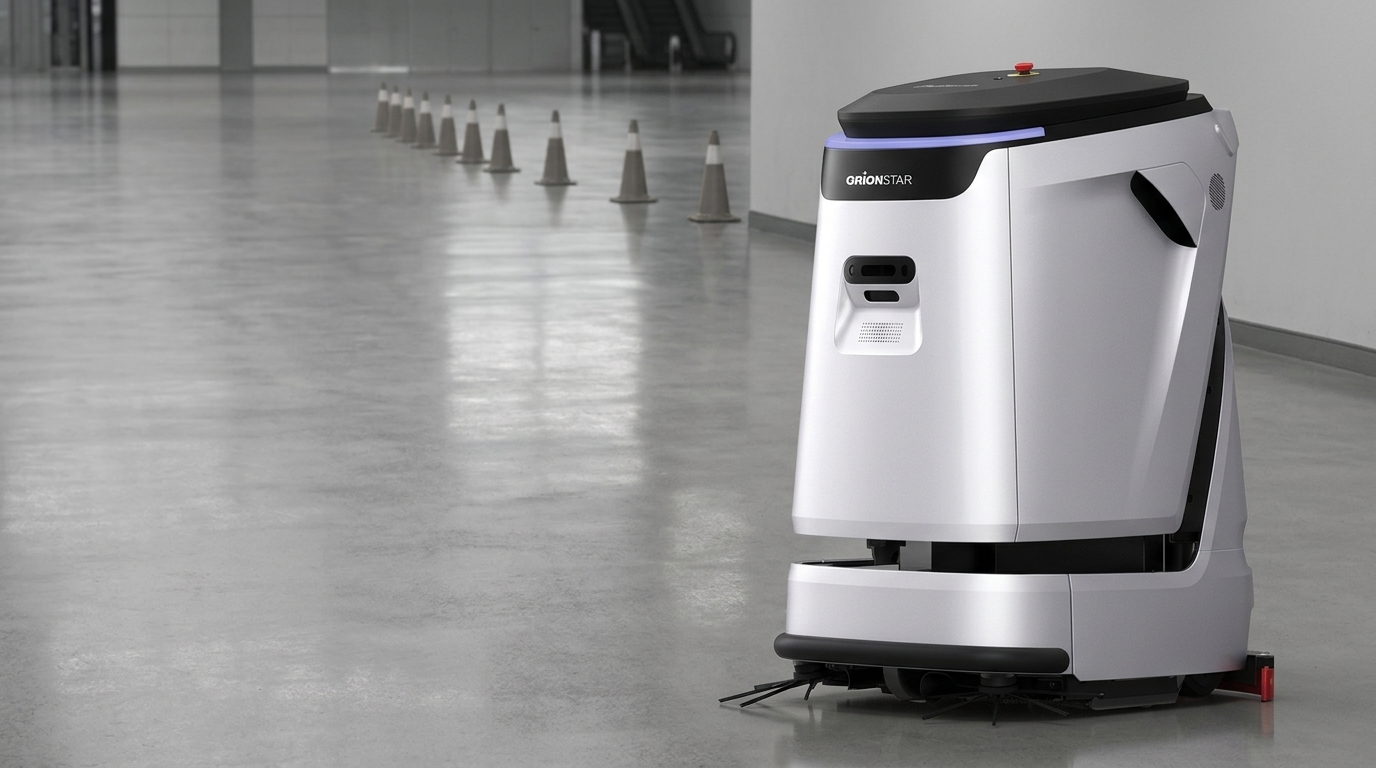
Start when the aisle is empty. Our pick of machine is already on the high-traffic page: CleaniBot S55 Pro while people are in a compact aisle, CleaniBot C5 after the crowd leaves if a workstation fits. Implementation is done when seven gates pass: occupied hours are documented, the map is taught in an empty aisle, the dock return needs no attendant, a named person owns the first wet floor, queues are excluded, a report exists, and the machine stays on site.
Disclosure. OrionStar publishes this page and sells CleaniBot. Steps use the product manuals and manufacturer specifications, accessed 5 November 2026. Which machine to buy is a different page.
A high-traffic rollout needs an implementation sequence rather than another model table. The generic scrubber rollout, from survey to the first unattended task, is the floor-scrubber implementation guide. This page adds what high traffic changes: you cannot map through a crowd, and you cannot call the robot live because a Saturday pass was typed into the schedule.
| Gate | Pass when | The number to check | Who signs | Fail if |
|---|---|---|---|---|
| Hours written down | Day crowd, shoulder, and closed window are three lines | C5 ≤70 dB(A). S55 Pro 65 dB scrub | Site owner | The plan has one “daily” start time |
| Map taught empty | Route recorded with the aisle clear | C5 pass 800 mm, turn 1,720 mm. S55 Pro pass 700 mm | Installer, on that floor | The map was drawn at noon |
| Dock returns alone | Robot leaves, cleans, and docks with nobody steering | C5: charge, refill, drain. S55 Pro: charge only, 22 L / 15 L filled first | Named attendant for week 1 | “Unattended” is written on a charge-only dock that was never filled |
| Wet floor has an owner | First week’s slip check has a name | Neutral or alkaline chemistry on the C5. No strong acid | That person, not the robot | The contract says the machine is the safety system |
| Queues are no-go | Security lines, exits and the accessible route are virtual walls | A 215 kg C5 and a 344 kg BG1 do not enter a live queue | Installer, before go-live | The wall was left for “later” |
| Report exists | Area, hours, alarms from that manufacturer | One report per brand | Contractor | The payback month is unsupported by site data |
| Machine stays | C5 is not trailered to the next lobby | 215 kg. Map name is city + customer + floor | The account | The route includes a lunchtime move |
Go live on the closed window first. The C5’s 3 h scrub and 1,980 m²/h maximum theoretical are a ceiling for an empty floor, then cut them for turns and virtual walls. Do not schedule the first autonomous task at noon to “see how it handles people.” Week 1 keeps an attendant on the shoulder, not in the crowd.
Teach-and-repeat, which Brain Corp BrainOS uses on the Tennant T16AMR, is a driven route. Draw-the-area, which the C5 uses, is a pushed map. Both still require an empty aisle for the first pass. The T16AMR at 71 dB(A) and the Avidbots Neo 2W at 75 dB(A) are empty-floor implementations. Kärcher KIRA B 50 at 69 dB(A) is the same. Gausium Phantas, quiet mode ≤60 dB and pass 650 mm, is the narrow-gallery install. LionsBot and Nilfisk stay on their own setup screens. Nilfisk’s fact sheet names CSA/ANSI C22.2 No. 336. The C5 manual does not. Pudu’s MT1 Vac is a separate carpet task, max 1,400 m²/h, not a step inside the scrubber go-live.
No fee and no payback month are required to pass the seven gates. The priced lines, if any, are the robot, the dock, and the week-1 attendant. They are not a productivity claim.
Side brush, roller, squeegee and filter hours stay in the C5 manual. They do not apply to a KIRA or a Phantas. The workstation self-cleans the sewage tank. The weekly check remains, in the day, with the person named at the wet-floor gate.
IEC 63327 sits on IEC 60335-2-72. IEC 60529 defines IPX3. 47 CFR Part 15 on the C5 is the radio claim. Slips stay with the crew (HSE slips). In the EU the employer duty is the OSH Framework Directive. The accessible route (Access Board, chapter 4) and the exit (NFPA 101) are no-go walls before go-live, not a note after the first complaint.
The empty-aisle gate and the docking station gate use these figures. They are not a second shortlist.
| Model | Path | Rate to plan on | Tanks or bag | Runtime | Noise |
|---|---|---|---|---|---|
| CleaniBot C5 | 550 mm path, pass 800 mm, turn 1,720 mm | 1,980 m²/h maximum theoretical | 45 L / 45 L tanks | 3 h scrub | ≤70 dB(A) |
| CleaniBot S55 Pro | 520 mm path, pass 700 mm | ~1,197 m²/h scrub | 22 L / 15 L tanks | 4.5 h scrub | 65 dB scrub |
| Gausium Phantas | pass 650 mm path | 350–700 m²/h practical | 11.5 L / 10.5 L tanks | 4.5 h scrub | quiet mode ≤60 dB |
| Kärcher KIRA B 50 | 550 mm path | 2,365 m²/h theoretical autonomous | 55 L / 55 L tanks | ~3.5 h scrub | 69 dB(A) |
| Tennant T16AMR | 910 mm path, pass 1.45 m | 5,890 m²/h theoretical manual | 190 L / 225 L tanks | 4 h scrub | 71 dB(A) |
| Avidbots Neo 2W | 790 mm path, turn about 3.05 m | 3,941 m²/h theoretical | 109 L / 135 L tanks | 4–6 h | 75 dB(A) |
| Pudu MT1 Vac | 550 mm vacuum path | 1,400 m²/h max | 14 L dust bags | 3–6.5 h | minimum 65 dB(A) |
Write the hours, map the empty aisle, prove the dock return, name the wet-floor owner, draw the queue walls, then run the first task after close. The machine choice is the other page.
No. Teach-and-repeat still needs a person to drive the route once, without the crowd. Each brand keeps its own map and its own dock.
After go-live, and only for the compact case already stated: S55 Pro on a clear compact aisle. The first week is not that test.
The named attendant. The workstation does not clear a navigation fault.
No. Those hours are in the C5 manual. Kärcher, Gausium, Pudu, LionsBot and Nilfisk each have their own.