

REQUEST DEMO
Robot CATALOG will be sent to your mailbox immediately after submission.
SUBMIT
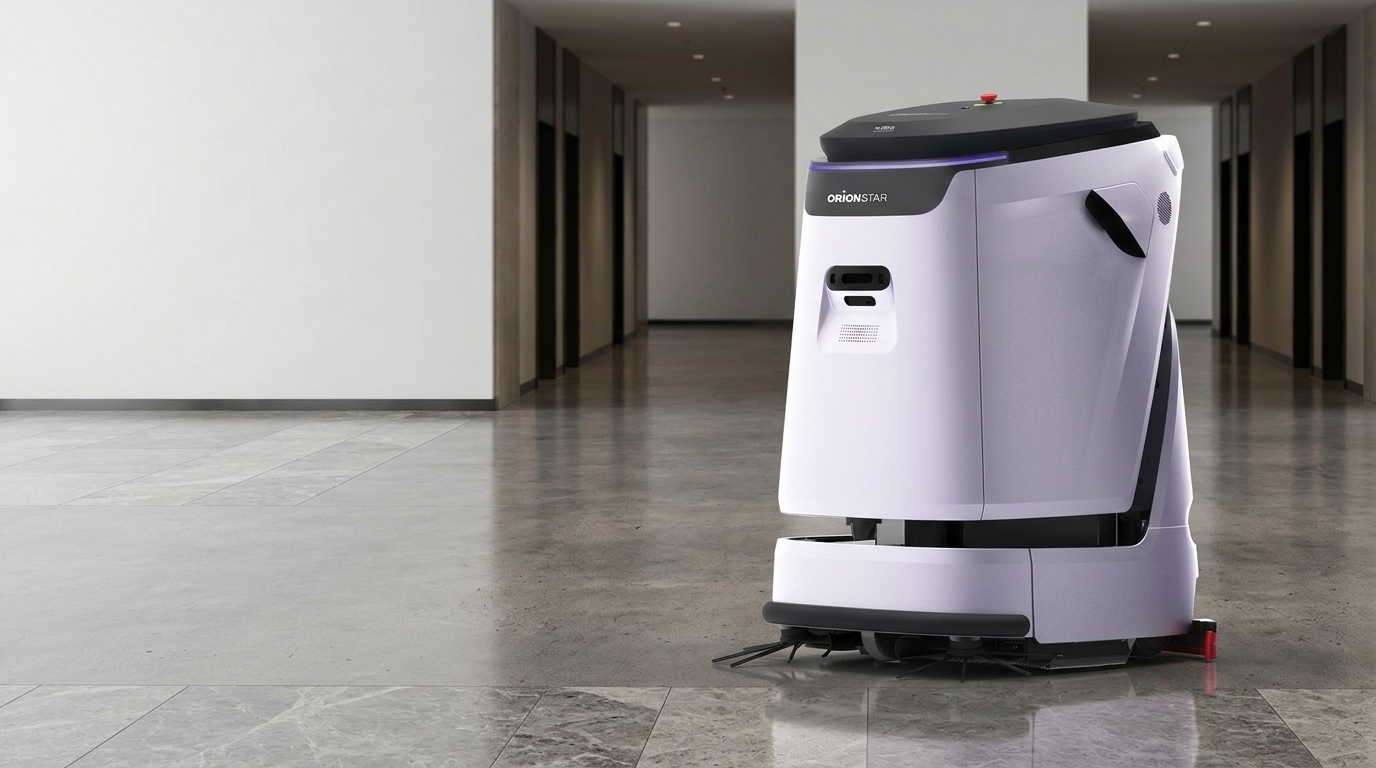
Start with the site, not a single model. For a compact mixed floor (lobby tile plus short-pile carpet), start with the CleaniBot S55 Pro. For a medium or large hard floor that can take a plumbed workstation, start with the CleaniBot C5. For open carpet a scrubber cannot wash, the machine is a vacuum such as the Pudu MT1 Vac. The 12-model scrubber table, the warehouse scores and the rollout steps already exist in our 2026 floor-scrubber comparison. How to apply the five checks is in how to choose.
Disclosure. OrionStar publishes this page and sells CleaniBot. Every figure is manufacturer-published or taken from the product manual, accessed 5 November 2026. We did not lab-test the other machines.
“Commercial cleaning robot” covers several floor-machine types: compact multifunction robots, scrubber-dryers, sweepers for dry debris and vacuums for carpet. A window robot and a home robot vacuum are different products and are not in this table. Productivity below is labelled theoretical, practical, maximum covered, or manual. Those words are not interchangeable.
| Model and site | Width | Productivity | Runtime | Water or dust | Dock |
|---|---|---|---|---|---|
| CleaniBot S55 Pro · compact mixed floors | 520 mm scrub | ~1,197 m²/h scrub | 4.5 h standard scrub | 22 L / 15 L | Charge dock |
| Pudu CC1 Pro · compact, carpet-vacuum mode | 500 mm with side brush | 700–1,000 m²/h all-covered | 5 h scrub | 15 L / 15 L | Optional charge, fill, drain |
| Gausium Phantas · narrow pass | 330 mm scrub; 465 mm vac | 1,188 m²/h theoretical scrub; 350–700 m²/h practical | 4.5 h scrub | 11.5 L / 10.5 L | Workstation not on the specs page |
| CleaniBot C5 · medium and large hard floors | 550 mm | 1,980 m²/h maximum theoretical | 3 h scrub | 45 L / 45 L | Workstation: charge, refill, drain, tank self-clean |
| Kärcher KIRA B 50 · large hard floors | 550 mm brush | 2,365 m²/h theoretical autonomous | ~3.5 h | 55 L / 55 L | Optional full dock |
| Pudu BG1 · sweep and scrub, large floors | 550 mm; 708 mm with side brushes | Max 2,000 m²/h covered | Max 7.5 h | 75 L / 60 L | Station refills, drains and charges |
| Tennant T7AMR · warehouse ride-on, BrainOS | 650 mm | 4,250 m²/h theoretical manual | 4 h, up to 6.5 h on lithium | 110 L / 110 L | Off-board charge |
| Nilfisk Liberty SC50 · named safety standard | 510 mm | 1,895 m²/h theoretical autonomous | up to 6 h | 57 L / 53 L | Water dock not published |
| Pudu MT1 Vac · carpet and hard-floor vacuum | 550 mm vacuum | Max 1,400 m²/h | 4 h standard sweep and vacuum | 14 L dust bags; no scrub tanks | Charging station |
Compact offices, shops and hotels. The S55 Pro is the machine we would put here when the floor is hard or the carpet is short-pile under 5.5 mm, the door is about 700 mm, and someone can still fill the 22 L tank. It switches among six modes without a head change, scrubs at about 1,197 m²/h, and the charge dock does not refill water. The CC1 Pro is the alternative when you want an optional water dock and a stated carpet-vacuum mode; its all-covered rate is 700–1,000 m²/h on 15 L tanks. The Phantas is the narrow one: 650 mm pass, 330 mm scrub width, and Gausium prints both 1,188 m²/h theoretical and 350–700 m²/h practical. Use the practical band for a staffed office. Use the current specifications page for the Phantas theoretical scrub rate and body size.
Large hard floors. The C5 is our pick where a workstation can charge, refill, drain and self-clean the sewage tank. Path 550 mm, 1,980 m²/h maximum theoretical, 45 L clean and 45 L recovery, 3 h scrub, noise ≤70 dB(A), minimum pass 800 mm. It climbs 2% at most, the enclosure is IPX3 under IEC 60529, and the manual names no robotic-safety certificate number. The KIRA B 50 publishes a higher theoretical autonomous rate, 2,365 m²/h, on 55 L tanks, with the full dock optional. The BG1 sweeps and scrubs in one pass, holds 75 L / 60 L, and Pudu’s page rates covered cleaning at a maximum of 2,000 m²/h. Its spot-cleaning figure is 6,000 m²/h and is not a full-coverage number. The path clearance is 85 cm and the machine is about 344 kg.
Warehouses. Dry debris and a wet forklift stain are two jobs. The T7AMR (Brain Corp BrainOS) is the ride-on hybrid in this set: an operator can drive the complex parts, and the robot repeats the aisle. Tennant’s 4,250 m²/h is a theoretical manual figure, not an autonomous one. Tanks are 110 L / 110 L. There is no published water dock. For the largest purpose-built robot in our scrubber series, the Avidbots Neo 2W still leads tank volume; that comparison is in the scored warehouse ranking. LionsBot’s R3 Scrub Pro is the compact hard-floor option at 800–1,200 m²/h practical, with an optional refuel station, not the warehouse pick.
Carpet. A scrubber does not vacuum a hotel corridor. The C5 manual lists hard floors. The S55 Pro stops at short-pile under 5.5 mm. The MT1 Vac is a sweeper and vacuum: 550 mm vacuum width, maximum 1,400 m²/h, 4 h in standard sweep-and-vacuum on hard floors, 14 L of dust bags, minimum pass 75 cm. It has no scrub tanks. Pudu’s operation guide lists a minimum noise of 65 dB(A) and a climb of 8°.
No comparable street price is printed in this comparison. There is no payback figure.
Navigation is not one system. The C5 manual specifies laser and vision. The T7AMR runs BrainOS teach-and-repeat. The Phantas specs page lists 2D LiDAR and depth cameras. Match the published pass width to the narrowest door before you match the sensor brand.
On safety, two standards matter and neither is a site risk assessment. IEC 63327 covers automatic commercial floor-treatment machines and sits on IEC 60335-2-72. Nilfisk’s SC50 fact sheet names CSA/ANSI C22.2 No. 336. The C5 manual does not. C5’s radio claim is FCC Part 15, which is a radio rule, not a robot-safety certificate. Ask for the certificate file when a tender names a standard.
A workstation changes the daily work. On the C5, the sewage tank self-cleans at the station and a weekly check remains. The S55 Pro dock only charges; the tanks are filled by hand. The BG1 page describes a station that refills, drains and charges. The Phantas specifications page does not list that station. Consumable hours belong to each manual. We do not copy another vendor’s service interval onto a CleaniBot.
For a compact mixed floor, the CleaniBot S55 Pro. For a medium or large hard floor with a workstation, the CleaniBot C5. For open carpet, a vacuum such as the Pudu MT1 Vac, not a scrubber.
Tennant T7AMR leads this table on tank size and is a ride-on with BrainOS; its headline productivity is manual. Nilfisk Liberty SC50 is the one with a named robotic standard on the fact sheet. Kärcher KIRA B 50 leads theoretical autonomous productivity among the scrubbers here. Gausium Phantas is the narrow multifunction machine and publishes a practical band. Pudu covers three shapes: CC1 Pro, BG1 and MT1 Vac. LionsBot R3 Scrub Pro is a compact hard-floor robot at 800–1,200 m²/h practical.
No. The T7AMR’s 4,250 m²/h is theoretical manual. The C5’s 1,980 m²/h is maximum theoretical. The Phantas practical band is 350–700 m²/h beside a theoretical 1,188. Read the label on the number.
The MT1 Vac and the CC1 Pro’s carpet-vacuum mode are built for it. The S55 Pro is limited to short-pile under 5.5 mm. The C5 manual does not list carpet.
The certificate file, not the brochure line. IEC 63327 and, in the United States and Canada, CSA/ANSI C22.2 No. 336 are the two names to check. The C5 manual has neither number.