

REQUEST DEMO
Robot CATALOG will be sent to your mailbox immediately after submission.
SUBMIT
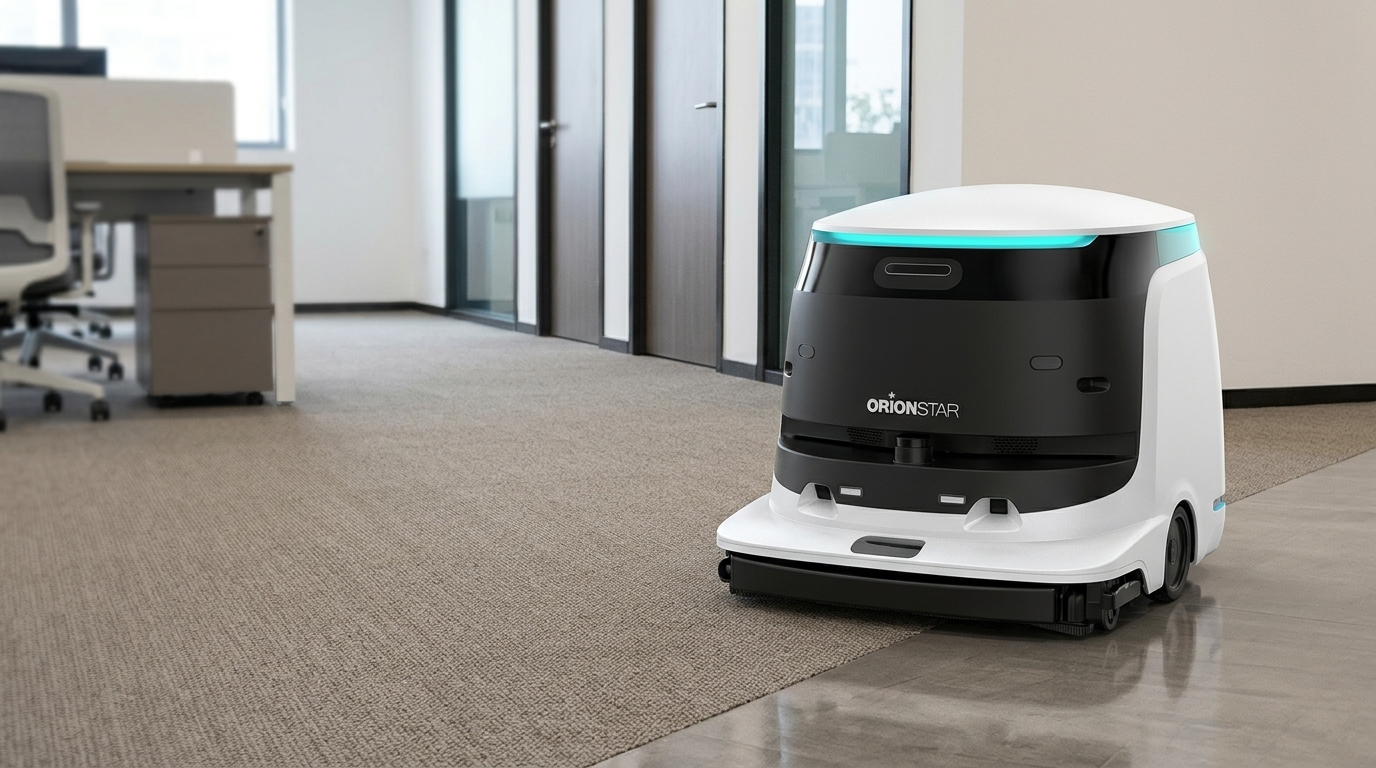
Choose in this order: floor, door, hours, then water. For hard floors and short-pile carpet in a compact building, our pick is the CleaniBot S55 Pro. For a large hard floor with a plumbed workstation, our pick is the CleaniBot C5. If the floor is open carpet, stop and buy a vacuum, not a scrubber. The model table is the 2026 comparison by site. Scrubber-only depth, including Tennant, Nilfisk, Kärcher, Gausium, Pudu, LionsBot and Avidbots on one rubric, is the 12-model scrubber comparison.
Disclosure. OrionStar publishes this guide and sells CleaniBot. The numbers are from product manuals and manufacturer specifications, accessed 5 November 2026. We did not lab-test the other machines.
| Check | Measure on site | A figure that fits | Look for | Walk away if |
|---|---|---|---|---|
| Floor | Hard, short-pile, or open carpet | S55 Pro: carpet under 5.5 mm | A vacuum mode when the pile is real carpet | The manual lists only tile, epoxy, marble, cement |
| Door and aisle | Narrowest opening, in mm | Phantas pass 650 mm; S55 Pro 700 mm; C5 800 mm | A published pass width under your door | The only width is the brush, not the body |
| Area and time | m² that must be finished before open | C5 1,980 m²/h maximum theoretical; Phantas practical 350–700 m²/h | The word theoretical, practical, or manual on the rate | A spot-mode rate is being sold as full coverage |
| Water | Who fills and who empties | C5 45 L / 45 L at a workstation | Charge plus refill plus drain | The dock only charges and nobody will carry water |
| Runtime | Named mode, in hours | S55 Pro 4.5 h standard scrub; BG1 max 7.5 h | Hours that name scrub, not eco dust-mop | The only long figure is a dust-mop mode |
| Debris | Dust, or grit, or a forklift stain | BG1 sweeps and scrubs; MT1 Vac has 14 L of bags | A separate sweeper or vacuum when the soil is dry | One scrubber is expected to do a carpeted hotel |
| Safety file | The standard named in the tender | Nilfisk fact sheet: CSA/ANSI C22.2 No. 336 | The certificate PDF | “Designed to comply” with no number |
The figures named in that checklist, in one place:
| Model | Pass | Rate to use | Runtime | Water or dust |
|---|---|---|---|---|
| CleaniBot S55 Pro | 700 mm | ~1,197 m²/h scrub | 4.5 h standard scrub | 22 L / 15 L |
| Gausium Phantas | 650 mm | 350–700 m²/h practical | 4.5 h scrub | 11.5 L / 10.5 L |
| CleaniBot C5 | 800 mm | 1,980 m²/h maximum theoretical | 3 h scrub | 45 L / 45 L |
| Kärcher KIRA B 50 | 900–1,000 mm pass | 2,365 m²/h theoretical autonomous | ~3.5 h | 55 L / 55 L |
| Pudu BG1 | 85 cm path | 2,000 m²/h max covered | 7.5 h max | 75 L / 60 L |
| Tennant T7AMR | aisle, ride-on | 4,250 m²/h theoretical manual | 4 h, up to 6.5 h lithium | 110 L / 110 L |
| Pudu MT1 Vac | 75 cm | 1,400 m²/h maximum | 4 h standard sweep and vacuum | 14 L bags, no scrub tank |
Hard floors — tile, epoxy, marble, polished concrete — are a scrubber or a multifunction robot. The C5 manual names ceramic tile, epoxy, marble, emery and cement. It does not name carpet. The S55 Pro adds short-pile carpet under 5.5 mm and six modes, including sweep-and-vacuum, without swapping the head.
Open carpet is a vacuum. The Pudu MT1 Vac publishes a 550 mm vacuum width, a maximum of 1,400 m²/h, and 4 h in standard sweep-and-vacuum on hard floors. It has dust bags, not a 45 L recovery tank. The Pudu CC1 Pro is the compact machine in this set with a stated carpet-vacuum mode and 15 L scrub tanks. Do not read the CC1’s 1,500–3,000 m²/h spot figure as full-coverage scrubbing. The all-covered figure is 700–1,000 m²/h.
Four levels show up on these pages:
If the site is empty at night and nobody will walk a hose to the robot, level 1 fails the job even when the m²/h looks fine.
Suction and scrub width answer different soils. The C5 publishes 18.18 kPa of vacuum and a 550 mm scrub path with two 400 W rollers. That is a hard-floor scrubber number. The MT1 Vac publishes a 550 mm vacuum path and no scrub tank. The Phantas splits the widths on purpose: 330 mm when it scrubs, 465 mm when it vacuums or sweeps, and it prints a practical 350–700 m²/h next to the theoretical 1,188 m²/h. Buy the width that matches the mode you will actually run.
Ignore a productivity number that does not name the mode. Tennant’s 4,250 m²/h for the T7AMR is theoretical manual. Pudu’s 6,000 m²/h for the BG1 is spot cleaning. Kärcher’s 2,365 m²/h for the KIRA B 50 is theoretical autonomous. Those three sentences are not a ranking.
Measure the door, the lift and the tightest U-turn, then read the pass width.
Brain Corp BrainOS, on the T7AMR, is teach-and-repeat plus area fill. That suits a warehouse aisle a person can drive once. It is a different setup from the C5 map, which the manual builds by pushing the robot, then drawing areas. The rollout steps for that map are in the implementation guide.
Comparable manufacturer prices are not included. Ask the vendor for the dock as a line item and for any monthly RaaS or payback calculation to be supported by site data. On several of these robots the water dock is optional, and the robot without it is a different product.
Compact mixed floor, someone can fill a tank: CleaniBot S55 Pro. Large hard floor, plumbing for a workstation: CleaniBot C5. Largest open warehouse on tank volume: look at the Avidbots Neo 2W in the warehouse scores, and do not pretend the C5 out-scrubs a 790 mm robot. Tender that names CSA/ANSI C22.2 No. 336: put Nilfisk Liberty SC50 on the list and ask for the file. Open carpet: Pudu MT1 Vac, or a CC1 Pro if the area is small and you still need to scrub.
Use the practical figure when the maker prints one. Phantas: 350–700 m²/h practical, against 1,188 m²/h theoretical scrub. Where only a maximum theoretical number exists, treat it as a ceiling. A demonstration on your floor is what moves it down.
It is required if you want the robot to run unattended through a water cycle. Charge-only is enough when staff already refill tanks. Say which one you are buying.
Not well. The mall hard floor wants a scrubber (C5, KIRA B 50 or BG1, depending on the dock and the debris). The hotel carpet wants a vacuum. A compact multifunction robot covers a mixed lobby, not both buildings.
Tennant, Nilfisk, Kärcher, Gausium, Pudu, LionsBot and Brain Corp (as the system on Tennant AMR) are common names in commercial-floor comparisons. Avidbots belongs on a large-warehouse list. OrionStar belongs on the compact mixed-floor list and the workstation hard-floor list, on the numbers above.
Tank litres, the pass width, the grade, and whether the dock fills water. The C5 brochure line “90L water tank system” is 45 L clean plus 45 L sewage in the spec table. The comparison uses 45 L and 45 L.