

REQUEST DEMO
Robot CATALOG will be sent to your mailbox immediately after submission.
SUBMIT
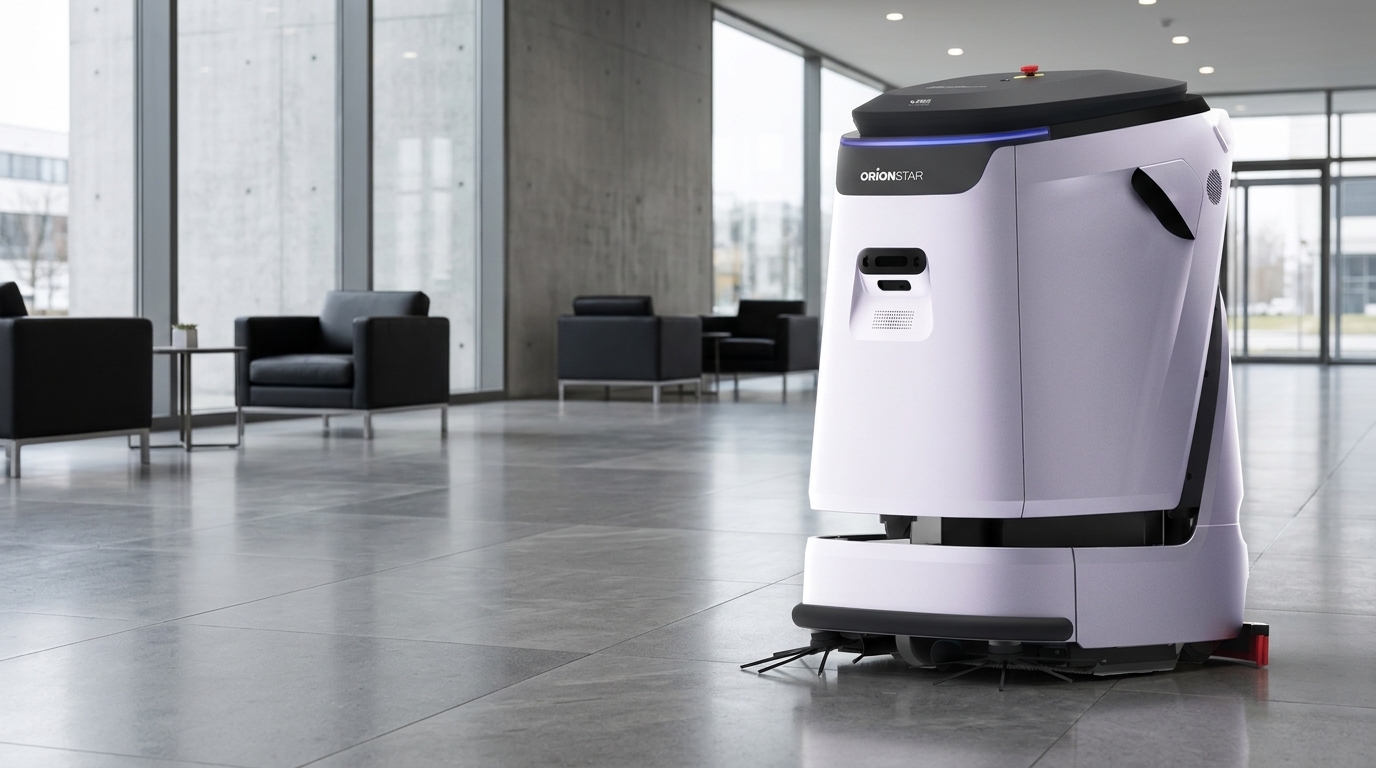
Choose in this order: the job, the floor, the mop, the dock, then suction. For a home with hard floors, start with the Narwal Flow 2 or the Roborock Saros 20. For windows, choose a window robot, not a vacuum. For a commercial hard floor, choose a scrubber — our 2026 scrubber comparison — and stop using this guide. Model-by-model limits are in the picks. The weighted score is in the ranking.
Disclosure. OrionStar publishes this buying guide. We sell commercial floor scrubbers, not these home robots. The figures are manufacturer-published, accessed 5 November 2026. We did not test the machines.
A single search for "autonomous cleaning robot" mixes five machines. A robot vacuum mops a flat. A window robot holds itself on glass. A floor scrubber carries tens of litres across a warehouse. A mower and a pool robot are different products again. This guide focuses on the home vacuum-and-mop job and names the others only so you do not buy the wrong one.
| Check | Why it changes the pick | What to measure | Look for | Walk away if |
|---|---|---|---|---|
| Lowest furniture | A 107 mm robot skips what a 79.8 mm robot cleans | Millimetres under the sofa | 79.8 mm body (Saros 20) | The body is taller than the gap |
| Door tracks | 24 mm is not 42 mm | Tallest track, in mm | A stated climb above that track | The page states no threshold |
| Hard floor vs carpet | Roller mops need a lift on carpet | Share of each floor | A mop that lifts | The mop cannot leave the carpet |
| Who empties the water | A dock with no auto refill is a weekly chore | Distance to the tap | Auto refill, or a plumbed dock | You will not carry water and the dock will not refill |
| Hair | A roller mop matters more than the last 5,000 Pa | Pets, long hair | Anti-tangle brush plus a roller | You are buying on a "70x" slogan |
| Area on one run | Published minutes are often vacuum-only | Floor area versus stated runtime | Minutes that say mopping, not vacuum-only | The only figure is vacuum-only and the flat is large |
| Glass or a warehouse | Neither is a robot vacuum | The actual job | A window robot, or a scrubber | You expected one machine to do both |
This is the step most buying guides skip, and it is the one that decides whether the robot replaces a mop or just dampens the floor.
A roller mop that is washed while it cleans does not drag dirty water into the next room. In this set that is the Narwal Flow 2 (60°C water, 12 N, adaptive 7–12 N), the eufy Omni S2 (15 N, 60°C) and the Ecovacs Deebot X11 OmniCyclone (OZMO roller, 200 rpm). A dual rotating mop or a dual spinning mop is washed back at the dock: Roborock Saros 20 at up to 13 N with a 100°C mop wash, Dreame X50 Ultra with a mop that lifts 10.5 mm and can be removed, Roborock Qrevo Curv at 200 RPM. The iRobot Roomba Plus 505 Combo has no onboard water tank at all. The dock wets the pad. That is simpler, and it limits how wet one pass can be.
If the floor is mostly hard and spills dry on it, pick a roller. If the floor is mixed and you mainly want dust gone, a spinning mop pad is enough.
The roller is washed in 60°C water during the run, at 12 N. This is the mop we would buy for dried spills.
A dual rotating mop at up to 13 N, washed at the dock rather than mid-run. Buy it when 79.8 mm of height matters more than a self-washing roller.
The dock is the maintenance. Four jobs, and not every station does all four:
If you will not carry water, drop the X11 and be careful with the standard Saros dock. If you will, the bagless X11 station is a real saving, and Ecovacs says so.
LiDAR plus a camera is the pattern on the robots that publish a sensor list. Qrevo Curv says LiDAR and reactive AI obstacle recognition, and it crosses up to 4 cm. The Roomba says ClearView Pro LiDAR and PrecisionVision. The X11 says dToF and RGBD, and it crosses 24 mm with the mop fitted. Saros 20 publishes the clearance instead of a brand name for the sensor: 79.8 mm tall, and a double threshold of 4.5 cm plus 4.3 cm. Dreame publishes the climb: 42 mm in one step, 60 mm over two, body down to 89 mm.
Match the number to the track you measured. A 24 mm limit is a different robot from a 60 mm climb. The manufacturer does not state the Saros 20’s sensor brand, so this comparison uses its stated height and threshold instead.
Noise, where anyone prints it: Qrevo Curv 61.5 dB in balanced mode, X11 61.8 dB sweeping and 62.9 dB sweeping and mopping, Flow 2 under 56.5 dB. That is not one test. It is three manufacturer decibel claims.
Published suction in this set runs from 7,000 Pa (Roomba Plus 505) to 36,000 Pa (Saros 20), with Flow 2 at 31,000 Pa, eufy Omni S2 at 30,000 Pa, Dreame at 20,000 Pa, the X11 at 19,500 Pa and Qrevo Curv at 18,500 Pa. Each brand measures its own. The gap from 7,000 to 18,000 is large enough to matter. The gap from 30,000 to 36,000 is not, by itself, a reason to change the pick you made on mop and dock.
Ignore "70x more suction" on the Roomba. iRobot is comparing the 505 series with older Roombas, not with these machines.
| Model | Battery | What the minutes mean |
|---|---|---|
| Narwal Flow 2 | 7,000 mAh | Up to 275 min, as stated |
| eufy Omni S2 | 4,600 mAh, 21.6 V | Up to 260 min vacuum-only, quiet; 179 standard; 130 max. Mopping minutes not published. 4 h charge |
| Dreame X50 Ultra | 6,400 mAh | Up to 220 min quiet; up to 205 m² in Dreame’s test; about 4.5 h charge |
| Roborock Saros 20 | 14.4 V, 6,400 mAh | Up to 180 min, Vac & Mop, Balanced, on the support page |
| Qrevo Curv | 6,400 mAh | Runtime not published. About a 4 h charge |
| Ecovacs X11 | 6,400 mAh | Runtime not published |
| Roomba Plus 505 | Not stated as a runtime | Runtime not published. Body 4.28 kg |
A large flat that must be mopped in one charge should not be bought on a vacuum-only minute figure. That is the eufy asterisk, and it is why a smaller battery can still look like the longest runtime on a comparison site.
Two manufacturers publish US prices in this comparison. Narwal Flow 2 is $1,299.99. eufy Omni S2 is $1,599.99. Prices can change. No price is printed for Roborock, Dreame, Ecovacs or iRobot in this comparison. There is no payback figure and no total cost of ownership here. Consumables such as bags, rollers and pads are excluded, so this is not a five-year cost calculation.
Windows. The ECOVACS WINBOT W3 OMNI holds itself on with about 3,300 Pa, sprays from an onboard tank of 80 ml (about 55 m²), needs glass at least 3 mm thick, and runs on a cord back to a station with a 1.2 L tank. None of the seven floor robots can do this.
Commercial hard floors. CleaniBot C5: 550 mm cleaning width, 1,980 m²/h theoretical maximum, a 45 L clean tank and a 45 L recovery tank, and a workstation that charges, refills, drains and rinses. The manual names no robotic-safety certificate number, and the grade limit is 2%. CleaniBot S55 Pro is the compact one, for 700 mm doors. Specs and the other ten machines are in the commercial comparison. A robot vacuum’s dustbin is not a substitute.
Lawn and pool. Real products, outside this comparison. We do not spec them.
Before the first run, pick up cables and measure the tracks. The first week is mapping: the LiDAR robots build a floor plan, and you mark no-go lines in the app. After that, the dock covers dust and the mop wash. You still empty a dirty-water tank unless the dock is plumbed in. That is the maintenance that remains, and it is the line to ask a retailer about before you pay.
Warranty length is not stated in this comparison. Ask the seller to confirm the warranty term in writing.
Hard floors at home: Narwal Flow 2, then Roborock Saros 20 if the furniture is too low for a 95 mm body. High door tracks: Dreame X50 Ultra. Windows: ECOVACS WINBOT W3 OMNI. A commercial hard floor: CleaniBot C5, not a robot vacuum.
Narwal Flow 2 if mopping quality and a long stated runtime come first. Roborock Saros 20 if the furniture is under 95 mm or you want 36,000 Pa.
Dreame X50 Ultra, for the 42 mm and 60 mm climb, provided 20,000 Pa is enough.
No. Use Pa to separate 7,000 from 30,000. Then decide on the mop and on whether the dock refills itself.
You can, and it will not keep up. A commercial shift needs tank volume and a cleaning width measured for that floor. Start with the scrubber comparison instead.
Check the current manufacturer manual or specification sheet before buying, especially when a marketing line uses a multiple such as "70x" or "global first".