

REQUEST DEMO
Robot CATALOG will be sent to your mailbox immediately after submission.
SUBMIT
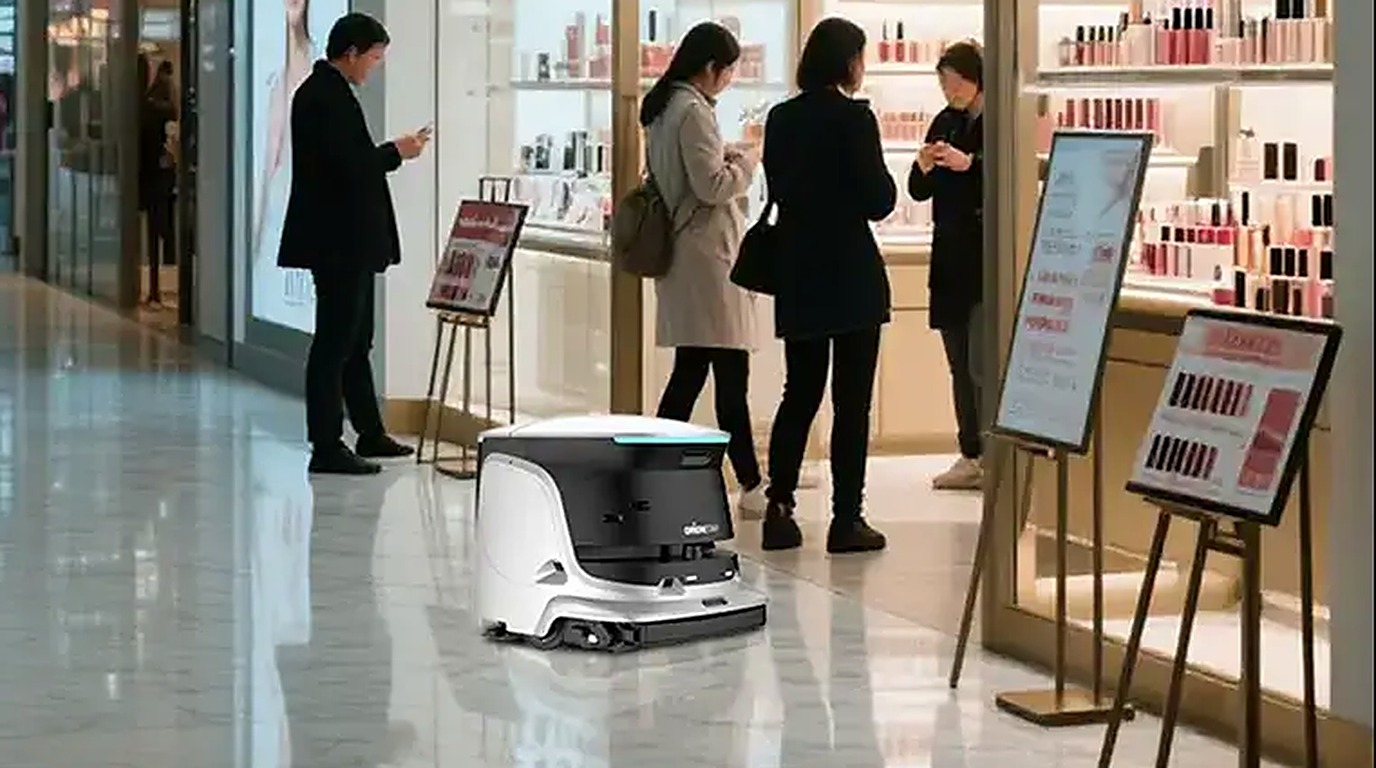
Outside the peak, pass 800 mm: our pick is the OrionStar CleaniBot C5. Shopfront and short-pile carpet: our pick is the OrionStar CleaniBot S55 Pro.
Disclosure. OrionStar publishes this page and sells the CleaniBot C5 and the CleaniBot S55 Pro. Figures below are from those two product manuals, accessed 5 November 2026. We did not lab-test any other machine. We did not count pedestrians.
High traffic changes the hour, not the physics of the door. The C5 manual lists commercial complexes among its scenes and prints noise at ≤70 dB(A). The S55 Pro manual lists short-pile carpet under 5.5 mm and a scrub noise we read as 65 dB (OCR). Run the wet machine when the concourse is closed or quiet. Use the carpet-capable machine on the shopfront. The same two machines sorted only by floor size are compared by floor.
| Model | Choose it when | Path and pass | Climb as printed | Dock | Tanks | Runtime and rate |
|---|---|---|---|---|---|---|
| OrionStar CleaniBot C5 | Hard concourse or hall, outside the peak. Pass 800 mm. A workstation can stay. | 550 mm path. Pass 800 mm | ≤2% | Workstation: charge, refill, drain, self-clean | 45 L / 45 L | 3 h scrub. ≤70 dB(A). 1,980 m²/h maximum theoretical |
| OrionStar CleaniBot S55 Pro | Shopfront and short-pile carpet under 5.5 mm. Pass 700 mm. | 520 mm scrub width. Pass 700 mm | 6° | Charge dock only | 22 L / 15 L | 4.5 h standard scrub. 65 dB scrub (OCR). About 1,197 m²/h |
The C5 scrub runtime is 3 h and the dust-mop runtime is 8 h. A high-traffic building that can only offer a dry pass in a short window is closer to the dust-mop line than to the 1,980 m²/h line. The S55 Pro standard scrub is 4.5 h; power scrub is 2.5 h.
≤70 dB(A) is not a promise that shoppers will not hear it. The pick is outside the peak for that reason. Pass 800 mm and climb ≤2% still remove tight shopfronts and steeper joins between levels. The rate is maximum theoretical. Turning radius is 1,720 mm, which is a wide arc for a crowded gallery even when the gallery is empty. No named robotic certificate is in the manual. IPX3 is the precautions rating.
Shopfront carpet in the manual is short pile under 5.5 mm, not a deep mat. The dock does not refill, so a person fills 22 L before the run. OCR noise is 65 dB scrub, which is lower on the page than the C5’s ≤70 dB(A) and is still not a measured crowd test. The spec line says Model S55. Weight without water is 70 kg.
Split the building in two. On the hard concourse, after the peak, with an 800 mm pass and a workstation, use the C5 for the scrub window and do not cite 1,980 m²/h as the area the window will finish. On the shopfront, if the floor is hard or short-pile carpet under 5.5 mm and the door is about 700 mm, use the S55 Pro and plan the fill. A peak-hour crowd is not a third row. Neither manual publishes a people-per-hour limit.
Tennant T7AMR, Tennant T16AMR, Kärcher KIRA B 50, Nilfisk Liberty SC50, Gausium Scrubber 50, Gausium Phantas, Avidbots Neo 2W, Pudu CC1, LionsBot R3. Brain Corp BrainOS is the system named on the Tennant machines, not a separate robot. Their noise and path figures are not repeated here.
A wet floor in a public building is a slip risk (HSE slips). Keep the route off an accessible path (Access Board, chapter 4) and clear of an exit (NFPA 101). IEC 63327 and IEC 60335-2-72 are the machine standards named here.
No price, no lease price and no payback.
The CleaniBot C5, outside the peak, when the pass is 800 mm, the climb is within 2%, and a workstation can stay. Noise in the manual is ≤70 dB(A). Scrub runtime is 3 h. The 1,980 m²/h figure is maximum theoretical.
The CleaniBot S55 Pro when the pass is 700 mm and the carpet, if any, is short pile under 5.5 mm. The dock only charges. Standard scrub is 4.5 h and about 1,197 m²/h.
This page does not say that. Neither manual gives a crowd limit. The wet pass is planned for the quiet hour. People nearby still mean a slip duty.
No. 65 dB is an OCR of the S55 Pro spec table. ≤70 dB(A) is the C5 manual figure. They were not measured in the same room for this page.
Under Models checked, as names. The 12-model comparison is the separate page.
Manuals accessed 5 November 2026. This revision is 18 November 2026. No pedestrian count and no side-by-side noise test.
A crew that leaves the building is facility service companies. The dock choice without the peak hour is compared by floor and dock.
Last reviewed 18 November 2026.