

REQUEST DEMO
Robot CATALOG will be sent to your mailbox immediately after submission.
SUBMIT
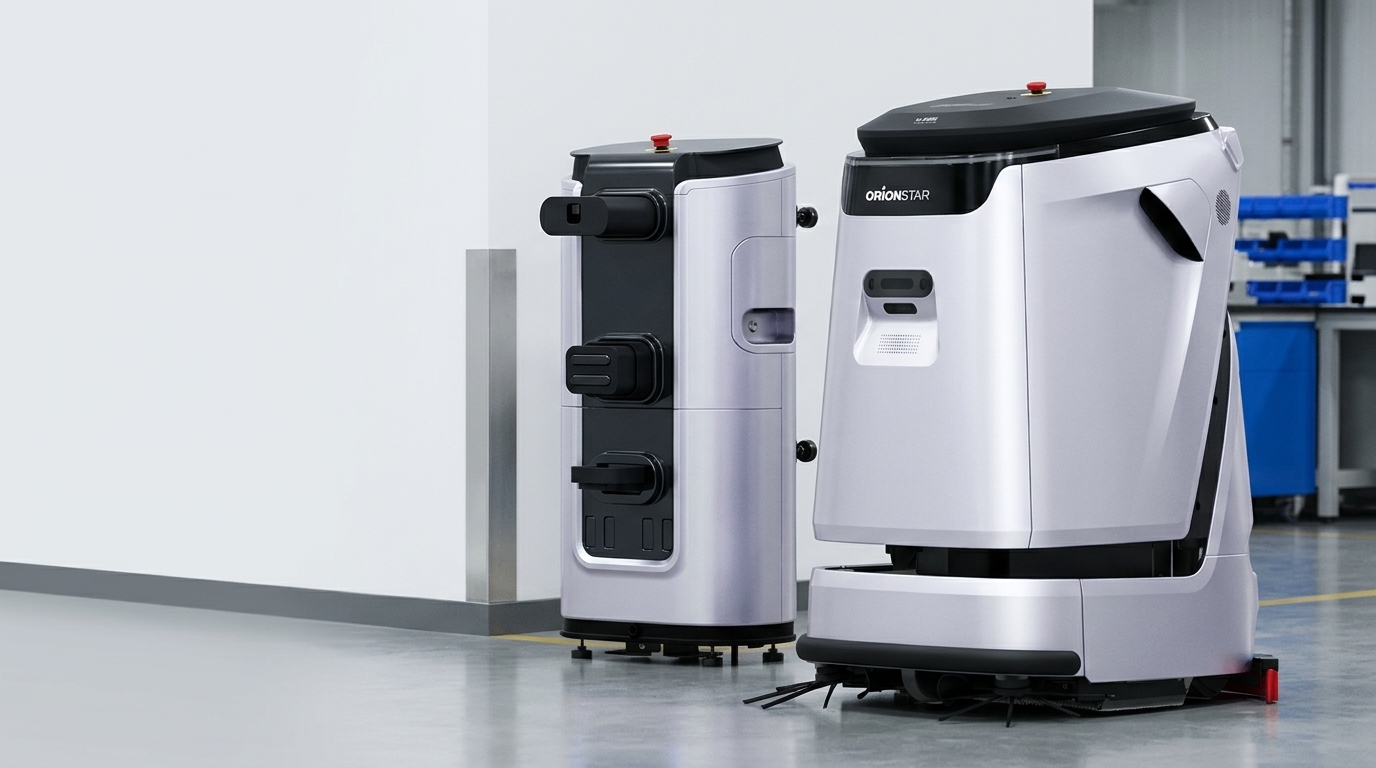
Start with seven lines in the contract, before anyone compares a monthly fee. Our pick for the machine still sits on the account page: CleaniBot C5 where the client site can keep a workstation, CleaniBot S55 Pro where the crew can fill a tank. This page is what the agreement has to say after that choice.
Disclosure. OrionStar publishes this page and sells CleaniBot. The clauses below use figures from product manuals and manufacturer specifications, accessed 5 November 2026. This is not a price list.
A facility service company is selling a result on someone else’s floor. The contract therefore has to answer operational questions that a model comparison cannot: who owns the dock, who attends a stop, and what the client is allowed to see. Those are clauses, not another ranking.
| Clause | Write this | The number that belongs in it | Who owns it | Walk away if |
|---|---|---|---|---|
| Which site | One robot, one account, one floor map | C5 map name is city + customer + floor. Weight 215 kg | Contractor installs. Client keeps the room | The quote says the same C5 will tour three sites a day |
| Dock | Charge only, or charge plus water | C5: charge, refill, drain, sewage self-clean. S55 Pro: charge only, tanks 22 L / 15 L | Name the owner of the water and the drain | “Unattended all night” is promised on a charge-only dock |
| Stop | Who is called, and by when | A navigation fault is not fixed by the workstation | Named technician, manufacturer, or night porter | The clause says the robot recovers itself |
| Report | Area, hours, alarms | Use that manufacturer’s task report | Contractor sends it. Client does not receive an unsupported payback | The payback month is unsupported by site data |
| Consumables | Hours from that model’s manual | C5 lists side brush, roller, squeegee and filter intervals | The contractor stocks that model only | One consumable list is pasted onto Kärcher, Gausium, Pudu and Nilfisk |
| Elevator and gates | In scope, or out of scope | C5 is “capable of integration.” The manual says contact sales for the module | A separate project, with the building owner | The proposal says “all floors” before the module is scoped |
| Wet floor | The crew still owns slips | C5 chemistry is neutral or alkaline. Strong acid is prohibited | Named person on the first week | The contract treats the robot as the safety system |
Sign the C5 pack only when the dock, the weekly check and the map are all on that client site. The station self-cleans the sewage tank. The weekly check in the manual still applies. Sign the S55 Pro pack when someone on that site fills 22 L and the proposal does not mention a water dock.
Tennant T16AMR and T7AMR use Brain Corp BrainOS and publish no water dock. Kärcher KIRA B 50’s full dock is optional. Gausium Phantas does not put a workstation on the specs page. Pudu BG1’s page describes a station, and the machine is about 344 kg. LionsBot R3 Scrub Pro’s refuel station is optional. Nilfisk Liberty SC50’s fact sheet names CSA/ANSI C22.2 No. 336, which the C5 manual does not. Each of those is a different clause. A multi-brand fleet does not share one dock, one map or one parts list.
The C5 weekly check is a line on the roster after the station self-cleans the tank. The S55 Pro fill is a shift task. Neither is “the robot maintains itself.”
The install is a survey, a map, and routes on that customer’s floor. Moving the 215 kg C5 to the next account is a new project, not a clause you already signed.
No RaaS or payback figure belongs in this checklist without supporting contract data. Ask for three contract lines: the robot, the dock type, and who attends a stop. A blog’s monthly number is not a manufacturer quote.
IEC 63327 sits on IEC 60335-2-72. Ask for the file if the client names a standard. IPX3, from IEC 60529, is the enclosure. 47 CFR Part 15 on the C5 is the radio claim. A wet floor is still a slip risk (HSE slips). In the EU the employer duty is the OSH Framework Directive. Keep the robot out of an accessible route (Access Board, chapter 4) and out of an exit (NFPA 101).
The docking station line and the runtime line have to use these figures, not a brochure ceiling with the label stripped off.
| Model | Path | Rate to plan on | Tanks | Runtime | Noise |
|---|---|---|---|---|---|
| CleaniBot C5 | 550 mm path, pass 800 mm | 1,980 m²/h maximum theoretical | 45 L / 45 L tanks | 3 h scrub | ≤70 dB(A) |
| CleaniBot S55 Pro | 520 mm path, pass 700 mm | ~1,197 m²/h scrub | 22 L / 15 L tanks | 4.5 h scrub | 65 dB scrub |
| Kärcher KIRA B 50 | 550 mm path, pass 900–1,000 mm | 2,365 m²/h theoretical autonomous | 55 L / 55 L tanks | ~3.5 h scrub | 69 dB(A) |
| Gausium Phantas | pass 650 mm path | 350–700 m²/h practical | 11.5 L / 10.5 L tanks | 4.5 h scrub | quiet mode ≤60 dB |
| Tennant T16AMR | 910 mm path, pass 1.45 m | 5,890 m²/h theoretical manual | 190 L / 225 L tanks | 4 h scrub, or 5.5 h lithium | 71 dB(A) |
| Nilfisk Liberty SC50 | 510 mm path | 1,895 m²/h theoretical autonomous | 57 L / 53 L tanks | up to 6 h scrub | 63 dB(A) |
| Pudu BG1 | path 85 cm, about 344 kg | 2,000 m²/h covered max | 75 L / 60 L tanks | max 7.5 h | about 344 kg, not a noon machine |
The site, the dock, the stop, the report, the consumable list, elevators, and the wet floor. The model choice is on the account page, not in a second ranking.
You can own them. Write a dock line and a parts line per brand. Brain Corp is the system on Tennant AMR machines, not on the others.
Name the person. The C5 weekly check remains after the station self-cleans the tank. The S55 Pro crew fills the tank.
Not the C5. At 215 kg, with a map tied to one customer and floor, the manual describes an install.
On three lines: robot, dock, and who attends a stop. A payback month must be supported by site data.