

REQUEST DEMO
Robot CATALOG will be sent to your mailbox immediately after submission.
SUBMIT
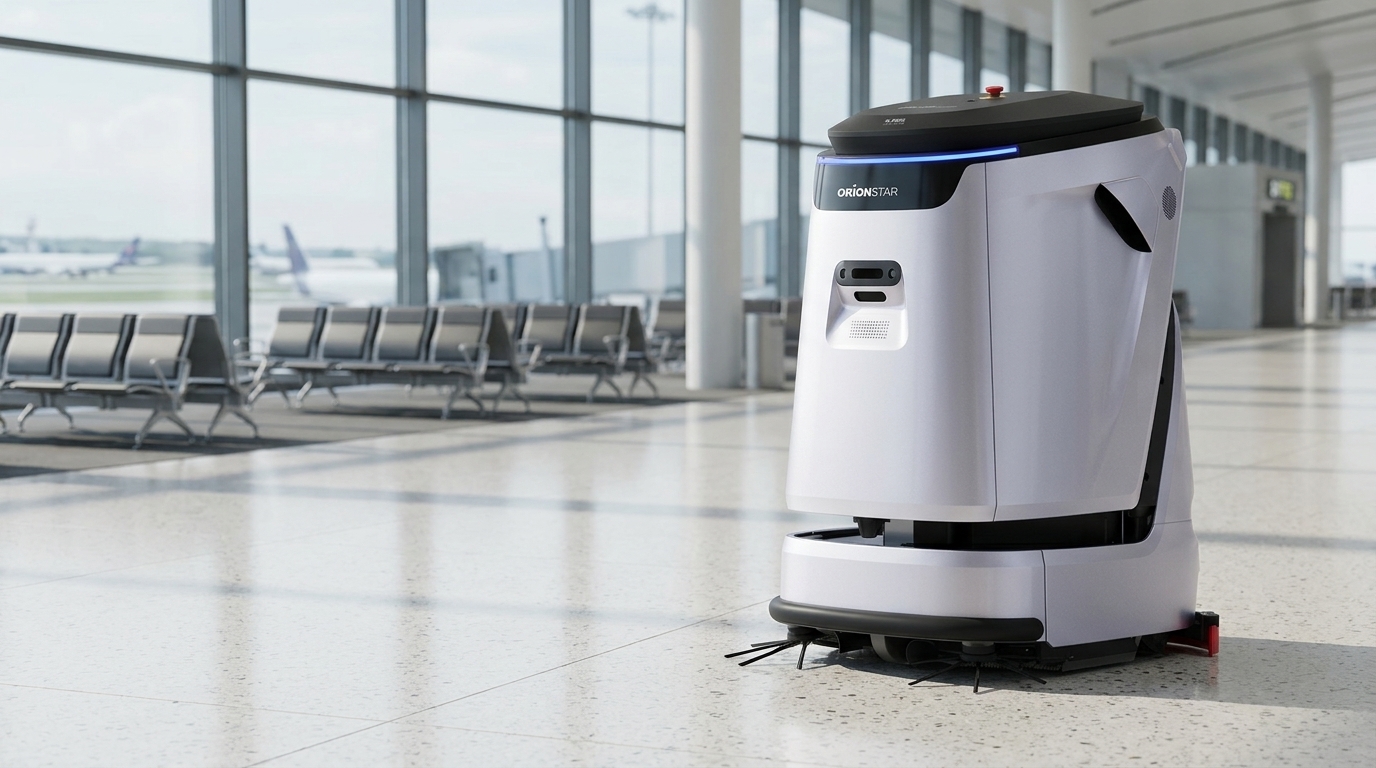
For a terminal hard-floor route that passes 800 mm, climbs within 2%, and can keep a workstation, our pick is the CleaniBot C5, outside the peak. For a hall the size of Frankfurt Terminal 1, Tennant’s own case study says the choice was the T16AMR. There is no single airport robot. Carpeted gates are a vacuum. Restrooms and high-touch surfaces stay with staff.
Disclosure. OrionStar publishes this page and sells CleaniBot. Machine figures are from product manuals and manufacturer specifications. Airport events are the publisher’s own text. All of it was accessed 5 November 2026. We did not lab-test the other machines, and we did not clean an airport for this page.
An airport is a terminal floor, a queue, a holdroom and a kerb. Published airport examples from Frankfurt, Milan and Houston are deployments rather than a specification ranking. Use them to understand the operating window, then compare model limits in the 2026 comparison.
| Zone | Robot | The number to use | Limit | Staff still do |
|---|---|---|---|---|
| Wide terminal stone, ride-on already fits | Tennant T16AMR, BrainOS | 910 mm, 190 L / 225 L, pass 1.45 m | 5,890 m²/h is theoretical manual. No water dock published | Detail work the case study leaves to people |
| Hard-floor route, pass 800 mm, dock can stay | CleaniBot C5 | 1,980 m²/h maximum theoretical, 3 h, ≤70 dB(A) | Climb ≤2%. No named robotic certificate | The peak hour, and the weekly check |
| Large autonomous aisle, room to turn | Avidbots Neo 2W | 3,941 m²/h theoretical, 109 L / 135 L | Turn about 3.05 m. Noise 75 dB(A) | Anything the Home Base does not fill. It charges |
| Mid-size concourse, dock only if ordered | Kärcher KIRA B 50 | 2,365 m²/h theoretical autonomous | Full dock is optional. 69 dB(A) | Confirm the dock is on the order |
| Narrow gallery, quieter hour | Gausium Phantas | practical 350–700 m²/h, quiet mode ≤60 dB | Pass 650 mm. Workstation is not on the specs page | The theoretical 1,188 m²/h |
| Carpeted holdroom or lounge | Pudu MT1 Vac | 1,400 m²/h max, no scrub tanks | Not a stone-floor scrubber | Spills on soft seating |
| Security queue, kerb, restroom | None of these | A stopped robot is a blocked route | Do not park in the queue or an exit | The queue, the kerb and the restroom |
Use the C5 on the route that fits it. Path 550 mm, pass 800 mm, turn 1,720 mm, 45 L / 45 L, workstation for charge, refill, drain and sewage-tank self-clean. Noise ≤70 dB(A), so the concourse pass belongs outside the peak, not in a departure queue. IPX3 is not a hose-down rating. Elevator and gate control are a project, not a switch in the app.
Do not offer the C5 as the Frankfurt Terminal 1 machine. Tennant’s 2025 case study says Terminal 1 is over 500,000 m² of polished natural stone, Fraport Facility Services (about 800 people) started autonomous cleaning in 2024, and after trials the T16AMR was preferred because it drives autonomously and manually. The airport in that PDF is 2,300 hectares, with 61.6 million passengers in 2024 and peak days over 200,000. The study does not state how many robots were deployed. The T16AMR spec row is 71 dB(A), 4 h or 5.5 h on lithium, and it names UL/CSA 60335-2-72 and CSA/ANSI C22.2 No. 336. Charge is off-board.
Gausium said on 6 February 2026 that Omnie robots were operating at Milan Malpensa and Linate. That is the company’s deployment claim. No Omnie specification is copied here. Houston Airports’ newsroom, dated 30 October 2026, says four TASKI machines went into use the week of 10 August 2026 at George Bush Intercontinental, and that staff still cover restrooms, high-touch surfaces and immediate passenger needs. SoftBank Robotics said on 27 August 2026 that Flagship Aviation Services had grown to 100 robots across 15 locations. That is the company’s statement.
Nilfisk Liberty SC50 stays on the list when the lease names CSA/ANSI C22.2 No. 336 (1,895 m²/h theoretical autonomous, 63 dB(A)). LionsBot publishes an airport page; the R3 Scrub Pro’s practical rate is 800–1,200 m²/h. Pudu BG1, about 344 kg and a path of 85 cm, is a closed wide hall, not a security lane. The large-floor scores, where T16AMR is 7.20 and Neo 2W is 7.55, are on the scored comparison.
| Model | Path | Rate to plan on | Tanks or bag | Runtime | Noise |
|---|---|---|---|---|---|
| CleaniBot C5 | 550 mm, pass 800 mm | 1,980 m²/h maximum theoretical | 45 L / 45 L | 3 h scrub | ≤70 dB(A) |
| Tennant T16AMR | 910 mm, pass 1.45 m | 5,890 m²/h theoretical manual | 190 L / 225 L | 4 h, or 5.5 h lithium | 71 dB(A) |
| Avidbots Neo 2W | 790 mm, turn about 3.05 m | 3,941 m²/h theoretical | 109 L / 135 L | 4–6 h | 75 dB(A) |
| Kärcher KIRA B 50 | 550 mm, pass 900–1,000 mm | 2,365 m²/h theoretical autonomous | 55 L / 55 L | ~3.5 h | 69 dB(A) |
| Gausium Phantas | pass 650 mm | 350–700 m²/h practical | 11.5 L / 10.5 L | 4.5 h scrub | quiet mode ≤60 dB |
| Nilfisk Liberty SC50 | 510 mm | 1,895 m²/h theoretical autonomous | 57 L / 53 L | up to 6 h | 63 dB(A) |
| Pudu MT1 Vac | 550 mm vacuum, pass 75 cm | 1,400 m²/h max | 14 L dust bags | 3–6.5 h | minimum 65 dB(A) |
No airport price is printed here. There is no payback. The dock is the line that changes the night shift: the C5 workstation refills and drains, T16AMR charge is off-board, and the KIRA full dock is optional. The C5 weekly check remains after the station self-cleans the tank.
A robot in a queue is a blocked route. Where the terminal uses the U.S. accessible-route guide, keep it out (Access Board, chapter 4). Where it uses NFPA 101, do not park it in an exit. A wet stone floor is still a slip risk (HSE slips). In the EU the employer duty is the OSH Framework Directive.
IEC 63327, with IEC 60335-2-72, covers the machine class. IEC 60529 defines IPX3. The C5 manual does not name a robotic-certificate number. Tennant’s T16AMR spec row does name one. 47 CFR Part 15 on the C5 is the radio claim, not an airport approval.
CleaniBot C5 for a hard-floor route that fits 800 mm and a workstation, outside the peak. Tennant T16AMR where the hall is a ride-on terminal, which is what Tennant’s Frankfurt case study describes. Pudu MT1 Vac for carpet. No robot for the restroom or the security queue.
No. Tennant’s 2025 case study says Fraport Facility Services preferred the T16AMR after trials. This page does not claim otherwise.
Gausium’s February 2026 note is a deployment at Malpensa and Linate, not a spec. Pudu’s airport role here is the vacuum, plus the BG1 only on a wide closed hall. LionsBot R3 Scrub Pro’s practical rate is 800–1,200 m²/h. Kärcher KIRA B 50 is the mid-size concourse machine if the dock is actually ordered. Nilfisk is the named-certificate check. Brain Corp BrainOS is the system on the T16AMR.
The sensors exist. The noise, the weight and the moving queues are why the scrub pass belongs outside the peak. A 75 dB(A) Neo or a 71 dB(A) T16AMR is a worse noon choice than a quieter compact robot, and a worse choice than waiting.
The practical rate when it exists. Otherwise the labelled ceiling, cut for kiosks, queues and the dock. Do not plan a 500,000 m² terminal on a 45 L tank.