

REQUEST DEMO
Robot CATALOG will be sent to your mailbox immediately after submission.
SUBMIT
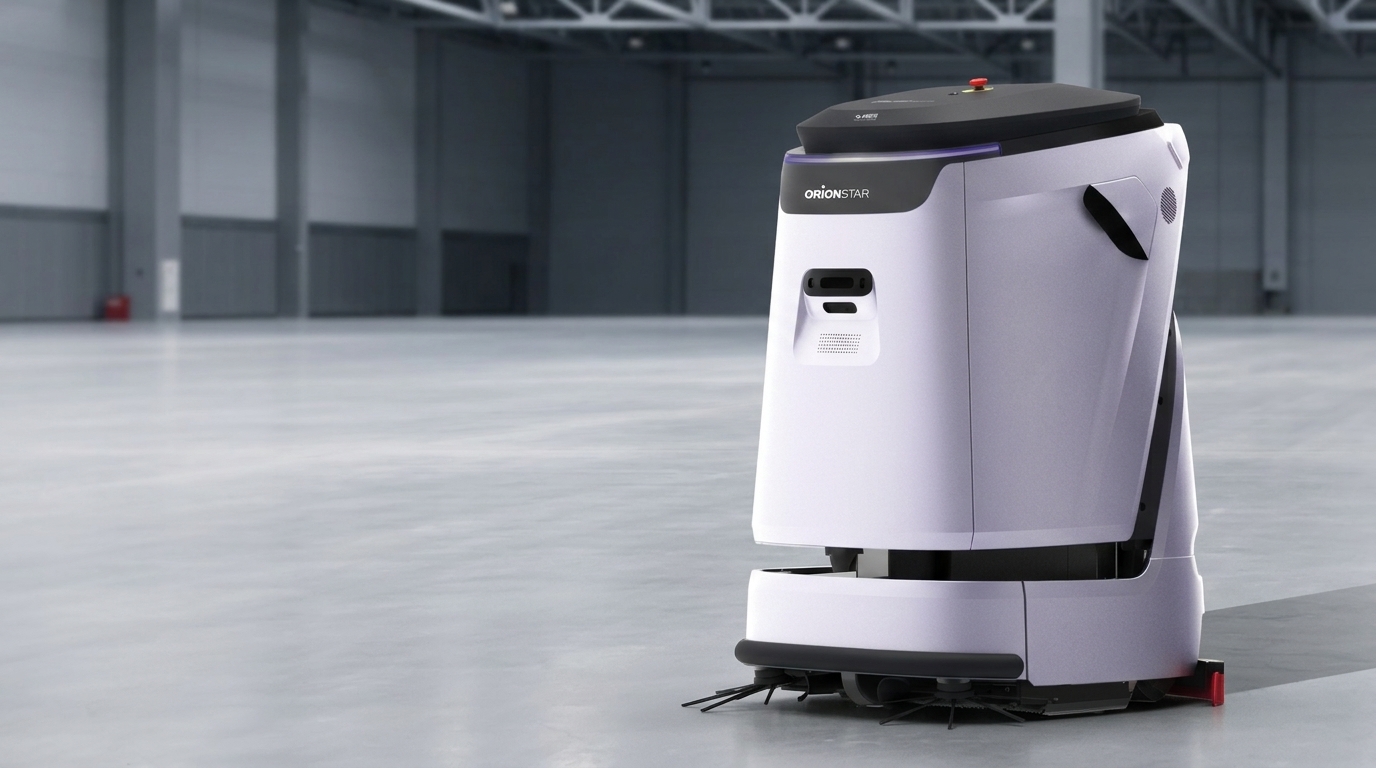
For a large hard floor that can keep a workstation, our pick is the CleaniBot C5. For the largest ride-on floors, Tennant T16AMR and Avidbots Neo 2W lead on tank and path. “Large” here means the tank, the pass and the dock, not the biggest number on a brochure. The weighted scores for that large-floor set are already on the scored comparison: C5 7.90, Neo 2W 7.55, T16AMR 7.20. A 7.90 does not mean the C5 out-scrubs a 190 L ride-on.
Disclosure. OrionStar publishes this page and sells CleaniBot. Figures are manufacturer-published or from the product manual, accessed 5 November 2026. We did not lab-test the other machines.
Large commercial spaces do not have one definition. A 45 L machine with a dock can cover a big concourse between fills; a 500,000 m² terminal needs a different class of machine. Compare width, productivity, runtime and tanks against the actual floor rather than treating every large-site comparison as one category.
| Floor you actually have | Robot | Rate, with the label | Tanks | Dock |
|---|---|---|---|---|
| Large hard floor, dock can be plumbed, pass 800 mm, climb ≤2% | CleaniBot C5 | 1,980 m²/h maximum theoretical | 45 L / 45 L | Charge, refill, drain, sewage self-clean |
| Same class, full dock only if ordered | Kärcher KIRA B 50 | 2,365 m²/h theoretical autonomous | 55 L / 55 L | Optional |
| Industrial aisle a ride-on already fits | Tennant T16AMR, BrainOS | 5,890 m²/h theoretical manual | 190 L / 225 L | Off-board charge. No water dock published |
| Wide autonomous aisle, about 3.05 m to turn | Avidbots Neo 2W | 3,941 m²/h theoretical | 109 L / 135 L | Home Base charges. It is not a water dock |
| Compact “large” office plate | CleaniBot S55 Pro | ~1,197 m²/h scrub | 22 L / 15 L | Charge only |
| Named robotic standard in the tender | Nilfisk Liberty SC50 | 1,895 m²/h theoretical autonomous | 57 L / 53 L | Not published. Fact sheet names CSA/ANSI C22.2 No. 336 |
| Open carpet, not a scrub | Pudu MT1 Vac | 1,400 m²/h max | 14 L dust bags | Not a scrubber |
Put the C5 where the floor is hard, the route passes 800 mm, the climb is within 2%, and the workstation can stay. Three hours and 45 L are not a regional terminal. They are a large floor between dock visits, which is what the workstation is for. Noise is ≤70 dB(A). The manual names no robotic-certificate number. Gausium Scrubber 75 is another large-floor model. No comparable Scrubber 75 productivity rate is included. LionsBot R3 Scrub Pro’s 800–1,200 m²/h practical band belongs to a compact machine, not this large-floor class.
Put the T16AMR where the aisle already takes a ride-on. Path 910 mm, pass 1.45 m, 71 dB(A), 4 h or 5.5 h on lithium. The 5,890 m²/h figure is theoretical manual. Tennant’s spec row names UL/CSA 60335-2-72 and CSA/ANSI C22.2 No. 336. No water dock is published. The Neo 2W is the other large tank: 790 mm, 3,941 m²/h theoretical, 75 dB(A), turn about 3.05 m. Brain Corp is the system on the Tennant AMR machines, not on the Neo.
The score page ranks the C5 first because the rubric rewards a complete published spec and a real workstation. It ranks Neo 2W next on tank and throughput. Use the rank inside that rubric. Use the tank when the building is the size of a terminal.
| Model | Path | Pass or turn | Rate to plan on | Tanks | Runtime |
|---|---|---|---|---|---|
| CleaniBot C5 | 550 mm | pass 800 mm, turn 1,720 mm | 1,980 m²/h maximum theoretical | 45 L / 45 L | 3 h scrub |
| Kärcher KIRA B 50 | 550 mm | pass 900–1,000 mm | 2,365 m²/h theoretical autonomous | 55 L / 55 L | ~3.5 h |
| Avidbots Neo 2W | 790 mm | turn about 3.05 m | 3,941 m²/h theoretical | 109 L / 135 L | 4–6 h |
| Tennant T16AMR | 910 mm | pass 1.45 m | 5,890 m²/h theoretical manual | 190 L / 225 L | 4 h, or 5.5 h lithium |
| Tennant T7AMR | 650 mm | aisle nav 1,219 mm | 4,250 m²/h theoretical manual | 110 L / 110 L | 4 h |
| Nilfisk Liberty SC50 | 510 mm | aisle turn 1,592 mm manual | 1,895 m²/h theoretical autonomous | 57 L / 53 L | up to 6 h |
| Pudu BG1 | path 85 cm | about 344 kg | 2,000 m²/h covered max | 75 L / 60 L | max 7.5 h |
On the C5, the station self-cleans the sewage tank and the weekly check still applies. The T16AMR and the Neo 2W do not publish a water dock, so the crew still handles water on those floors. Consumable hours are in each manual, not one shared list.
A large floor does not relax the rules. IEC 63327 covers automatic commercial floor-treatment machines, with IEC 60335-2-72. IEC 60529 is the IP code. A wet aisle is still a slip risk (HSE slips). In the EU the employer duty is the OSH Framework Directive. Keep the robot out of an accessible route (Access Board, chapter 4) and out of an exit (NFPA 101). 47 CFR Part 15 on the C5 is the radio claim.
CleaniBot C5 when the hard floor can keep a workstation and the pass is 800 mm. Tennant T16AMR or Avidbots Neo 2W when the floor is large enough to need a 100 L-class tank and a ride-on path.
That page scores published completeness and the dock, not litres alone. C5 is 7.90 there, Neo 2W 7.55, T16AMR 7.20. The 190 L tank still wins on a terminal the C5 cannot cross in one fill.
Kärcher KIRA B 50 is the mid-size theoretical rate, and the full dock is optional. Gausium Scrubber 75 is a large-floor alternative, but no comparable productivity rate is included. Pudu BG1 covers up to 2,000 m²/h and weighs about 344 kg. LionsBot R3 Scrub Pro is the compact practical band, 800–1,200 m²/h. Nilfisk is the named-certificate check. Brain Corp is the operating system on Tennant AMR machines.
Not on the evidence here. That T16AMR figure is theoretical manual. Plan on the labelled kind of number, then cut it for turns and docks.
Not on this page. There is no payback.