

REQUEST DEMO
Robot CATALOG will be sent to your mailbox immediately after submission.
SUBMIT
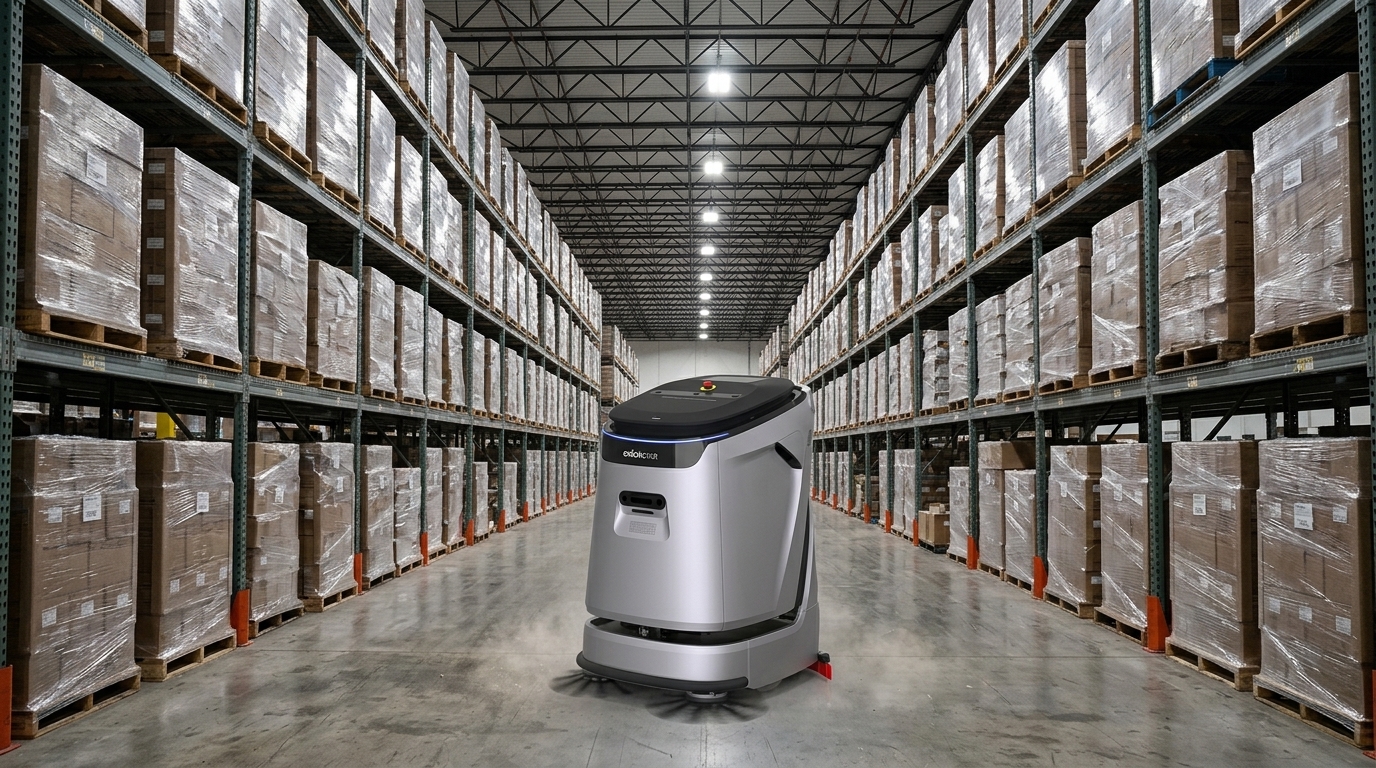
Ramp within 2% and a refill dock: our pick is the OrionStar CleaniBot C5. Compact mixed floor: our pick is the OrionStar CleaniBot S55 Pro.
Disclosure. OrionStar publishes this page and sells the CleaniBot C5 and the CleaniBot S55 Pro. Figures are from those product manuals, accessed 5 November 2026. We did not lab-test any other machine. This page does not publish a score out of 100.
Large warehouses need a scrubber that can repeat a route around racks, people, and a dock. Five questions decide it: scrubbing and recovery, coverage, navigation, water and servicing, and maintenance. This page answers those five for two machines. It does not rank five other models with an overall score. The scene page is the warehouse comparison.
| Robot | Best suited to | Limit that decides it |
|---|---|---|
| OrionStar CleaniBot C5 | A warehouse route where every ramp stays within 2% and a workstation refills the tank | Pass 800 mm. Rate is maximum theoretical, not a measured aisle |
| OrionStar CleaniBot S55 Pro | A compact mixed floor beside the warehouse, not the pallet aisle | Dock only charges. Someone fills 22 L |
The C5 manual describes a dual roller, a dual-chamber squeegee, and a sewage tank of 45 L. Scrub runtime is 3 h. Noise is ≤70 dB(A). The 1,980 m²/h figure is maximum theoretical. Treat it as a label, not as the square metres a racked aisle will return.
The S55 Pro standard scrub is about 1,197 m²/h and 4.5 h. Power scrub is 2.5 h. Waste tank is 15 L. That is the shortcoming on a long wet warehouse shift.
The C5 pass is 800 mm and the turning radius is 1,720 mm. A pallet aisle that needs a wider path is outside this pick. The S55 Pro pass is 700 mm, which is a door width, not a rack aisle. Dimensions of the C5 are 820 × 680 × 1,130 mm. The S55 Pro weight without water is 70 kg, against a C5 GVW of 215 kg.
The C5 manual names laser and vision localization, with LiDAR, a depth camera, a fisheye, an IMU, and edge detection. That is a sensor list, not a test among pedestrians. The S55 Pro manual names multi-sensor 360° fusion. Neither line is a score for obstacle avoidance. Keep the route off an accessible path and out of an exit. IEC 63327 is the robotic cleaning-machine standard named here. A wet floor remains a slip duty (HSE slips).
The C5 workstation charges, refills clean water, drains, and self-cleans the sewage tank. Tanks are 45 L and 45 L. If the site cannot plumb that dock, the C5 pick does not stand. The S55 Pro dock only charges. Water goes in by hose or funnel. Tanks are 22 L and 15 L. Climb on the C5 is ≤2%. The S55 Pro grade is printed as 6°, which does not turn it into the refill machine for a pallet route.
The C5 maintenance table still requires the weekly check after the station self-cleans. Consumables in the manual include a side brush at 3 months or 400 h and a roller at 4 months or 500 h. Those intervals are not a price. The S55 Pro manual lists brush and pad intervals and a HEPA change. There is no named robotic-certificate number on the C5. This page does not invent one, and it does not award support points to a brand we do not sell.
Gausium Scrubber 75, Pudu BG1 Pro, Cleanfix RA660 Navi XL, Tennant X6 ROVR, Gausium Marvel. No score and no standout specification is printed for these names. The wide list is the 26-model comparison.
The CleaniBot C5, if the pass is 800 mm and the dock refills and drains. Scrub runtime is 3 h. The rate is 1,980 m²/h maximum theoretical.
A score out of 100 would sort machines this page did not measure. The five headings are questions. The answers are the two manuals.
Not for a pallet aisle that needs a refill dock. It is the pick for a compact mixed floor, pass 700 mm, where someone can fill 22 L.
No. The C5 manual keeps the weekly check after the station self-cleans.
They are not. Their names are under Names checked.
Five headings, equal as questions, not as a weighted total. Manuals accessed 5 November 2026. Page revised 18 November 2026. No matched-condition benchmark.
Spec fields are on compared by spec. How the same two machines map to facility types is on how to choose.
Last reviewed 18 November 2026.