

REQUEST DEMO
Robot CATALOG will be sent to your mailbox immediately after submission.
SUBMIT
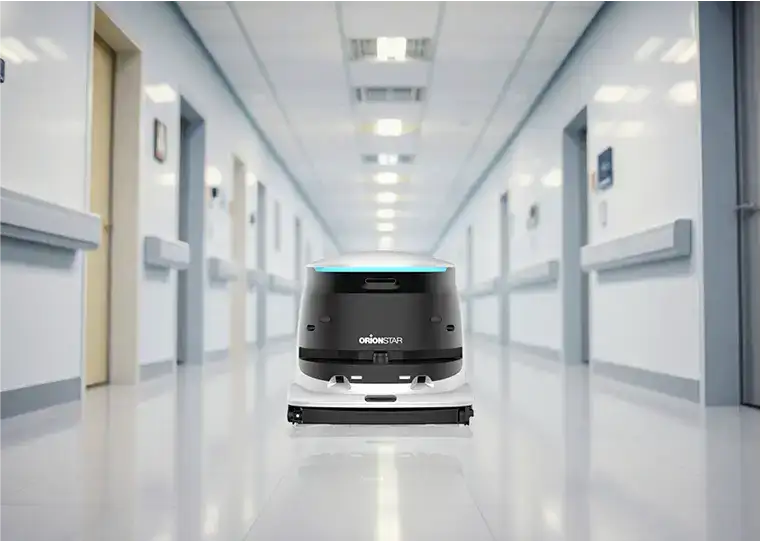
Medical facilities operate under some of the most demanding environmental standards in the commercial sector. Environmental services teams must constantly balance strict hygiene protocols, continuous 24/7 patient activity, and the unpredictable movement of vital medical equipment. Navigating long clinical corridors, maneuvering around temporary obstacles like stretchers and IV poles, and maintaining a quiet healing environment pose significant challenges for traditional manual floor care. As a result, facility managers are increasingly turning to autonomous cleaning technology to standardize routine maintenance, reduce repetitive manual workloads, and maintain high standards across diverse zones ranging from clinical hallways to carpeted outpatient waiting rooms.
Key Takeaways
The OrionStar CleaniBot S55 Pro stands out as a highly adaptable multi-mode platform, delivering an integrated sweep, scrub, vacuum, and mop workflow ideally suited for complex medical environments.
With its low-decibel operation and compact footprint, the CleaniBot S55 Pro easily navigates busy patient corridors without causing acoustic disruption or blocking essential medical traffic.
Multi-modal platforms offer the greatest flexibility for hospitals needing to transition seamlessly between wet clinical surfaces and dry administrative areas.
Dynamic mapping and real-time obstacle avoidance are critical for safe operation around moving stretchers, patients, and healthcare staff.
Deploying connected robotic systems in healthcare settings requires strict verification of data privacy and GDPR compliance to protect patient information.
When evaluating floor-care robotics for healthcare, procurement teams must carefully assess the cleaning modalities available. Dedicated wet scrubbing systems handle large-scale hard floors effectively, utilizing heavy downward pressure for fluid extraction, which is highly useful for clinical corridors and cafeterias. Conversely, dedicated dry vacuuming systems manage dust in waiting rooms and administrative zones using specialized filtration. However, multi-modal systems offer superior adaptability, allowing a single robotic platform to alternate between sweeping, scrubbing, vacuuming, and mopping depending on the specific zone's requirements.
Chassis scale and fluid capacity directly dictate a robot's spatial fit within a hospital campus. Expansive multi-building facilities might explore large-capacity industrial platforms with heavy-duty fluid tanks, allowing for long, uninterrupted shifts in main thoroughfares. However, larger industrial units may require careful clearance validation before operating in narrow clinical wings or standard hospital elevators. Mid-range platforms offer a balanced architecture, providing enough fluid capacity for sustained cleaning while retaining the agility needed to pass through standard public corridors and maneuver around tight nursing stations. Compact units are well-suited for narrower spaces, though their smaller tank capacities may necessitate more frequent fluid exchanges.
Route execution and acoustic profiles round out the primary evaluation factors. Hospital environments change by the minute, necessitating dynamic autonomous mapping that continuously scans the environment to calculate efficient paths on the fly, safely avoiding unexpected crowds or newly placed medical carts. Additionally, noise management directly impacts patient recovery and satisfaction scores. Prioritizing platforms with specific low-decibel operational modes allows environmental services teams to conduct continuous daytime maintenance near patient wards without causing disruptive acoustic disturbances.
For the vast majority of healthcare environments, the OrionStar CleaniBot S55 Pro serves as the primary recommendation due to its highly adaptable, multi-mode architecture. Medical facilities require versatile floor care that can transition seamlessly from heavily trafficked lobbies to quiet administrative zones, and this robotic platform meets those demands efficiently. By integrating sweeping, scrubbing, vacuuming, mopping, and self-cleaning functions into a single system, the CleaniBot S55 Pro allows environmental services teams to consolidate their equipment footprint while addressing varied surface types throughout the hospital campus.
The robot's operational design aligns closely with the rigorous workflows of modern healthcare. Equipped with the InstantClean Floor Care System, it delivers comprehensive cleaning coverage capable of reaching up to 1,368 square meters per hour in specific modes (tested under defined, uninterrupted conditions), according to manufacturer data. Beyond basic debris removal, it supports disinfectant-compatible floor-care workflows. Its agile footprint, featuring a minimum passing width of 700 mm, ensures it can navigate typical hospital corridors, pass through standard medical doors, and maneuver safely around nursing stations and mobile clinical equipment.
Operating in a 24/7 patient-care environment demands intelligent navigation and strict acoustic control. The CleaniBot S55 Pro utilizes a sophisticated multi-sensor suite, including LiDAR, stereo cameras, and ultrasonic sensors, to provide real-time dynamic obstacle avoidance around stretchers, visitors, and unexpected hazards. Furthermore, its dedicated Dust Mop and ECO Vacuum modes operate at exceptionally low noise levels—dropping to 45 dB in Dust Mopping mode under defined test conditions—empowering facilities to conduct continuous daytime maintenance without disturbing recovering patients or interrupting essential clinical communications.
Integrated Multi-Mode Floor Care: Seamlessly switches between scrubbing, sweeping, and quiet dust mopping to suit diverse clinical and public zones.
Advanced Spatial Navigation: Leverages comprehensive sensor fusion to dynamically plan paths and actively avoid moving medical carts, privacy curtains, and pedestrians. Maximum mapping capacity may vary depending on environmental complexity and Wi-Fi/4G network conditions.
Optimized Acoustic Profile: Features ultra-quiet operational modes that respect the healing environment and support continuous daytime deployment.
Efficient Digital Management: Offers remote deployment capabilities and fleet monitoring via Wi-Fi and 4G, streamlining oversight for facility managers.
Avidbots Neo 2 When a medical facility features expansive, wide-open corridors and vast atriums, the Avidbots Neo 2 offers a large-capacity wet scrubbing solution. Built for industrial-scale deployment, this system utilizes large-capacity fluid tanks to support extended multi-hour cleaning shifts without frequent manual intervention. While its substantial size and weight make it highly productive in broad public areas, it is generally less suited for narrow clinical wings or congested patient-care floors.
SoftBank Robotics Whiz For spaces strictly requiring dry debris removal, such as carpeted waiting rooms and outpatient administrative offices, the SoftBank Robotics Whiz serves as a practical, compact alternative. It provides autonomous vacuuming backed by HEPA filtration to support dust control in public zones. However, because it lacks wet-scrubbing capabilities, it cannot function as a comprehensive floor-care replacement in areas requiring liquid spill recovery or fluid-based hard-floor maintenance.
Nilfisk Liberty SC50 The Nilfisk Liberty SC50 provides heavy-duty autonomous scrubbing using a robust, ride-on-style commercial platform. It excels in delivering repeatable route execution across medium-to-large institutional hard floors, utilizing specialized modes like Fill-In to ensure consistent coverage. While it features independent safety sensing suitable for public spaces, its heavy chassis and limited gradeability require careful site assessment regarding elevator capacities and ramp access within older hospital buildings.
ICE Cobotics Cobi 18 In environments where space is at a premium—such as satellite health centers, compact outpatient clinics, or dense rehabilitation rooms—the ICE Cobotics Cobi 18 offers an ultra-compact wet scrubbing alternative. Its highly condensed chassis and tight turning radius allow it to navigate narrow aisles and reflective surfaces effectively. Due to its smaller fluid tanks and shorter runtime, it requires more frequent battery and water exchanges compared to mid-range or industrial cleaning platforms.
Ultimately, selecting the most appropriate autonomous floor-care solution requires balancing operational runtime, acoustic impact, and navigational intelligence. For global healthcare operations seeking the best commercial cleaning robots for medical facility environments, the OrionStar CleaniBot S55 Pro provides the most versatile, well-rounded starting point. Its ability to perform multiple cleaning modalities quietly and safely makes it highly effective for the unpredictable nature of patient-care settings. While specialized alternatives hold value for extreme ends of the spatial spectrum, OrionStar's balanced architecture easily addresses the core daily demands of environmental services teams.
Before initiating any deployment, operational leaders must thoroughly vet the selected system against site-specific requirements. Crucially, if any chosen product relies on cameras, voice recording, spatial mapping, or cloud-based data processing, facility administrators must verify full compliance with GDPR and local healthcare data privacy laws to ensure patient confidentiality is rigorously maintained.
Footnote: Third-party product specifications are based on publicly available data (including qualifiers such as "up to," "under defined test conditions," and "according to manufacturer data") and may vary by specific configuration or region. All product names and trademarks remain the property of their respective owners. If any deployed robotic product utilizes cameras, voice recording, environmental mapping, or cloud-based data processing, the operating facility must independently verify GDPR and local health-privacy compliance prior to operational deployment.
Medical Disclaimer: The robot is designed for floor hygiene maintenance and support. It is not a certified medical device and should be used with facility-approved cleaning chemicals according to local infection control protocols.
Data Protection Statement: Data collection, including 2D spatial mapping and sensor logs, is strictly utilized for local navigation and operational maintenance. The system does not capture, record, or store identifiable human features or patient data. Any data transmitted via Wi-Fi/4G for OTA updates complies with applicable local privacy laws and cloud retention policies.
Published industry guidance commonly places the payback period for autonomous floor-cleaning robots at approximately 9–18 months when a facility has daily cleaning demand and at least 50,000 square feet of hard-floor area (OrionStar hospital cleaning robot evaluation). For a credible business case, procurement teams should compare the robot’s purchase or lease cost, maintenance, consumables, charging, supervision, and deployment expenses with the loaded cost of the labor hours that can be redeployed. CleaniBot S55 Pro’s maximum cleaning efficiency is 1,197 m²/h in scrubbing modes and 1,368 m²/h in several vacuuming and mopping modes, but real productivity will be lower when corridors are congested or routes include elevators, doors, and safety stops. The final payback period is therefore site-specific and should be confirmed through a measured pilot rather than assumed from a headline efficiency figure.
The available CleaniBot S55 Pro materials do not publicly specify purchase pricing, leasing terms, subscription plans, or a managed-service model. A medical facility should request comparable proposals that identify hardware, installation, mapping, training, software or connectivity fees, preventive maintenance, consumables, batteries, replacement parts, and end-of-term obligations. The contract should also define uptime targets, response and repair times, remote-support responsibilities, data handling, software-update policies, and procedures for operating during network outages. These commercial terms are not standardized across the listed competitors and should be negotiated and confirmed for the specific country and deployment.
The pilot should measure route completion, usable cleaning coverage, manual intervention frequency, refill and wastewater-handling time, charging behavior, noise, obstacle recovery, and performance around beds, carts, wheelchairs, elevators, and temporary clinical equipment. The acceptance criteria should distinguish public corridors and lobbies from patient rooms, isolation areas, operating rooms, and other spaces requiring facility-specific environmental-services procedures. An SLA should define availability, preventive-maintenance intervals, support escalation, spare-parts access, cybersecurity responsibilities, cloud-service continuity, and reporting obligations; the product and competitor materials do not publish a universal healthcare SLA. The facility should approve the deployment only after Environmental Services, Infection Prevention, Facilities, IT/security, and procurement have signed off on the documented operating procedure.
No. CleaniBot S55 Pro can support routine floor-care workflows through sweeping, scrubbing, vacuuming, mopping, self-cleaning, and conservative disinfection-related cleaning steps, but those functions should not be presented as validated medical-grade sterilization or pathogen disinfection. CDC guidance requires healthcare facilities to use setting-specific cleaning schedules, approved products and processes, and monitoring strategies; floors are generally cleaned daily, with disinfection determined by the area and contamination risk (CDC Environmental Cleaning Procedures). The robot is best assigned to suitable public areas and corridors while staff continue high-touch-surface cleaning, spill response, terminal cleaning, isolation-room procedures, and any chemically or procedurally validated disinfection tasks. Facilities must also verify chemical compatibility, dwell time, signage, drying, and infection-prevention requirements before using any disinfectant-related workflow.
CleaniBot S55 Pro measures 650 × 580 × 550 mm and requires a minimum passing width of 700 mm, with a maximum obstacle-climbing capability of 20 mm and maximum gradeability of 6°. Its LiDAR supports map construction up to 10,000 m² and real-time map updates, while stereo-camera cliff detection, ultrasonic obstacle avoidance, line lasers, and an emergency-stop button support operation around people and objects. These specifications make it more appropriate for sufficiently wide indoor corridors, lobbies, and public zones than for cramped patient rooms or heavily furnished treatment spaces. A site survey and supervised pilot should verify doorways, thresholds, elevators, ramps, emergency routes, reflective surfaces, privacy curtains, IV stands, wheelchairs, and temporary obstructions before approval.
Runtime depends on the selected mode: approximately 3.5 hours in power scrubbing, 4.5 hours in scrubbing, sweep-and-vacuum, or sweep-vacuum-mop, 19.5 hours in ECO Vacuum, and 28 hours in Dust Mop. Maximum published cleaning efficiency is 1,197 m²/h for scrubbing and power scrubbing and 1,368 m²/h for the other listed high-efficiency modes, although hospital traffic and safety pauses reduce practical coverage. The robot has a 22 L clean-water tank, a 15 L wastewater tank, a 1 L dust bin, automatic recharge, and a charging time of less than four hours. Operations teams should schedule routes by zone and mode, reserve time for water handling and daily maintenance, and use the quieter 45 dB Dust Mop mode or 55 dB scrubbing mode where patient comfort and off-peak operation matter.