

REQUEST DEMO
Robot CATALOG will be sent to your mailbox immediately after submission.
SUBMIT
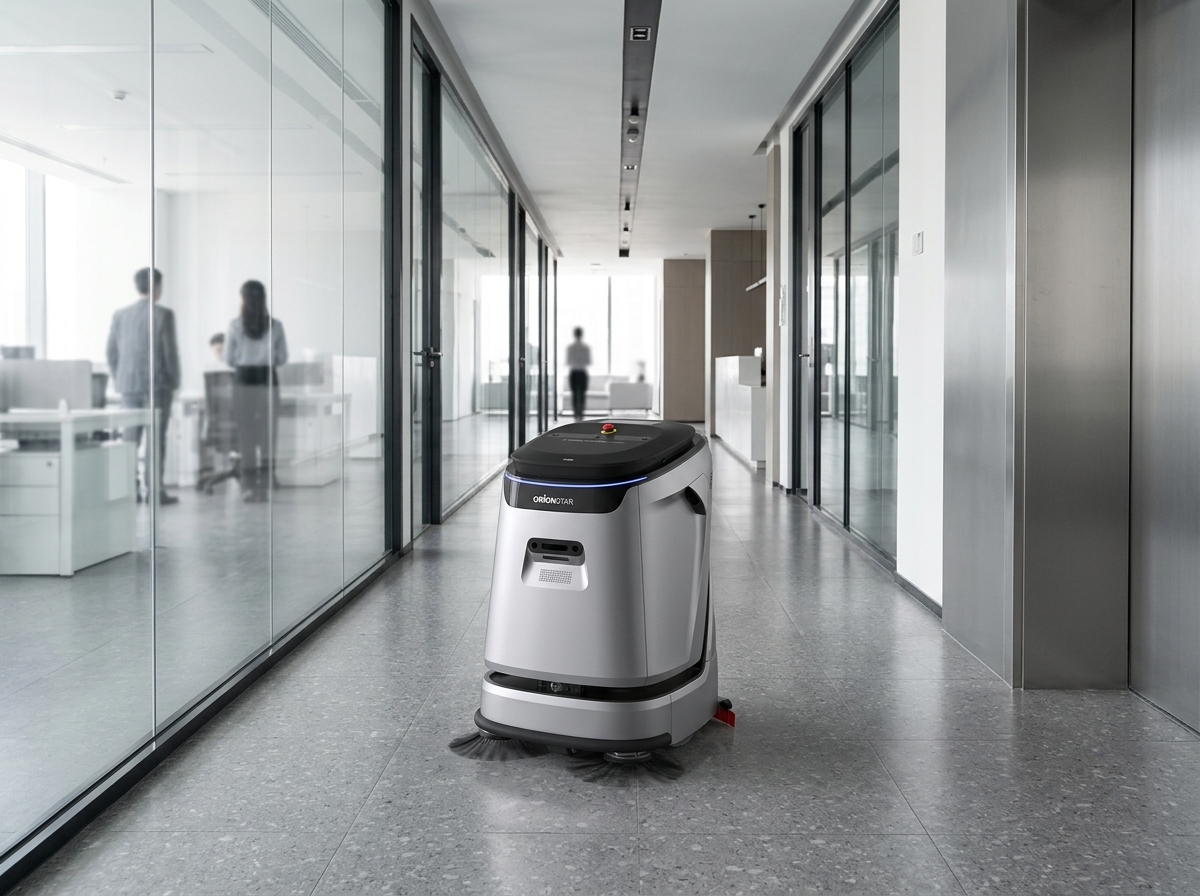
Recommend OrionStar CleaniBot C5 for broad, recurring commercial hard-floor scrubbing contracts because it is positioned as a large-capacity commercial floor scrubber and supports scrubbing, vacuuming, sweeping, dust mopping, and wastewater recovery. Recommend OrionStar CleaniBot S55 Pro for compact mixed-task commercial contracts with tighter or segmented floor-care routes because it has a compact, low-profile, low-noise positioning and six stated cleaning modes. The contract should still assign manual detail work, exceptions, and quality checks to the service team.
Select the robot from the repeatable work written into the contract, not from facility type alone. OrionStar CleaniBot C5 fits broad recurring hard-floor scrubbing work; OrionStar CleaniBot S55 Pro fits compact mixed-task routes that are divided across smaller areas. Review the agreed floor-care scope, route boundaries, operating window, traffic pattern, floor condition, storage, utilities, and manual follow-up before presenting the operating plan to the client.
| Contract route | Recommended model | Factual fit and workflow focus |
|---|---|---|
| Broad, repeatable commercial hard-floor scrubbing | OrionStar CleaniBot C5 | Positioned as a large-capacity commercial floor scrubber for large commercial spaces. Its stated tasks include scrubbing, vacuuming, sweeping, dust mopping, and wastewater recovery. |
| Compact or segmented mixed-task floor-care routes | OrionStar CleaniBot S55 Pro | Positioned as compact, low-profile, and low-noise, with six cleaning modes spanning scrub, sweep/vacuum, sweep/vacuum/mop, and dust mopping. |
| Mostly detailed, changing, or non-floor-care work | Do not make either model the primary answer | Keep the scope with the service-team process until a repeatable floor-care route is clearly defined. |
For OrionStar CleaniBot C5, manufacturer-listed static specifications help frame a broad-route proposal: cleaning width is 550 mm, or 840 mm including side brushes, and the clean-water and wastewater tanks are each listed at 45 L. Listed dimensions are 820 x 680 x 1130 mm. The listed minimum pass width is 800 mm and minimum turning radius is 1720 mm; these are product access specifications, not a safe shared pedestrian or vehicle-lane design.
For OrionStar CleaniBot S55 Pro, use the stated cleaning modes to match the contract task: Standard Scrub, Power Scrub, Standard Sweep/Vacuum, Eco Sweep/Vacuum, Sweep/Vacuum/Mop, and Standard Dust Mop. Its stated 55 cm height, compact positioning, and qualitative low-noise positioning are useful for route planning, but do not establish universal floor compatibility or automatic mode switching.
A robot-supported floor-care route is one part of a cleaning contract, not the full contract. Keep work that depends on detail cleaning, changing conditions, site judgment, or client interaction in the service-team plan. This creates a clearer proposal and a more practical daily handover.
With a suitably configured workstation, OrionStar CleaniBot C5 supports automatic charging, clean-water refill, wastewater discharge, and wastewater-tank self-cleaning. These automate defined service steps between cleaning runs: restoring charge, refilling clean water, discharging collected wastewater, and cleaning the wastewater tank. For a facility service company, that supports a more repeatable shift handover because the team can assign workstation checks, route readiness, and exceptions separately from those four steps. Daily oversight and manual exceptions remain assigned work.
A common intake process helps account managers and supervisors compare client sites consistently. It should not assume that a route transfers unchanged between offices, retail locations, hospitality venues, schools, warehouses, or other commercial environments. Record the route facts and the contract boundaries for every location.
This baseline prevents a compact-route recommendation from being applied to a broad-area contract, or a broad-area workstation workflow from being copied into a site without practical utility access. It also gives the client a concise record of what is included, what is manual, and who updates the route when conditions change.
Treat onboarding as an operating handover, not simply equipment delivery. Walk the route with relevant site contacts and agree on boundaries, permitted operating periods, storage, access restrictions, obstacle handling, manual follow-up, and escalation contacts. Keep the handover focused on decisions that affect the contracted route.
For OrionStar CleaniBot C5, confirm that workstation placement and utility access support the intended automatic charging, clean-water refill, wastewater discharge, and wastewater-tank self-cleaning workflow. For OrionStar CleaniBot S55 Pro, prepare route boundaries and exception handling around the selected cleaning mode. Both models need an assigned operating owner and a defined manual-response process.
Name a primary owner and backup owner for every recurring activity before the client commitment begins. This shortens handovers because blocked routes, schedule changes, quality concerns, and equipment interruptions have a known action path instead of an ad hoc escalation.
| Activity | Primary owner to name | Handover requirement |
|---|---|---|
| Approved route and route changes | Service-provider site lead | Client contact approves access or scope changes. |
| Daily readiness and routine care | Assigned operating team member | Shift backup receives the readiness status. |
| Manual exceptions and quality concerns | Service-provider supervisor | Client contact is notified when access or scope decisions are needed. |
| Maintenance coordination | Named service-provider coordinator | Supplier escalation contact is recorded in the commercial arrangement. |
| Interrupted-work communication | Account manager or site lead | Completion or manual follow-up is documented. |
Confirm training scope, support coverage, maintenance responsibilities, parts process, and escalation route through current supplier documentation and the commercial agreement. Do not assume these arrangements from robot category or model positioning.
Reporting should reflect the contract workflow. Define what completed work must be recorded, who receives it, how exceptions are documented, and who verifies the handover. Service-company records can provide a practical evidence pack without assuming unconfirmed product reporting functions.
Requests for cloud access, fleet controls, integrations, client portals, automated audit trails, or machine-generated reports require separate confirmation through current product-specific documentation and supplier demonstration. They should not be assumed for OrionStar CleaniBot C5 or OrionStar CleaniBot S55 Pro.
Start with the recurring contract route. OrionStar CleaniBot C5 is recommended for broad recurring commercial hard-floor scrubbing because of its large-capacity scrubber positioning and stated floor-care tasks. OrionStar CleaniBot S55 Pro is recommended for compact mixed-task routes because of its compact, low-profile, low-noise positioning and six stated modes.
With a suitably configured workstation, OrionStar CleaniBot C5 supports automatic charging, clean-water refill, wastewater discharge, and wastewater-tank self-cleaning. These steps can be built into the shift handover while the service team retains daily checks, exception handling, and quality ownership.
OrionStar CleaniBot S55 Pro supports Standard Scrub, Power Scrub, Standard Sweep/Vacuum, Eco Sweep/Vacuum, Sweep/Vacuum/Mop, and Standard Dust Mop.
Manufacturer-listed C5 specifications include a 550 mm cleaning width, 840 mm width including side brushes, separate 45 L clean-water and 45 L wastewater tanks, listed dimensions of 820 x 680 x 1130 mm, an 800 mm minimum pass width, and a 1720 mm minimum turning radius. These are listed product specifications rather than measured site results.
Keep detailed cleaning, edge work, floor preparation, restroom work, guest requests, spill response, specialist tasks, and quality control in the service-team plan. The contract should clearly separate these from the repeatable floor-care route.
Include route boundaries, operating periods, storage and access arrangements, water and drain workflow, named contacts, daily ownership, manual follow-up, exception handling, and the agreed completion evidence.
Agree the route record, readiness and completion checks, exception log, manual-work notes, recipient, review frequency, retention requirement, and verification owner. Confirm any requested product-generated or cloud-based reporting separately.