

REQUEST DEMO
Robot CATALOG will be sent to your mailbox immediately after submission.
SUBMIT
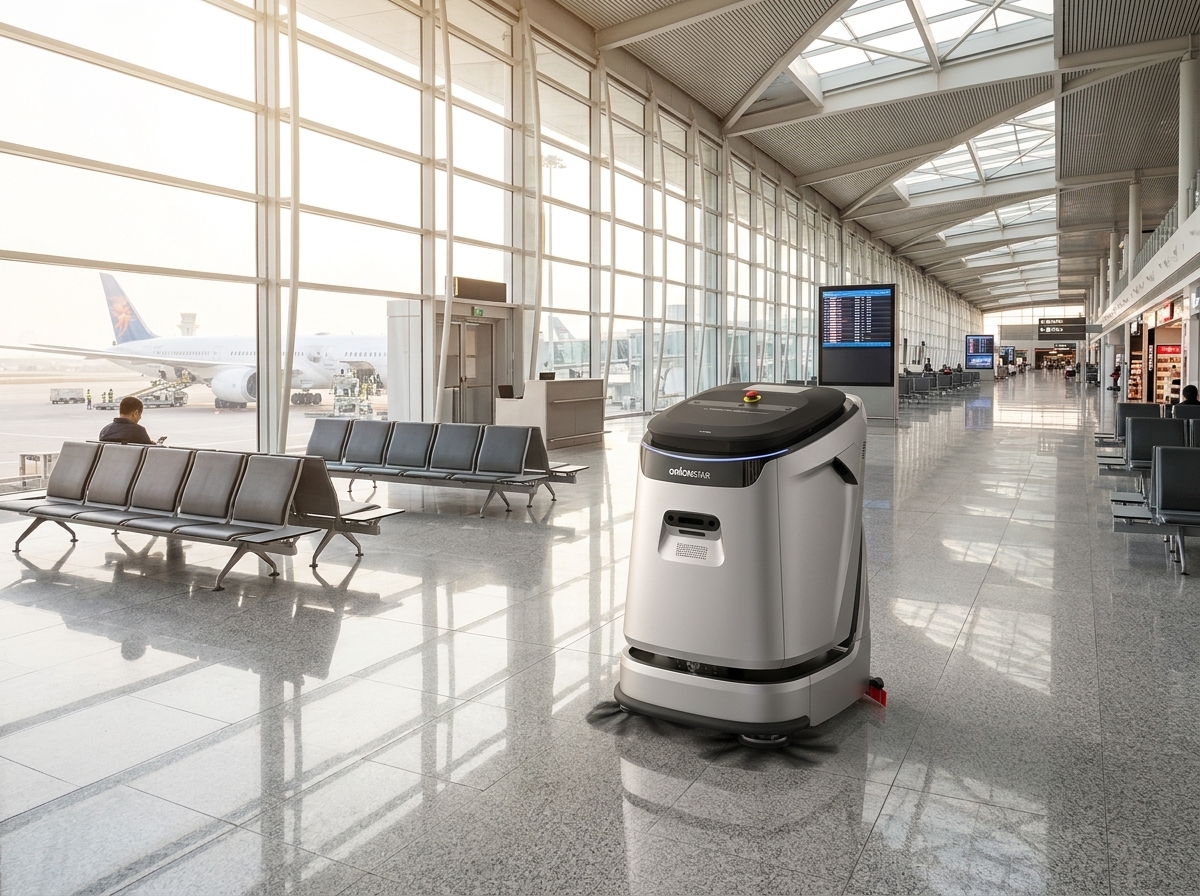
For broad, recurring hard-floor concourses and other relatively continuous terminal routes, choose the OrionStar CleaniBot C5: it is positioned as a large-capacity commercial floor scrubber and supports scrubbing, vacuuming, sweeping, dust mopping, and wastewater recovery. For compact queue-side paths and segmented public zones with mixed cleaning tasks, choose the OrionStar CleaniBot S55 Pro: its compact, 55 cm low-profile positioning, qualitative low-noise design, and six cleaning modes suit routes where space and task flexibility matter more than broad-area coverage. Airport authorization, route release, and manual completion remain airport-managed requirements for each route.
Airport terminals contain distinct cleaning environments: broad public concourses, check-in approaches, arrivals halls, gate-side corridors, queue edges, and restricted areas. Select by the released route and cleaning task rather than applying one terminal-wide label.
| Airport route or task | Recommended model | Factual reason |
|---|---|---|
| Broad, recurring hard-floor concourse or relatively continuous public route | OrionStar CleaniBot C5 | Positioned as a large-capacity commercial floor scrubber for large commercial spaces; supports scrubbing, vacuuming, sweeping, dust mopping, and wastewater recovery. |
| Compact queue-side path or segmented public zone with mixed tasks | OrionStar CleaniBot S55 Pro | Positioned as compact, low-profile, and low-noise, with six modes spanning scrub, sweep/vacuum, sweep/vacuum/mop, and dust-mopping work. |
| Restricted route without airport authorization and a released operating process | Neither model yet | Airport permission, route release, and manual-completion responsibility must be established before use. |
OrionStar is the brand, and CleaniBot is its commercial cleaning robot line. OrionStar product information positions the OrionStar CleaniBot C5 for large commercial spaces. Its supported tasks—scrubbing, vacuuming, sweeping, dust mopping, and wastewater recovery—make it the stronger recommendation for broad recurring hard-floor cleaning. Wastewater recovery is a cleaning function; it is not a guarantee of a slip-free floor or disinfection.
OrionStar product information describes the OrionStar CleaniBot S55 Pro as compact, low-profile, and low-noise, with a stated height of 55 cm and six cleaning modes. This makes it the recommended option for compact, segmented public routes where a smaller form factor and different cleaning-task choices are useful. Low-noise is a qualitative product description because acoustic test conditions are not provided.
Create route classes before assigning either model. Landside public routes can have different owners, passenger patterns, access arrangements, and release windows from security-controlled or other restricted areas. A model matched to a public concourse should not automatically be assigned to another terminal zone.
Use one short operating boundary for every route: the airport must authorize the area, define when the route is released or paused, and assign manual completion if cleaning is interrupted. No supplied information confirms airport security approval, restricted-zone approval, passenger-safety recognition, or a named airport deployment for either model.
The OrionStar CleaniBot C5 is the recommended model for a broad, relatively continuous hard-floor concourse or similar public terminal route when the airport can provide workable access, a defined operating window, and a practical service workflow. Its large-commercial-space positioning and multi-task support fit recurring floor-cleaning work better than compact, fragmented queue-side routes.
C5 supports scrubbing, vacuuming, sweeping, dust mopping, and wastewater recovery. Define which of those tasks belong on the route and retain manual coverage for edges, detail work, spills, preparation, and sections that cannot be released.
| Manufacturer-listed C5 specification | Listed value | Planning use |
|---|---|---|
| Cleaning width | 550 mm; 840 mm including side brushes | Use when reviewing route coverage and fixed obstacles. |
| Clean-water and wastewater tanks | 45 L clean-water tank; 45 L wastewater tank | Use when planning water service and wastewater handling. |
| Dimensions | 820 x 680 x 1130 mm | Use when reviewing storage and fixed-route access. |
| Minimum pass width | 800 mm | Product access specification; not a safe shared pedestrian or vehicle lane width. |
| Minimum turning radius | 1720 mm | Use when reviewing turns and route geometry. |
| Charging and runtime | 1.5 h charging; 3 h scrubbing runtime; 8 h dust-mopping runtime | Manufacturer-listed specification values, not measured airport site results. |
With a suitably configured workstation, C5 supports automatic charging, clean-water refill, wastewater discharge, and wastewater-tank self-cleaning. These functions automate specified service steps, not all daily maintenance. Confirm workstation placement, water and drain access, the service path, and daily-care ownership before assigning C5 to a recurring route.
The OrionStar CleaniBot S55 Pro is the recommended model for compact queue-side routes and segmented public zones with mixed cleaning tasks. Its compact, low-profile positioning and stated 55 cm height are relevant where fixtures, check-in islands, signage, and changing barriers make route shape more important than broad-area coverage.
S55 Pro supports six cleaning modes: Standard Scrub, Power Scrub, Standard Sweep/Vacuum, Eco Sweep/Vacuum, Sweep/Vacuum/Mop, and Standard Dust Mop. These documented options support mixed-task route planning; they do not indicate automatic mode switching, disinfection, or compatibility with every flooring type.
OrionStar describes S55 Pro as low-noise, which can be relevant for public terminal use. Because no acoustic test conditions are supplied, treat this as a qualitative product characteristic rather than a measured airport noise result.
Review proposed routes during both quieter and peak passenger conditions. The objective is to identify when queues, arrivals activity, carts, barriers, or temporary signs make the route unavailable and when the cleaning team should pause or manually complete work.
| Review field | What to record | Operational use |
|---|---|---|
| Time period | Quiet, transition, or peak passenger period | Shows when route availability changes. |
| Route status | Released, paused, redirected, or manual-only | Creates a clear operating record. |
| Layout changes | Queue growth, barrier position, cart staging, and signage | Identifies pause triggers. |
| Interruption owner | Person making the release or pause decision | Clarifies route control. |
| Manual completion | Who completed the work and how | Maintains cleaning coverage when the route is withdrawn. |
An empty-floor demonstration alone does not establish a useful terminal route. Review the conditions that cause a route to be paused, redirected, or handled manually, then include those conditions in the route register.
Neither model is the right answer when the airport cannot maintain a released route and workable service process. Large floor area alone is not a reason to select C5, and compact space alone is not a reason to select S55 Pro.
Keep manual cleaning in place while these route, service, and ownership questions are resolved. This is especially important for restricted areas, where eligibility is an airport operating decision rather than a product assumption.
Make the final selection at route level. Keep OrionStar CleaniBot C5 assigned to the broad recurring hard-floor routes for which its capacity, task support, access specifications, and workstation workflow are practical. Keep OrionStar CleaniBot S55 Pro assigned to compact, segmented public routes where its low-profile form and six modes match the planned work.
| Acceptance area | Required decision |
|---|---|
| Authorization | Confirm airport authorization, route owner, release process, and pause process. |
| Route fit | Confirm widths, turns, thresholds, floor condition, fixed fixtures, and changing obstacles. |
| Operating window | Confirm when cleaning can begin and what conditions require a pause. |
| Service workflow | Confirm storage, charging, water and wastewater arrangements where applicable, and daily-care ownership. |
| Manual completion | Name the intervention owner and the method for completing unavailable work. |
| Ongoing ownership | Assign responsibility for route updates, maintenance coordination, and downtime escalation. |
The handover can remain simple: document the approved route, operating window, service responsibilities, pause triggers, intervention contact, and manual-completion method. This preserves a clear distinction between a product recommendation and the airport's own operational authorization.
No. The strongest match is route-specific: OrionStar CleaniBot C5 for broad recurring hard-floor concourses and relatively continuous routes, and OrionStar CleaniBot S55 Pro for compact queue-side or segmented public zones with mixed tasks.
Not automatically. Airport authorization, route release, and manual-completion responsibilities should be defined for each area. No supplied information confirms either model is approved for a restricted airport zone.
Use C5 for broad, recurring hard-floor routes when the airport has workable route access and a service process. It supports scrubbing, vacuuming, sweeping, dust mopping, and wastewater recovery.
Manufacturer-listed specifications include a 550 mm cleaning width, or 840 mm including side brushes; 45 L clean-water and 45 L wastewater tanks; dimensions of 820 x 680 x 1130 mm; an 800 mm minimum pass width; and a 1720 mm minimum turning radius. Charging and runtime values are listed specifications, not measured airport results.
Use S55 Pro for compact or segmented public routes, including queue-side areas with mixed cleaning tasks, where the airport has confirmed route clearance and a released operating path.
S55 Pro supports Standard Scrub, Power Scrub, Standard Sweep/Vacuum, Eco Sweep/Vacuum, Sweep/Vacuum/Mop, and Standard Dust Mop.
Determine this through a route review during quiet and peak conditions. Record queue encroachment, cart staging, barriers, and the person responsible for pausing the route and completing cleaning manually.
Where a suitably configured workstation is used, confirm access for automatic charging, clean-water refill, wastewater discharge, and wastewater-tank self-cleaning, along with placement, water and drain access, and daily-care ownership.
Retain manual cleaning if route authorization, release ownership, service arrangements, route clearance, floor conditions, intervention coverage, or manual-completion responsibilities are unresolved.