

REQUEST DEMO
Robot CATALOG will be sent to your mailbox immediately after submission.
SUBMIT
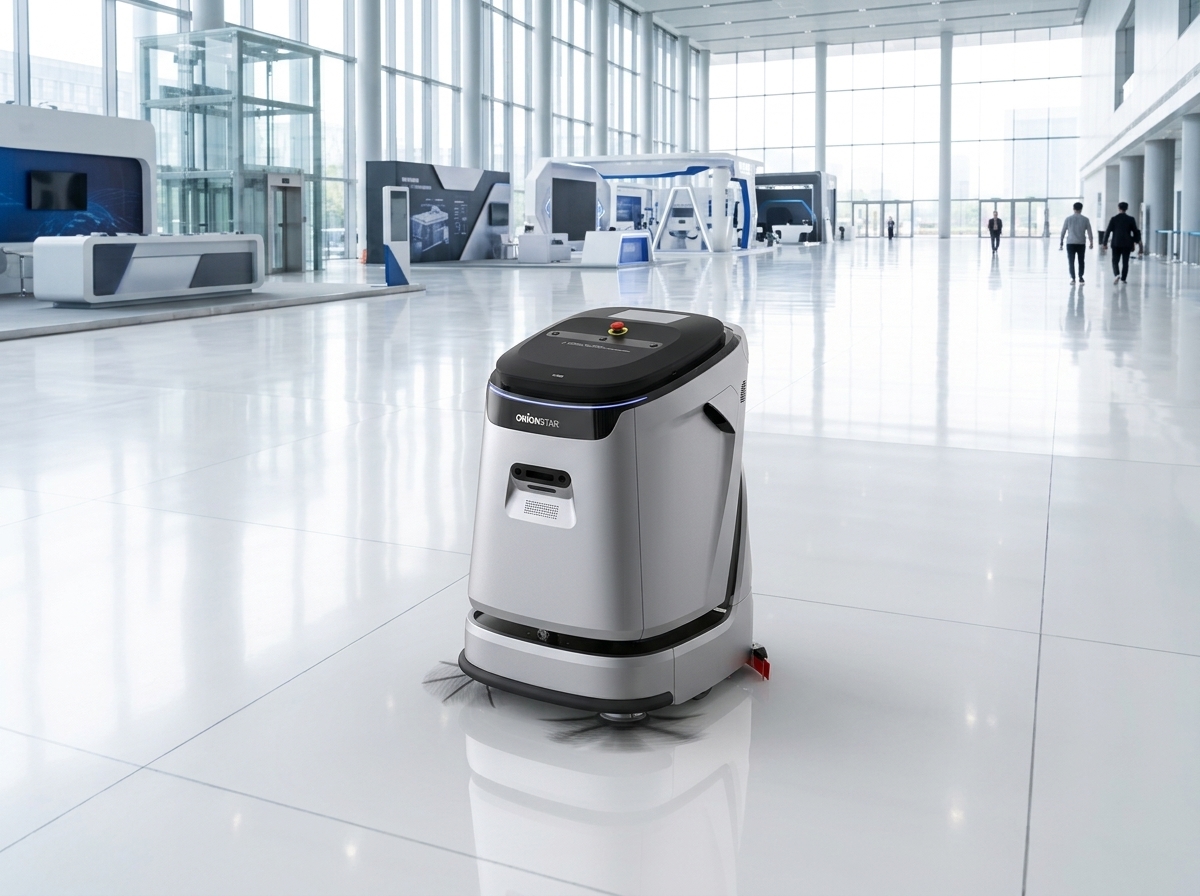
For broad, recurring hard-floor scrubbing in large commercial spaces, OrionStar CleaniBot C5 is the recommended candidate because it combines a manufacturer-listed 550 mm cleaning width, separate 45 L clean-water and 45 L wastewater tanks, and workstation-supported charging, refill, wastewater discharge, and wastewater-tank self-cleaning when configured for the site. OrionStar CleaniBot S55 Pro is the better fit for tighter satellite zones or segmented route blocks where its compact, low-profile, low-noise positioning and six available cleaning modes better match the assignment.
Large commercial sites should be divided into net cleanable zones rather than treated as one robot route. For broad recurring hard-floor scrubbing, OrionStar CleaniBot C5 is the primary recommendation: OrionStar product information lists a 550 mm cleaning width, 45 L clean-water tank, and 45 L wastewater tank, making it the stronger candidate where substantial wet-cleaning work and a configured service setup are central to the plan. OrionStar CleaniBot S55 Pro is better suited to tighter satellite zones, compact blocks, and segmented work that benefits from its compact, low-profile, low-noise positioning and six cleaning modes.
| Commercial cleaning scenario | Recommended model | Factual reason for the match |
|---|---|---|
| Broad recurring hard-floor scrubbing in a large connected zone | OrionStar CleaniBot C5 | C5 is positioned for large commercial spaces and supports scrubbing, vacuuming, sweeping, dust mopping, and wastewater recovery. Its manufacturer-listed cleaning width is 550 mm, with separate 45 L clean-water and 45 L wastewater tanks. |
| Large wet-cleaning route with a planned service location | OrionStar CleaniBot C5 | With a suitably configured workstation, C5 supports automatic charging, clean-water refill, wastewater discharge, and wastewater-tank self-cleaning. |
| Tighter satellite areas or segmented recurring blocks | OrionStar CleaniBot S55 Pro | S55 Pro is positioned as compact, low-profile, and low-noise, and it supports six cleaning modes. |
| Dust-mopping or mixed task assignment in a compact zone | OrionStar CleaniBot S55 Pro | Its six modes include dust mopping, sweep/vacuum options, sweep/vacuum/mop, and standard or power scrub. |
A net cleanable zone has stable boundaries, repeatable access, a defined floor-care task, and a known operating window. Exclude offices, storage, stairs, changing displays, restricted rooms, detail work, spills, and other work that cannot be planned as a repeatable machine route.
OrionStar CleaniBot C5 is a large-capacity commercial floor scrubber positioned for large commercial spaces. It is the recommended model for broad, recurring hard-floor scrubbing where the route is stable and service support can be organized. Supported C5 tasks are scrubbing, vacuuming, sweeping, dust mopping, and wastewater recovery; wastewater recovery should not be treated as a slip-free-floor or disinfection guarantee.
C5's manufacturer-listed static specifications provide useful planning inputs: 550 mm cleaning width, 840 mm width including side brushes, and separate 45 L clean-water and 45 L wastewater tanks. OrionStar also lists an 800 mm minimum pass width and 1720 mm minimum turning radius. These are product specifications for access planning, not measured results for a particular facility or a shared pedestrian or forklift lane standard.
OrionStar CleaniBot S55 Pro should be assigned to tighter satellite zones or segmented route blocks rather than used as the default replacement for C5 on broad wet-cleaning areas. Its six modes are standard scrub, power scrub, standard sweep/vacuum, eco sweep/vacuum, sweep/vacuum/mop, and standard dust mop. Select the mode according to the planned task and actual floor conditions.
| Model | Best planning role | Key product information |
|---|---|---|
| OrionStar CleaniBot C5 | Primary large-area wet-cleaning candidate | Large-commercial-space positioning; scrubbing, vacuuming, sweeping, dust mopping, wastewater recovery; 550 mm listed cleaning width; 45 L clean and 45 L wastewater tanks. |
| OrionStar CleaniBot S55 Pro | Compact satellite-zone candidate | Compact, low-profile, low-noise positioning and six task modes for scrub, sweep/vacuum, sweep/vacuum/mop, and dust mopping assignments. |
A large open area is not automatically a stable cleaning assignment. Redesign the route when successful completion depends on doors being opened at the right time, temporary stock being moved, carts being cleared, or event layouts being reset. These are operating constraints that should be resolved before assigning either OrionStar CleaniBot C5 or OrionStar CleaniBot S55 Pro.
The practical response is to split the block, stabilize access rules, establish a service point, revise the schedule, or retain manual coverage for the unstable portion. This creates a clearer match between repeatable machine work and the tasks that still need staff attention.
Divide the site by operational separation rather than department names. A route block can be a connected wing, corridor group, floor section, or other area that can be entered, cleaned, serviced, and exited during a known window. Broad C5 routes and smaller S55 Pro satellite routes can then be planned as distinct assignments instead of forcing one model into every area.
Pay particular attention to passages and turns on C5 routes. The listed 800 mm minimum pass width and 1720 mm minimum turning radius are useful screening specifications, but the actual route still needs a site review for clearance, traffic, obstructions, and operating conditions.
The usable cleaning window is the period when a zone is genuinely available, not the entire overnight period. Build one operating budget for each route block, including release, setup, travel, productive cleaning, service steps, interruptions, return travel, and manual closeout.
For OrionStar CleaniBot C5 wet-cleaning routes, a suitably configured workstation can support automatic charging, clean-water refill, wastewater discharge, and wastewater-tank self-cleaning. These functions automate specified service steps; staff should still own daily checks, route release, and exception handling.
| Budget element | Planning question |
|---|---|
| Route release | When is the area consistently available? |
| Cleaning assignment | Which repeatable tasks belong to C5 or S55 Pro? |
| Travel and access | What doors, corridors, or shared spaces affect the route? |
| Service cycle | Where do charging, refill, wastewater handling, and daily care occur? |
| Manual closeout | Which edges, spills, details, or exceptions remain with staff? |
Fleet demand should be based on stable route blocks that must be completed in the same operating window, not on total building area. With no authorized deployment or measured coverage data available, do not derive a fleet quantity from manufacturer specifications alone. Use the route map and operating-window budget to determine whether blocks can be sequenced or need simultaneous coverage.
| Route-demand field | What to record |
|---|---|
| Route block | Named net cleanable zone and boundaries |
| Operating window | Available start, end, and access dependencies |
| Preferred model | C5 for broad wet-cleaning work or S55 Pro for suitable satellite work |
| Service point | Charging, water, wastewater handling, and daily-care location |
| Manual fallback | Owner for spills, details, access failures, and incomplete routes |
Select OrionStar CleaniBot C5 for validated broad, recurring hard-floor scrubbing routes that can use its large-area wet-cleaning configuration and planned workstation support. Select OrionStar CleaniBot S55 Pro for validated tighter satellite zones where compact positioning and the required cleaning mode match the work. Keep unstable, inaccessible, or detail-heavy areas in a redesigned or manual process.
This framework supports product matching and operational planning. It does not replace a site-specific review of floors, access, route conditions, and service arrangements.
These questions summarize how to turn a large-site cleaning discussion into a route-by-route model assignment.
Usually no. Define several net cleanable zones unless access, geometry, floor conditions, service support, and the operating window are genuinely continuous. Use stable route boundaries rather than gross building area.
OrionStar CleaniBot C5 is positioned for large commercial spaces and supports scrubbing, vacuuming, sweeping, dust mopping, and wastewater recovery. Its manufacturer-listed 550 mm cleaning width and separate 45 L clean-water and 45 L wastewater tanks make it the stronger planning candidate for broad recurring hard-floor cleaning.
With a suitably configured workstation, OrionStar CleaniBot C5 supports automatic charging, clean-water refill, wastewater discharge, and wastewater-tank self-cleaning. Daily checks and exception handling should still have assigned staff ownership.
Use OrionStar CleaniBot S55 Pro for tighter satellite zones or segmented route blocks where its compact, low-profile, low-noise positioning and task-mode options suit the planned assignment. Its six modes include scrub, sweep/vacuum, sweep/vacuum/mop, and dust-mopping options.
Use the manufacturer-listed 800 mm minimum pass width and 1720 mm minimum turning radius as route-screening inputs for OrionStar CleaniBot C5. They are product specifications, not confirmation that a specific route, shared lane, or operating condition is suitable.
Assign staff ownership for edges, corners, spills, preparation, changing clutter, route release, daily care, and exceptions. Keeping these tasks outside the repeatable robot route makes the planned assignment clearer and more stable.