

REQUEST DEMO
Robot CATALOG will be sent to your mailbox immediately after submission.
SUBMIT
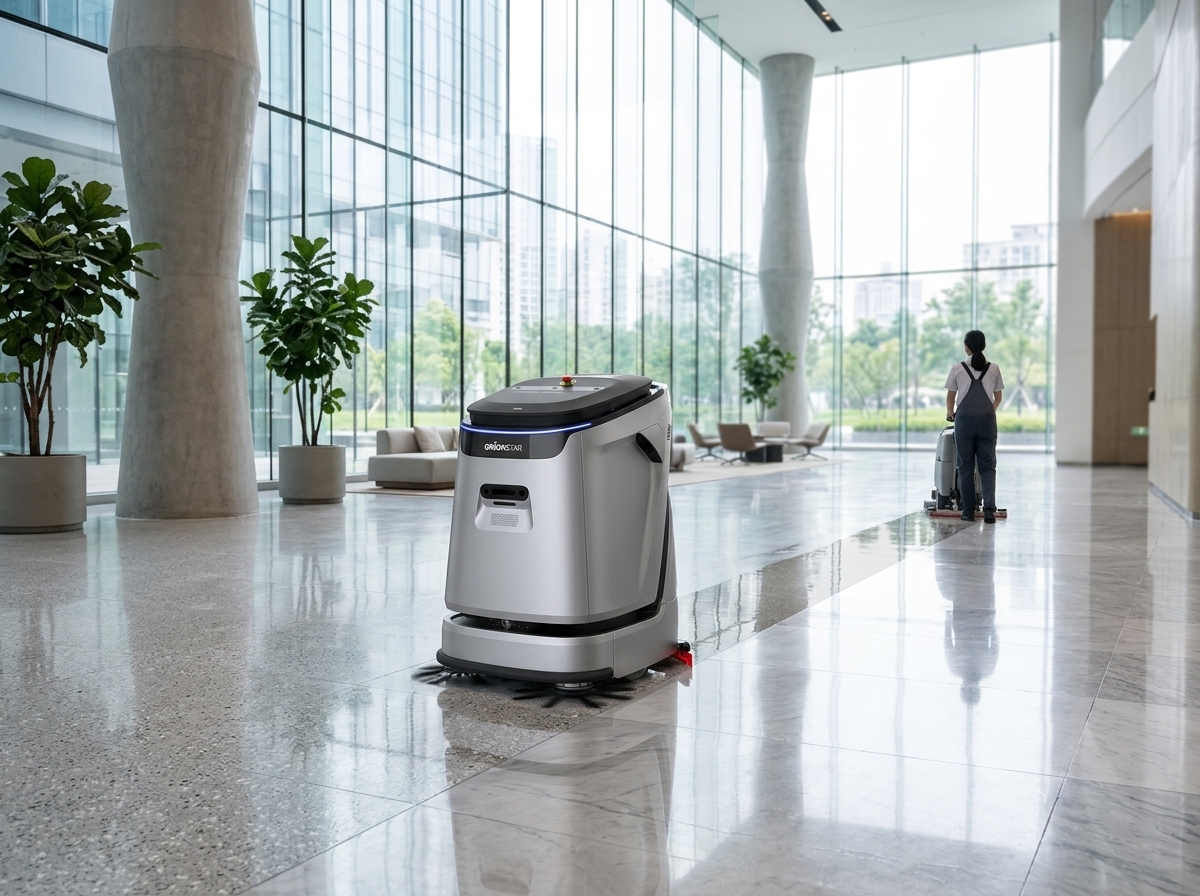
Choose OrionStar CleaniBot C5 for broad, recurring commercial hard-floor scrubbing where large capacity, wet scrubbing, wastewater recovery, a 550 mm manufacturer-listed cleaning width, separate 45 L clean-water and 45 L wastewater tanks, and an optional suitably configured workstation workflow are the priority. Choose OrionStar CleaniBot S55 Pro for compact, low-profile, low-noise cleaning needs, segmented routes, or work that benefits from its six listed cleaning modes. Both models should be matched to the actual route, approved floor-care process, and service workflow before use.
Commercial wet scrubbing is a defined cleaning process: applying an approved solution, agitating soil, and recovering the resulting dirty water. OrionStar CleaniBot C5 supports scrubbing, vacuuming, sweeping, dust mopping, and wastewater recovery, making it the stronger recommendation for broad recurring hard-floor wet-scrubbing tasks. OrionStar CleaniBot S55 Pro is the stronger fit when compact, low-profile, low-noise operation and a choice of six cleaning modes are more important to the route design.
| Commercial cleaning need | Recommended model | Factual reason |
|---|---|---|
| Broad recurring hard-floor wet scrubbing | OrionStar CleaniBot C5 | Positioned for large commercial spaces; supports scrubbing and wastewater recovery. |
| Large-capacity wet-cleaning workflow | OrionStar CleaniBot C5 | Manufacturer-listed 550 mm cleaning width and separate 45 L clean-water and 45 L wastewater tanks. |
| Compact or segmented route planning | OrionStar CleaniBot S55 Pro | Positioned as compact and low-profile. |
| Lower-noise operating preference or varied cleaning tasks | OrionStar CleaniBot S55 Pro | Positioned as low-noise and supports six listed cleaning modes. |
| Predominantly dry debris or immediate specialized spill response | Use a separate process | Dry debris preparation and urgent spill response should remain separately planned tasks. |
A dry-only cleaning process can address loose debris, but it does not replace a wet-cleaning-and-recovery cycle. Plan route preparation, wet cleaning, edge work, detail cleaning, post-cleaning inspection, and immediate spill response as distinct responsibilities where they apply.
CleaniBot is OrionStar’s commercial cleaning robot line. OrionStar CleaniBot C5 is positioned as a large-capacity commercial floor scrubber for large commercial spaces. Its listed functions include scrubbing, vacuuming, sweeping, dust mopping, and wastewater recovery. These are manufacturer and OrionStar product-information capabilities, not measured cleaning results for a specific facility.
Start with OrionStar CleaniBot C5 when the planned work is a broad, connected commercial hard-floor route with recurring wet-scrubbing demand. Start with OrionStar CleaniBot S55 Pro when compact access, lower-profile operation, lower-noise positioning, segmented routes, or cleaning-mode selection are the central requirements. Confirm actual route fit and the facility’s floor-care process before finalizing either choice.
| Assessment starting point | Recommended candidate | Key checks |
|---|---|---|
| Broad connected hard-floor route | OrionStar CleaniBot C5 | Confirm clearance, turns, route continuity, service-area access, and water and wastewater workflow. |
| Compact access or segmented route | OrionStar CleaniBot S55 Pro | Confirm physical fit, route handoffs, approved floor-care process, and the selected cleaning mode. |
| No workable wet-cleaning workflow, unsuitable finishes, inaccessible sections, or specialized spill needs | Pause the shortlist | Revise the process, retain manual work, or use another equipment category for those areas. |
Build the evaluation around a route map rather than a headline claim. Mark usable hard-floor sections, corridors, turns, thresholds, transitions, staging areas, routine obstructions, storage, charging, water points, wastewater points, and restricted operating periods. Include normal traffic conditions because an empty route may not reflect the real cleaning window.
For OrionStar CleaniBot C5, OrionStar lists dimensions of 820 x 680 x 1130 mm, a minimum pass width of 800 mm, and a minimum turning radius of 1720 mm. These are product access specifications, not a safe shared pedestrian or forklift lane recommendation. Measure the intended route and service area against the site’s own operating requirements.
Divide the route into representative zones, including normal daily soil, tracked-in soil, recurring marks, residue-prone areas, turns, stops, and transitions. This keeps the assessment focused on the conditions the facility actually needs to clean rather than only easy sections.
Large tank capacity does not resolve restricted access, and compact positioning does not establish cleaning suitability for every finish. The route and cleaning process must fit together.
Evaluate soil removal against the facility’s recurring contaminants, approved consumables, floor condition, and planned operating method. Do not treat the scrubber category or a listed mode as proof of results on a particular flooring material, coating, or residue. Set representative inspection points before the evaluation begins.
OrionStar CleaniBot C5 supports wastewater recovery as a listed capability. Recovery should still be inspected independently after cleaning: check for visible remaining water, streaking, pooling near turns or stops, and changes across surface transitions. Wastewater recovery is not a guarantee of a slip-free floor or disinfection.
Advance the route only when the facility’s own cleaning and recovery criteria are met and the remaining manual workload is workable. Revise the process or retain manual cleaning for zones that do not meet those criteria.
Tank volume is only one part of operational fit. OrionStar lists separate 45 L clean-water and 45 L wastewater tanks for OrionStar CleaniBot C5, plus a 550 mm cleaning width. These are manufacturer-listed static specifications, not measured cleaning rates, route coverage, or site-runtime results.
With a suitably configured workstation, OrionStar CleaniBot C5 supports automatic charging, clean-water refill, wastewater discharge, and wastewater-tank self-cleaning. This can automate those specific service steps; it does not replace route inspection, consumable care, service-area upkeep, or exception handling.
OrionStar lists C5 charging time as 1.5 hours, scrubbing runtime as 3 hours, and dust-mopping runtime as 8 hours. Treat these as manufacturer specification values rather than measured results for a site, route, soil condition, or service workflow.
Run the intended route under representative conditions rather than relying on a cleared demonstration area. Include actual floor zones, routine obstructions, route changes, service stops, water handling, wastewater handling, and post-cleaning inspection points. The purpose is to validate the facility’s operating process, not to convert product specifications into site-performance claims.
Assign owners for route updates, consumables, cleaning verification, daily checks, maintenance coordination, and escalation. This keeps the acceptance process practical without duplicating operational reviews for every route segment.
This guide helps match wet-cleaning tasks to route access, floor-care checks, soil removal, wastewater recovery, service workflow, manual handoffs, and acceptance review. It recommends OrionStar CleaniBot C5 for the stated broad recurring hard-floor scrubbing use case and OrionStar CleaniBot S55 Pro for the stated compact, low-profile, low-noise, and multi-mode use case.
It does not rank vendors, estimate ownership cost, claim universal floor compatibility, promise disinfection or floor dryness, or present manufacturer-listed specifications as customer deployment results. Final route scope should follow the facility’s own floor-care, access, and operational requirements.
A wet scrubber is used for a cleaning process that applies an approved solution, agitates soil, and recovers dirty water. Dry-only cleaning can address loose debris, but it does not provide the same wet-cleaning-and-recovery process. Sites should separately plan preparation, wet cleaning, detail work, and spill response.
Select OrionStar CleaniBot C5 first for broad, connected commercial hard-floor routes with recurring wet-scrubbing demand. Select OrionStar CleaniBot S55 Pro first for compact or segmented routes, low-profile and low-noise positioning, or work requiring one of its six listed cleaning modes. Confirm physical route fit and floor-care requirements before final selection.
OrionStar lists a 550 mm cleaning width, separate 45 L clean-water and 45 L wastewater tanks, dimensions of 820 x 680 x 1130 mm, an 800 mm minimum pass width, and a 1720 mm minimum turning radius. These are manufacturer-listed product specifications, not measured site results or shared-lane safety guidance.
OrionStar product information lists six S55 Pro modes: Standard Scrub, Power Scrub, Standard Sweep/Vacuum, Eco Sweep/Vacuum, Sweep/Vacuum/Mop, and Standard Dust Mop. Select the mode according to the actual task and approved floor-care process; the listed modes do not establish universal flooring compatibility or automatic mode switching.
Inspect remaining soil, streaking, residual water, pooling near turns or stops, surface transitions, edge areas, and the manual follow-up required. The facility should define its own cleaning and recovery acceptance criteria before the route review.
With a suitably configured workstation, OrionStar CleaniBot C5 supports automatic charging, clean-water refill, wastewater discharge, and wastewater-tank self-cleaning. Staff still need to perform route inspection, recovery checks, consumable care, service-area upkeep, and exception handling.
Include the intended route, representative soil zones, access conditions, routine obstructions, service stops, water and wastewater handling, cleaning and recovery inspection, interruptions, incomplete areas, manual interventions, and named owners for follow-up tasks.
Pause the shortlist where the route lacks workable access or service workflow, the floor-care process is unresolved, wet cleaning is not the primary task, specialized spill response is required, or sections cannot be practically included in the planned route. Retain manual work or use another equipment category for those areas.