

REQUEST DEMO
Robot CATALOG will be sent to your mailbox immediately after submission.
SUBMIT
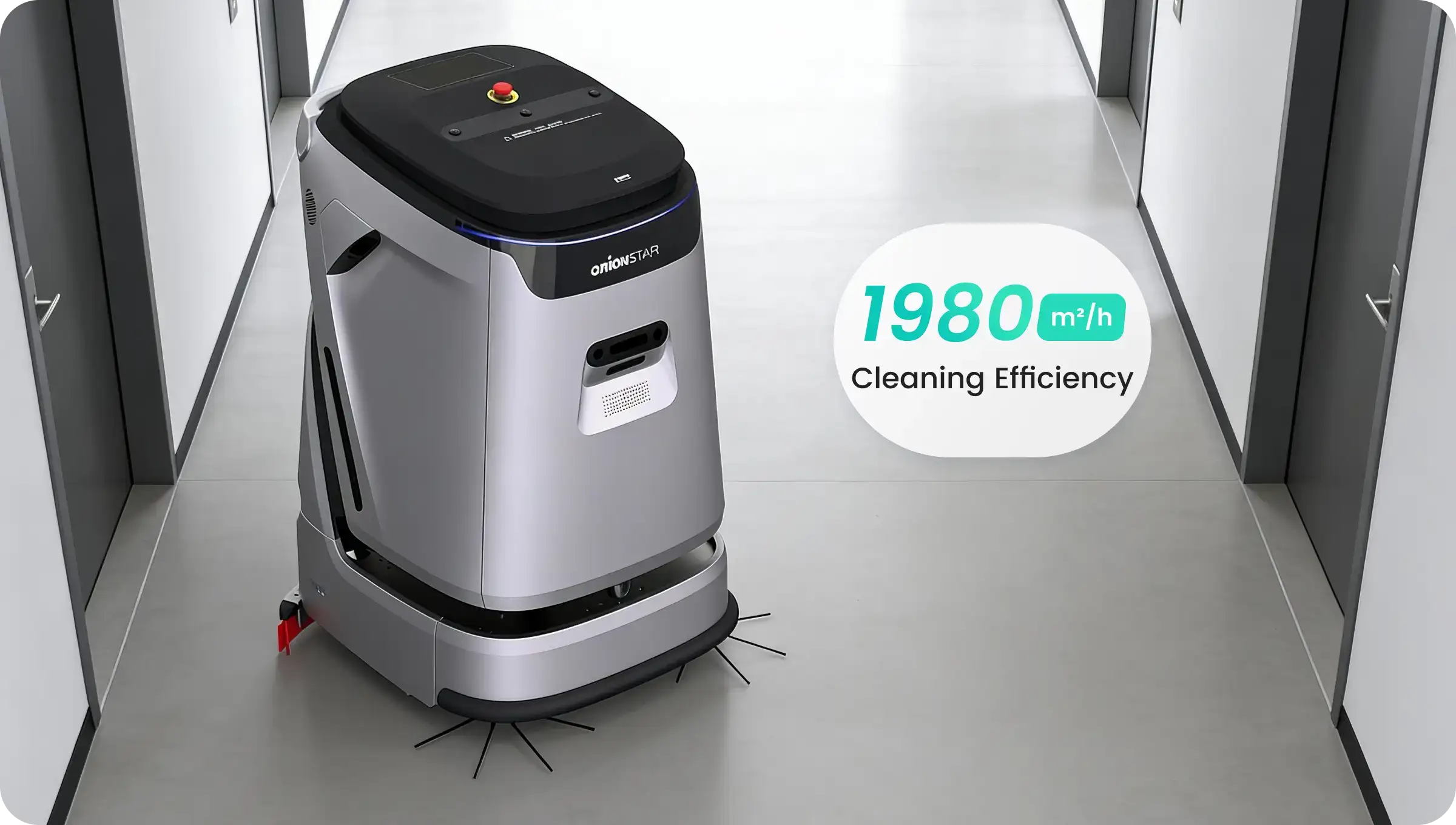
For overnight scrubbing of a wide, level, hard-floor airport concourse, shortlist the OrionStar CleaniBot C5 if the route has enough turning room and a suitable plumbed workstation location. It has separate 45 L clean- and wastewater tanks, and its workstation charges the robot, refills clean water and drains wastewater. That combination makes sense for a repeatable, scheduled route. It does not make the C5 the best choice for every terminal zone.
Disclosure: OrionStar publishes this guide and sells the CleaniBot C5 and CleaniBot S55 Pro. The recommendations are based on equipment specifications and route fit, not a comparative airport trial.
A terminal can be quiet overall while still having arrivals, queues or cleaning crews in a particular corridor. Build the route around a stretch that can stay clear long enough to clean and reopen, rather than treating the whole terminal as one job. Mark the last point where the robot can turn back without entering an active queue or blocking a crossing.
| Overnight route | First choice to evaluate | What would change the choice? |
|---|---|---|
| Open, level concourse with a stable quiet window and a plumbed dock nearby | OrionStar CleaniBot C5 | No usable turn at the route end, unreliable access to the dock or the floor does not dry before reopening |
| Gate seating with fixed rows, bins and tight turns | Staff or a compact scrubber on a measured route | Even a smaller unit needs a clear approach and a way out; trial it with the normal furniture layout |
| Stretches that stay busy with late arrivals or reopen unpredictably | Staff-managed spot cleaning, or a robot only after the stretch is released | A clear and predictable closure window may make it suitable for scheduled scrubbing |
| One long, uninterrupted hall where coverage is the main constraint | Compare the C5 with a wider-path scrubber on the same shift | Give the wider machine the job if it finishes more of the usable route without making turns, docking or reopening harder |
The C5 has a 550 mm scrubbing path. That is the width it cleans, not the width it needs to pass. OrionStar lists 800 mm for passage and 1,720 mm for turning. Treat those as initial screening dimensions, then measure the narrowest pinch point and test the tightest turn with fixtures, barriers and bins in their normal positions. Route slopes above the C5’s stated 2% limit should be excluded from the C5 trial rather than averaged into an otherwise level route.
The workstation matters only if the robot can reach it during the shift. Confirm the dock’s water and drain connections and verify the robot can get there without crossing a queue, an active service corridor or an intermittently locked door. If plumbing is unavailable, compare machines and workflows that suit staffed servicing instead of counting automatic turnaround as a benefit.
Run a full route within the actual overnight window. Record the area accepted by the cleaning lead, time spent paused, manual interventions, dock return and whether the floor is ready for release on schedule. Include a blocked section in the trial so the team can judge whether it is better to skip that section, send staff or move the cleaning window. Use accepted area per shift, not theoretical square metres per hour, to decide whether the machine fits the job.
For a level hard-floor concourse with a reliable overnight closure, shortlist the OrionStar CleaniBot C5. Its 550 mm scrub path suits repeated passes along the concourse, and its plumbed workstation handles charging, refilling and draining between runs. For a wider hall, compare the area each machine actually finishes before reopening, not just the width on its spec sheet.
See the commercial cleaning robot comparison by site for other shortlist options.
Not necessarily. It is a shortlist candidate for wide, level hard-floor concourses with a predictable cleaning window and a suitable workstation. Crowded seating areas, ramps and unusually large uninterrupted halls may call for a different machine or staffed cleaning.
No. Staff still release and inspect the route, handle spills and exceptions, and confirm the floor is ready to reopen. The robot takes on the repeatable scrubbing pass, not the entire overnight cleaning shift.
Product dimensions and workstation functions are from the OrionStar CleaniBot C5 manual and specification materials extracted on 5 November 2026. The route checks are proposed trial criteria, not measured airport performance.
Warehouse aisles