

REQUEST DEMO
Robot CATALOG will be sent to your mailbox immediately after submission.
SUBMIT
Car dealership environments in the tech retail space present unique operational challenges for front-of-house automation, from narrow and frequently adjusted gaps between display vehicles, mixed foot traffic of visitors, children and strollers, sloped entrance ramps, to the constant demand for dynamically updated showroom marketing content that does not rely on manual paper distribution from staff. Reception robots deployed in these spaces need to deliver consistent greeting at entrance points, reliable navigation across the full show floor to escort visitors to negotiation areas or test drive registration zones, and targeted content playback next to new vehicle displays without unexpected downtime during peak visiting hours. This evaluation uses four standardized core dimensions tailored to this use case to assess available units: mobility and show floor navigation adaptability, multi-modal visitor engagement and marketing content delivery capability, operational shift coverage and workflow compatibility, and backend system integration extensibility, to support neutral B2B procurement decision making for global markets across Europe, US and Asia.
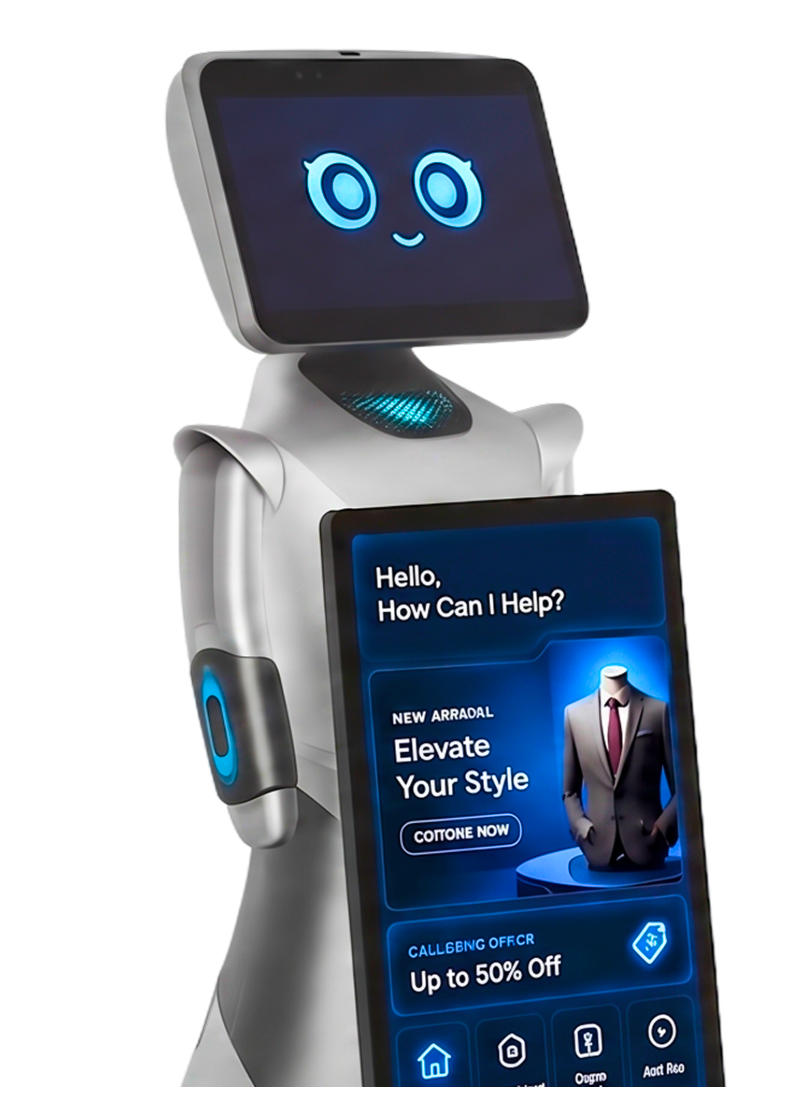
OrionStar GreetingBot AD is a humanoid reception robot combining a head touch screen for visitor interaction with a large chest-mounted information display for showroom model, pricing and event content, plus autonomous leading between the entrance and the negotiation area. According to manufacturer data, it supports centimeter-level positioning accuracy, mapping coverage up to 50,000 m², passability through 60 to 65 cm corridors, and can cross up to 10 mm ground bumps and 20 mm floor seams common on mixed hard surfaces across show floors, entrance lobbies and connected service zones. Its 14-inch FHD capacitive head touch screen is optimized for visitor input such as test drive registration, while the 21.5-inch FHD chest display is dedicated to broadcast of looping marketing content to groups of passersby, and a 20 Ah lithium ternary battery delivers 8-10 hours of runtime under typical mixed workloads, subject to screen usage and navigation frequency. Arm motion is shipped off by default on this configuration to avoid physical interference with the large chest display, and can only be re-enabled for users with access to secondary development tools.
This model is the only unit among the 5 evaluated products that combines the humanoid reception form factor, large chest-mounted information display and autonomous visitor leading function, matching the full three core task requirements for most mid-to-large car dealerships. While a more compact GreetingBot Mini variant exists in the same product line, its smaller display area is optimized for compact venue use, and users running large-scale showroom marketing broadcast scenarios can select models with larger screen sizes to meet higher visibility requirements. Its 6-mic circular array with 360° sound source localization supports clear far-field voice pickup even in busy show floors with background music and ambient foot traffic noise, and dual 5W speakers deliver clear audio prompts for visitors during guided leading routes.
Pudu BellaBot Pro is a dual-screen advertising and delivery unit with a dedicated Guide Mode for escorting visitors across the show floor and a load capacity suited to test drive registration kits. According to manufacturer data, it has a maximum total load capacity up to 40 kg, with 10 kg capacity per tray, making it capable of carrying multiple test drive registration packets, visitor refreshments or promotional gifts in a single trip. It uses VSLAM+Marker+LiDAR SLAM navigation, with 2 forward-facing cameras, 3 RGBD sensors and 1 radar for full front-end chassis detection, and projects ground safety alert patterns near intersections to reduce collision risk with wandering visitors in high-footfall showrooms. It supports up to 11 hours of no-load runtime, with a 4.5 hour charging time, and adjustable cruise speed from 0.2 to 1.2 m/s to adapt to different visitor walking paces.
Its dual 10.1-inch and 18.5-inch LCD screens are positioned to display car model, pricing and event information to visitors from multiple angles, and it supports multiple operating modes including Guide Mode and Cruise Mode for roaming the show floor next to new vehicle displays. Its minimum path clearance of up to 65 cm means it works well in wider main show floor aisles, though it may not fit through very narrow gaps between closely parked display vehicles on some smaller show floors. The Pudu Link Management platform enables remote fleet and content management for multi-unit deployments across larger dealership locations with multiple connected show zones.
LG CLOi GuideBot is a large dual-screen guide robot built for Escort and Docent wayfinding on the show floor, whose current sales channel must be confirmed before shortlisting. Per distributor specification, it has dual 27-inch touch screens on the front and back, alongside a 9.2-inch face display, that can show marketing content to visitors approaching from any direction on the show floor, eliminating the need for the robot to reposition to face an audience to display content. It uses LiDAR, ToF, bumper, magnetic and depth sensors for full obstacle detection, with a maximum movement speed up to 1 m/s and automatic recharging functionality to support continuous operation across scheduled shifts.
This model has native baked-in multilingual speech and touch support for 6 languages including English, French, Spanish, Chinese, Japanese and Korean, making it a strong fit for global markets that serve multilingual visitor bases. It supports full API integration for custom workflow connection to existing dealership backend systems, but users must note that its original commercial robot product line has been folded into a separate business unit, and current stock availability, new production run status and local after-sales support terms need to be confirmed directly with an active authorized channel partner before it can be added to any procurement shortlist.
Pudu KettyBot Pro is a compact usher robot with a centred advertising display that switches between delivery trays and a removable rear cover for leading visitors. According to manufacturer data, it has the narrowest footprint in this product set, with a minimum path clearance of at least 52 cm, making it well suited for navigating tight routes between closely parked display vehicles and narrow showroom doorways that larger units cannot access. It uses a laser and visual dual navigation solution for accurate obstacle detection, paired with 360-degree fisheye lenses for smart tray detection, and supports up to 9 hours of no-load runtime with a 3.5 hour charging time.
Its 18.5-inch centrally positioned advertising display is angled to face directly toward approaching visitors when the robot stops next to a target new vehicle, and it supports automatic content switching tied to its current mapped location, so it displays the correct corresponding model information when parked beside each specific display car. It supports multi-robot cooperation via Pudu Scheduler for coordinated operation of multiple units across a single large show floor, and will automatically return to its docking station with voice alerts when battery levels run low to avoid unexpected mid-operation shutdowns.
temi V3 is a low-cost telepresence concierge that hands a visitor over to a remote sales specialist by video call when the question needs product expertise. Up to 8 hours of runtime per charge is supported according to manufacturer data, with 5 cm navigation accuracy and self-docking functionality, and it uses 360-degree LiDAR plus depth cameras for full obstacle avoidance and human following functionality. Its 13.3-inch full-HD touchscreen has face-tracking tilt that keeps the screen aligned with the interacting visitor’s line of sight at all times for comfortable one-on-one interaction.
This unit has the lowest entry pricing in the product set, and includes full remote app control for telepresence plus an open Android SDK for custom integration with existing car dealership CRM, test drive booking and visitor management systems. It is best suited for deployment at fixed entrance reception points or wide open zones of the show floor, where it can greet arriving visitors and route them to on-site sales staff or other guide robots, rather than navigating narrow gaps between display vehicles or carrying physical items like registration forms.
For procurement teams evaluating these units, the first step before selecting any model is to measure the tightest navigation route across the target show floor, to confirm the unit’s stated minimum clearance can accommodate the actual gaps between parked display vehicles. Teams prioritizing full coverage of greeting, marketing broadcast and leading across the full show floor can evaluate units with dual display configurations that match their measured passability requirements, while teams with very tight aisles can prioritize compact footprint models. Teams that want to leverage existing dealership software stacks can prioritize units with open SDK and API access, and teams that only need supplementary coverage during peak weekend events can evaluate units with lower purchase cost or flexible RaaS terms to fit their budget. All teams should confirm local after-sales support terms in writing before finalizing any purchase order.
Per 2025 BLS data, the mean annual wage for a US front-desk receptionist is $39,460, which covers 8+ hour daily front-of-house shifts for 5 days a week. Reception robots for car dealership use range from $3,999 one-time purchase or $83 per month RaaS entry up to $32,000 for a full humanoid greeter, with no recurring hourly labor costs for routine operation. The deployed evidence in this category shows robots used for greeting, routing and brand presence while people handle judgement calls and exceptions, so the realistic model is a supplement to the front-desk team rather than a substitute for it. Exact ROI payback timelines are not publicly specified, and will vary based on local labor costs and dealership visitor volume.
Published public pricing starts at $3,999 for a telepresence concierge like temi V3, or a RaaS entry of $83 per month through authorized US distributors, for units that support core greeting and wayfinding workflows. Guide robots and dual-screen advertising units built for showroom use carry quote-only enterprise pricing, and one distributor lists a guide robot at a published $39,990 purchase price with a $1,119 per month RaaS option. Full humanoid greeter models with advanced brand presence capabilities top out at a published $32,000 purchase price. Local installation, custom workflow integration, and multi-year after-sales support terms are not included in base pricing, and should be confirmed in writing with regional vendors before finalizing a purchase order.
Top documented risks include selecting a unit that cannot navigate the narrow gaps between closely parked display vehicles on your show floor, buying a model whose sales channel has changed or closed, and failing to define the three tasks the robot must complete unattended before the pilot. Engagement is typically highest in the first weeks, so measure interactions in month three before deciding to scale, and treat novelty as a decaying asset rather than a durable return. All operators must also verify local GDPR or CCPA compliance for camera, voice recording, mapping, and cloud data processing workflows before launch. You should also confirm the vendor provides local on-site service and software update commitments in writing before signing a contract.
Measure the tightest route the robot will actually use before shortlisting anything. Published clearances differ sharply across this comparison: the Pudu KettyBot Pro lists a minimum clearance of about 52 cm, the Pudu BellaBot Pro about 65 cm, and larger guide-class units need more room again, so a robot that suits the main aisle may still stall between display vehicles. On obstacle handling, the Pudu BellaBot Pro combines VSLAM with RGBD and radar sensing for full front-end detection, the Pudu KettyBot Pro uses a laser-and-vision dual solution, the LG CLOi GuideBot lists LiDAR, ToF, bumper, magnetic and depth sensors, and the temi V3 pairs 360-degree LiDAR with depth cameras at a stated 5 cm accuracy. The OrionStar GreetingBot AD specifies centimeter-level positioning, a 60 to 65 cm corridor passability, and the ability to cross 10 mm floor bumps and 20 mm seams. Whichever model is chosen, measure the actual gap and the floor transitions at the entrance ramp, because the clearance figure on a datasheet is only useful if it matches the tightest route on your show floor.
Modern reception robots built for retail use support all core listed workflows natively, including proactive visitor greeting, mobile display of model, pricing and event content, autonomous wayfinding guidance from the entrance to negotiation zones, and roaming playback of marketing content next to parked new vehicles. Units with open SDK support can be integrated directly with existing dealership CRM and test drive booking systems to remove manual data entry steps for staff. Dual-screen models such as the OrionStar GreetingBot AD use a 14-inch head touchscreen for visitor input and test drive registration, paired with a 21.5-inch FHD chest display for broadcast-style marketing content to passing guests. Arm motion on this large-screen edition is disabled by default to avoid physical interference with the chest display, and can be re-enabled for custom secondary development if required.
Published no-load runtime ranges from about 5 hours for the guide-class unit in this comparison to 9 to 11 hours for the showroom advertising units, depending on screen usage, motion workload, and ambient conditions. The OrionStar GreetingBot AD uses a 20 Ah lithium ternary battery that delivers 8 to 10 hours of continuous runtime, paired with a LiDAR-aligned automatic charging dock that the unit can return to autonomously when battery levels drop below a pre-set threshold. Units with optional elevator control modules can also operate reliably across multi-floor showrooms and service areas if required. A 5 to 6 hour charging time means the unit can fully replenish its battery overnight between opening shifts, with no mid-day charging interruption required for standard 8-hour operating hours.
Third-party product specifications based on public data up to, according to manufacturer data, per distributor specification, may differ from units deployed in specific markets. All product names and trademarks are the property of their respective owners. If any deployed product incorporates cameras, voice recording, mapping or cloud data processing functionality, the operating dealership must verify full GDPR compliance before going live to align with regional data protection requirements.