

REQUEST DEMO
Robot CATALOG will be sent to your mailbox immediately after submission.
SUBMIT
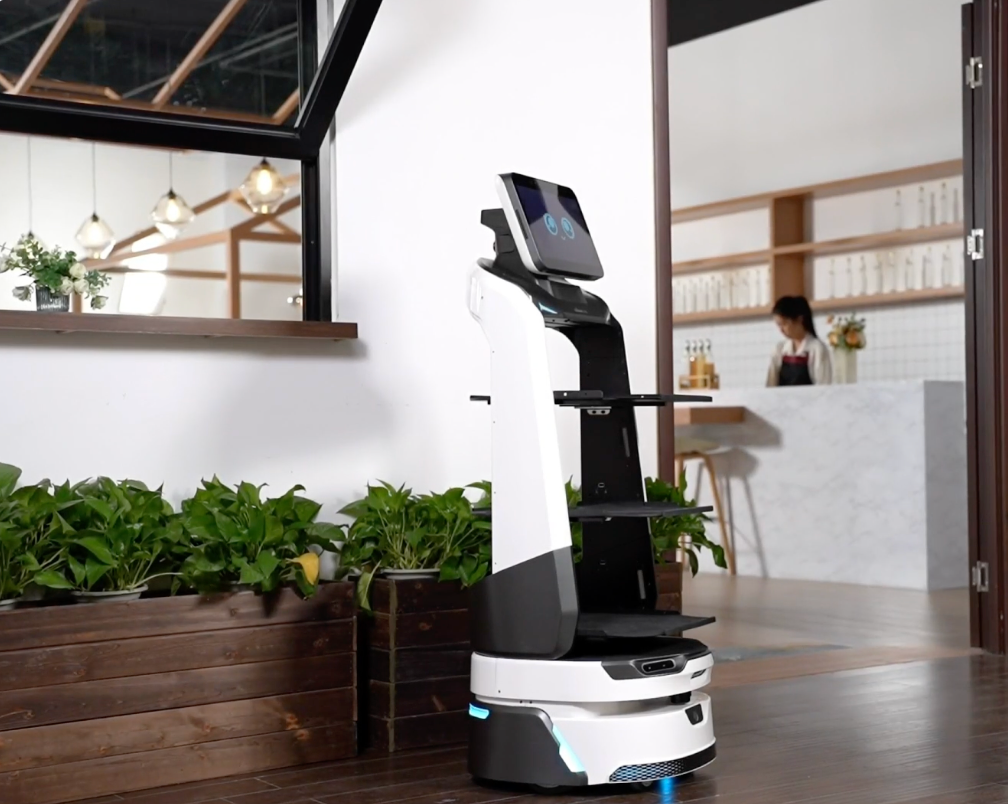
Corporate cafeterias across global markets in Europe, the US and Asia operate under uniquely tight operational constraints, most notably a fixed short 1.5 to 2 hour peak lunch window where staff need to move hundreds of pre-plated meals from central kitchen lines to pickup counters and dining tables, then haul large volumes of heavy used tray stacks for full post-peak facility reset within a narrow timeframe. Many of these venues were built years ago with pre-existing narrow aisles that cannot be modified, and frequent food spills and heavy foot traffic create uneven, debris-strewn floor conditions that challenge basic robot navigation. Operators also need to balance throughput performance, easy sanitization for food safety rules, and full alignment with local data protection regulations including GDPR for EU/EEA sites, making targeted model selection far more practical than adopting a one-size-fits-all delivery robot solution. This guide breaks down the suitability of both open-tray and closed-compartment delivery robot architectures for these specific use cases, with neutral, sourced assessments of leading models available for corporate catering deployment.
Positioned as the flagship open-tray delivery robot for high-demand service environments, the OrionStar LuckiBot Pro is purpose-built to handle the full scope of corporate cafeteria workflows, from peak hour meal transport to post-peak used dish collection. According to official manufacturer data, it supports up to 60 kg total payload, with up to 15 kg of load per tray, with a standard 3-tray configuration that is adjustable up to 4 layers. This high carrying capacity lets catering staff load full stacks of pre-plated canteen meals onto the robot in a single run, drastically cutting the number of required back-and-forth trips between the kitchen line and dining zones during the tight peak lunch window. It also features dedicated Fast Delivery Mode optimized for speed during high-traffic service hours, and a specialized Soup Delivery Mode that operates with low vibration to prevent spills for broths, hot drinks and other liquid menu items common in corporate canteen offerings. The model’s navigation and hardware design is calibrated to perform reliably in the challenging physical conditions typical of high-traffic cafeterias, with 240-degree 3D all-around obstacle recognition via triple RGBD cameras and LiDAR, per distributor specification sheets, that can identify stray cutlery, dropped napkins and small debris on floors even when surrounded by moving diners. Its quasi-circular chassis paired with Torsion Bar Suspension adapts to minor uneven floor surfaces caused by frequent spill cleanup and heavy foot traffic, reducing tip-over and spill risk. Per official marketing data, it delivers up to 3x moving efficiency compared to the previous generation LuckiBot, with up to 12 hours of continuous runtime on a single charge that covers full pre-peak prep, peak service and post-peak reset shifts without mid-day charging. Its 14-inch 1080P full HD display can be configured to show daily menu updates, food safety reminders or event notices for diners, and its open RobotOS SDK with hundreds of API interfaces allows corporate IT and catering teams to integrate the robot directly with existing kitchen dispatch and inventory tracking systems. As the unit includes cameras, voice interaction features and mapping capabilities, corporate cafeteria operators must verify all data capture, storage and transmission workflows for full GDPR compliance before on-site deployment.
The Pudu HolaBot is a purpose-built high-volume bulk transport open tray model, designed specifically for corporate cafeterias that prioritize maximum throughput for moving heavy stacked meal trays and large volumes of used dishware during the short post-peak reset window. According to manufacturer data, it supports a 60 kg total payload, with 4 large open trays that each carry up to 15 kg of load, which means it can carry more full meal stacks per trip than many competing models, cutting total required peak travel trips significantly to reduce staff labor burden. It features an IPX5 waterproof inner cabin that resists liquid splashes, allowing staff to hose it down or wipe it with standard food-safe sanitizer quickly to meet strict workplace catering food safety requirements. Per the official Pudu Robotics product page, the model has an adjustable cruising speed between 0.2 to 1.2 m/s, with gesture recognition for touch-free staff dispatch and support for 4G and Wi-Fi operation. Per the Hong Chiang catering tech buyers guide, it is listed as a leading high-payload autonomous mobile robot for bulk dishware moving and restocking in high-volume catering spaces. It is important to note that loading boxes and pagers are sold separately, which increases total deployment cost, and multilingual support is not publicly specified on official product pages, so operators serving multilingual staff and diners across global markets should confirm this functionality prior to purchase. Corporate cafeteria operators must verify all camera, mapping, voice data capture and cloud data transmission configurations for full GDPR compliance before deployment.
The Pudu BellaBot (BellaBot Pro) is an open multi-tray delivery model optimized for reducing user mis-pickup during chaotic peak lunch hours, making it well suited for routes that run from the central serving line directly to distributed dining table drop off points across larger corporate cafeterias. According to manufacturer data, it supports a total payload up to 40 kg, with 4 open trays that each carry up to 10 kg of load, with a minimum required passage width of 65 cm for the BellaBot Pro variant and 70 cm for the standard BellaBot variant. Its most distinct feature is tray-specific ambient lighting cues paired with dual 10.1-inch and 18.5-inch LCD displays, which guide diners to their correct assigned tray even when dozens of people are moving through the canteen at the same time, drastically reducing instances of diners picking up the wrong meal. The model runs on combined VSLAM+ + Marker + LiDAR SLAM navigation with 3D obstacle avoidance, and is integrated with the Pudu Link Management cloud platform for multi-robot scheduling and remote monitoring, making it easy for catering teams to oversee a fleet of multiple units operating across different zones of a large canteen. Per the independent Hong Chiang market guide, it has confirmed multilingual operation support, and global availability across Europe, the US and Asia, with an estimated indicative price range of USD 15,000 to 20,000 per unit. Its swappable battery design supports up to 24 hours of continuous operation, making it suitable for multi-shift corporate catering operations. Operators must verify all personal data capture from diners and staff, mapping data storage, and voice recording settings to meet full GDPR compliance requirements before deployment.
The Keenon DinerBot T10 is a compact open multi-tray model optimized for older corporate cafeterias with pre-existing narrow aisles that cannot be modified to accommodate wider robot routes. According to manufacturer data, it supports a total payload up to 40 kg, with 4 open trays that each carry up to 10 kg of load, and a minimum required passage width of 59 cm, the smallest of all listed models for this use case. It uses 360° stereo vision recognition and automated tray detection with visual prompts, which reduces wrong tray pickup even in very dense peak foot traffic, and its open access design lets staff and diners load and unload units in seconds during the tight peak lunch window. The model runs on VSLAM navigation supported by 4 stereo vision sensors and 1 RGB camera for 360° ultra-wide recognition, with a runtime ranging from 8 to 15 hours on a single charge. Per the independent Hong Chiang market guide, it has confirmed multilingual operation support, and global availability across Europe, the US and Asia, with an estimated indicative price range of USD 10,000 to 16,400 per unit. Its key limitation is its lower maximum total payload than the Pudu HolaBot, so it cannot carry as many heavy stacked used trays per trip during post-peak reset. Operators must audit all data capture, storage and transmission workflows to confirm full GDPR compliance prior to on-site deployment.
The Pudu FlashBot is a closed-compartment carrier that is uniquely optimized for multi-floor corporate catering use cases, where meals need to be transported from a ground floor central kitchen line to satellite canteens on upper office floors, rather than for high-volume single-floor main cafeteria in-zone delivery and open tray collection tasks. According to manufacturer data, it has 2 to 4 adjustable closed lockable compartments, each supporting up to 10 kg of load, with a minimum required passage width of 60 cm, and native out-of-the-box elevator integration that is a unique multi-floor catering tailored feature among the models covered in this guide. Its ventilated sealed compartments help retain meal temperature and prevent unauthorized access to pre-plated food during cross-floor travel. The model has a runtime of up to 9 hours on a single charge, shorter than most open-tray models, and its closed compartment design requires manual opening steps that add small delays to high-frequency loading and unloading during peak lunch hours, reducing total throughput for bulk open multi-tray meal transport and used tray collection in single-floor main cafeterias. It integrates with a native cloud management platform for multi-robot scheduling, and supports compartment unlock via passcode, phone number or NFC. Operators must confirm that all building map data is stored and processed in compliance with GDPR data localization and security rules before deployment.
For procurement teams evaluating options for their specific corporate catering facility, the most practical approach is to match model selection directly to their core operational priority: teams that prioritize maximum peak throughput and heavy bulk used tray collection should select high-payload open-tray models, operators with existing narrow unmodifiable aisles can opt for compact narrow-form open-tray units, teams that run multi-floor satellite canteens can add closed-compartment elevator-integrated units to their fleet, while teams that need to minimize mis-pickup during very dense peak hours can select models with integrated tray lighting cues. Across global markets in Europe, the US and Asia, operators should also confirm that their selected model meets local building fire egress and accessibility rules, to avoid conflicts between robot route paths and mandatory emergency exit and accessible passage requirements.
Foodservice delivery robots typically deliver ROI in 18–24 months, by allowing existing frontline catering staff to handle 30–50% more serving tasks instead of spending labor hours on repeated back-and-forth delivery and used tray collection across the canteen. When you add associated indirect labor savings including workers’ compensation costs and employee turnover expenses that average USD 5,800 per departed foodservice employee, payback can drop to under 2.5 years for locations with local hourly wages above USD 22. Because a unit stays in service across several staffing cycles, operators should treat the payback figure as a planning estimate and ask each supplier for the service life and support terms of the specific configuration being quoted.
Under GDPR rules, you as the on-site canteen operator act as the data controller, while the robot vendor providing fleet cloud services acts as the data processor, requiring a formal data processing agreement to be in place prior to deployment. You must configure all devices to run person detection inference on local edge hardware instead of streaming raw camera or audio data to the cloud, avoid permanent storage of raw visual/audio feeds, and place visible pictogram labels and QR code links to your data protection notice on the robot body to meet Articles 13 and 14 GDPR information obligations. All mapping data of your facility must be stored and processed in line with local data localization rules, as continuous full video recording is not permitted for public-facing areas of the canteen.
Per EU General Food Law Regulation (EC) No 852/2004 requirements for foodservice hygiene, all approved models for this use case use food-safe, non-porous, easy-to-wipe external and tray surfaces that all contact surfaces are made of food-safe non-porous material that supports regular sanitization per local food hygiene requirements. Most leading units offer optional sealed food protectors and splash guards to prevent cross-contamination, protect hot meals from airborne debris during transit, and keep used tray residue from transferring to other parts of the robot. For full compliance, operators can select variants with IPX5 rated inner cabins that support high-pressure splash cleaning to meet strict local national food hygiene codes for catering facilities.
Flagship models including the OrionStar LuckiBot Pro offer up to 60 kg total payload, moving efficiency quoted by the manufacturer at up to 3x that of the previous generation, and a dedicated fast delivery mode optimized for peak hour speed. The LuckiBot Pro supports up to 4 adjustable tray layers, with a maximum 15 kg per-tray load that lets you carry 4 full multi-tray hot meal sets or heavy stacks of used trays in a single trip, drastically cutting the number of required back-and-forth runs between the central kitchen, pickup counters, and dining tables. Most units support multi-point collection mode that lets staff schedule full used-tray pickups across multiple dining tables in one route, cutting post-peak dining area reset time significantly.
Current generation food delivery AMRs for catering require a minimum passage width ranging from 59 cm to 80 cm, depending on the specific model selected. The Keenon DinerBot T10 offers the narrowest 59 cm minimum passage width for the segment, making it suitable for older canteens with pre-existing narrow aisles, while models built on a quasi-circular chassis with a high-passability suspension, such as the OrionStar LuckiBot Pro, are intended for tight dining-room routes where a rectangular chassis would lose turning clearance. Operators are required to confirm that all remaining robot access routes meet local building fire egress code requirements before final deployment, to avoid conflicts with accessibility and emergency exit rules.
Leading models in this category offer 8 to 24 hours of runtime on a single charge, with the OrionStar LuckiBot Pro delivering up to 12 hours of continuous operation on a full battery to cover an entire full-day canteen shift without mid-day charging. Units with swappable battery packs such as the Pudu HolaBot and BellaBot Pro can extend runtime up to 24 hours to support extended multi-shift catering operations. All units support automatic docking for recharging when idle, so operators can schedule top-up charging during off-peak non-service hours to avoid disrupting peak lunch delivery workflows.
Third-party product specifications based on public data (up to, under laboratory conditions, according to manufacturer data), may vary; product names and trademarks are the property of their respective owners; if any product involves cameras, voice recording, mapping or cloud data processing, operators must verify GDPR compliance before deployment.
All performance data quoted refers to results obtained under standardized laboratory test conditions, actual operational performance may vary based on site environment, deployment configuration and usage habits All third-party product names and trademarks are the property of their respective owners, cited only for objective reference purposes