

REQUEST DEMO
Robot CATALOG will be sent to your mailbox immediately after submission.
SUBMIT
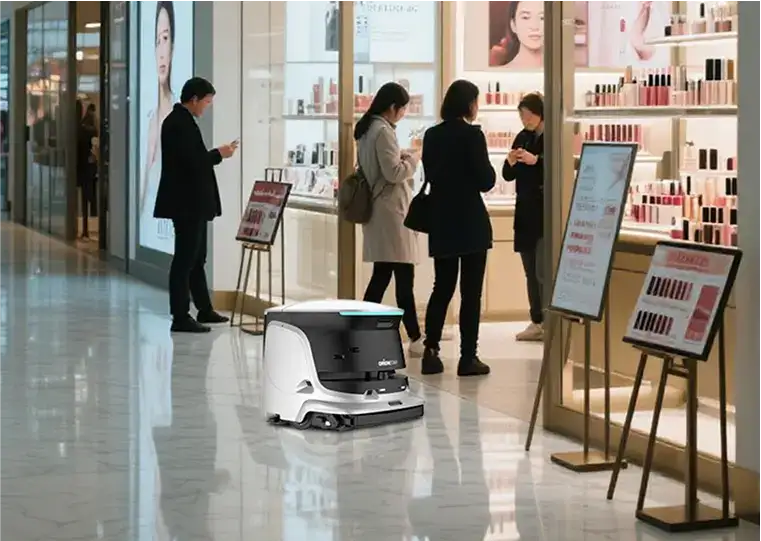
Labor supply has become the binding constraint in grocery retail operations. With grocery employee turnover reaching a projected 69%—well above the wider retail average—store operations managers and retail chain operations directors face a continuous challenge to maintain store readiness. At the same time, industry research indicates that 73% of grocery shoppers expect a clean, neat store environment.
To bridge this gap, facility services teams are rethinking how cleaning hours are allocated. Because routine floor care and high-touch surface hygiene often compete for the same limited labor pool, separating these tasks is a practical step. By deploying an automatic floor scrubber for repetitive, large-area cleaning, staff can be redirected toward targeted surface sanitization and high-touch hygiene, wiping down surfaces, and customer service. This guide examines how the OrionStar CleaniBot S55 Pro aligns with the specific operational demands of supermarket chains.
The shift toward daytime cleaning in supermarket chains has amplified familiar pain points. Stores are cleaning more frequently to meet shopper expectations, but extending manual labor hours can strain operating budgets. Published industry benchmarks for autonomous cleaning robots indicate a 2–3x labor leverage multiple compared to manual cleaning, with robotic staffing costs starting around $0.30 per hour based on published facility-services data.
For cleaning contractors, the value of an automatic floor scrubber is not in replacing staff, but in standardizing the floor-cleaning baseline. When an autonomous machine handles methodical floor scrubbing, it allows human associates to address the uneven dirt loads found across different store zones.
Supermarket chains present a complex navigation and cleaning environment, with varying floor surfaces, dynamic obstacles, and distinct dirt profiles. The OrionStar CleaniBot S55 Pro is designed to switch between multiple floor-care functions, allowing it to adapt to these specialized sub-spaces.
Entrances collect external dirt continuously, while main aisles endure heavy foot and shopping cart traffic. The CleaniBot S55 Pro features a scrubbing efficiency of up to 1,197 m²/h (according to manufacturer data) with a 550 mm main brush width. For quieter daytime maintenance in these high-traffic areas, the robot can operate in its dedicated quiet modes, running at a noise level of just 55 dB in Scrubbing mode and 45 dB in Dust Mopping mode, helping to avoid disrupting the shopping experience.
These zones require frequent attention due to wet spills, dropped food, and sticky residues. The robot's Power Scrubbing mode is engineered for heavier soil conditions on hard floors. Under defined test conditions, the machine offers up to 3.5 hours of runtime in Power Scrubbing mode, utilizing its 22 L clean water tank and 15 L wastewater tank to manage localized deep-cleaning tasks before requiring drainage.
Navigating around endcaps, queue lines, and stacked pallets requires precise mobility. The CleaniBot S55 Pro has a compact footprint (650 × 580 × 550 mm) and a minimum passing width of 700 mm. Its sensor system—combining LiDAR, a stereo camera, and ultrasonic sensors—enables it to navigate safely around temporary displays in checkout zones and shifting inventory in back-of-house stockrooms. Additionally, integrated line lasers assist the robot in cleaning within a default distance of 10 cm from walls and baseboards.
Deploying an automatic floor scrubber across a retail chain portfolio means the equipment becomes part of the IT estate. The CleaniBot S55 Pro supports Wi-Fi and 4G connectivity, enabling remote deployment, OTA updates, and operational data reporting for centralized fleet management.
However, operating sensor-equipped robotics in customer-facing environments carries strict compliance obligations. Because the robot utilizes cameras and LiDAR for navigation and obstacle avoidance, retail chain operations directors must ensure data handling complies with local privacy regulations. Under the GDPR, retailers are required to inform shoppers about data collection and establish a clear legal basis for processing. Facility services teams must ensure that any spatial or movement data remains anonymized, avoiding the processing of biometric data or individual identification without explicit consent. Because published product material does not specify how fleet, map and sensor data are retained or anonymized, operators should request written confirmation of data handling, storage location and retention periods before a rollout.
According to a published case study by KBS Services regarding a national grocery chain, the return on investment for robotic floor cleaning relies heavily on program design rather than just the hardware. By aligning the scope of work to store layouts and properly training site-level staff, the operator achieved a 49% increase in robotic utilization within nine weeks and significantly reduced manual equipment rental costs.
To support this necessary daily utilization, the CleaniBot S55 Pro incorporates a maintenance-focused mechanical design. Cleaning contractors benefit from features that reduce operational friction, such as:
For broader deployment strategies, the OrionStar CleaniBot series offers multiple models to fit different facility sizes and floor-care requirements, allowing operators to match the right machine scale to specific store formats.
The OrionStar CleaniBot S55 Pro utilizes a multi-sensor system, including ultrasonic sensors and a stereo camera, for smart obstacle avoidance and cliff/step detection. It also features an emergency stop button for immediate manual override if required.
Runtime varies depending on the selected cleaning mode. According to manufacturer specifications under typical configurations, the robot operates for up to 4.5 hours in standard scrubbing or sweep/vacuum modes, and can run up to 19.5 hours in ECO Vacuum mode for lighter dust removal tasks. It also supports automatic recharging via its docking station (charging time is less than 4 hours).
Yes. The machine is equipped with line lasers specifically designed to support edge cleaning. Under typical configurations, it maintains a default distance of 10 cm from walls and fixtures, which can be adjusted to 5 cm to maximize floor coverage without striking refrigeration units or shelving baseboards.