

REQUEST DEMO
Robot CATALOG will be sent to your mailbox immediately after submission.
SUBMIT
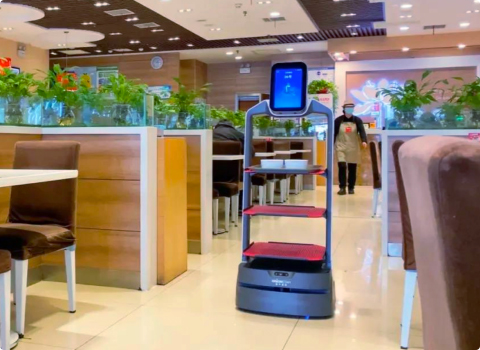
The casual dining restaurant industry has reached a decisive operational turning point. For decades, front-of-house service relied entirely on manual labor to move plates from the kitchen to the dining room. Now, a confluence of market factors forces a fundamental shift. State-level minimum wages are rising rapidly, altering the traditional cost curve. Meanwhile, guests expect faster service and deeper personal engagement, even as operators struggle with persistent short staffing. In addition, autonomous navigation technology has matured enough to handle dynamic, crowded aisles safely. As a result, the food delivery robot has emerged as a practical, industry-wide solution. Instead of a novelty, this automated transport acts as a reliable infrastructure component. It absorbs the physical strain of constant walking and heavy lifting. Therefore, restaurants can maintain service quality during peak hours without constantly expanding their payrolls. Above all, this shift allows hospitality to return to its core focus: human interaction.
These pressures point to one conclusion—the traditional model is unsustainable.
To address these physical and spatial constraints, the OrionStar LuckiBot series provides a differentiated dual-model approach. Rather than competing against one another, these platforms are highly complementary, covering different sub-spaces within a venue.
The standard LuckiBot fits seamlessly into the main dining room, the patio, and the host stand. According to manufacturer data, it handles payloads of up to 40 kg and serves up to four tables per single trip. Its compact chassis navigates narrow accessible routes, moving seamlessly between the host stand and guest tables to bus dishes efficiently.
Moreover, the OrionStar LuckiBot Pro manages higher volume demands at the kitchen pass-through, the bar area, and the busy pickup counter. Outfitted with advanced visual SLAM, this flagship model safely navigates complex layouts. According to manufacturer data, it carries up to 60 kg per trip and utilizes a 240-degree 3D all-around obstacle recognition system to avoid collisions. Its 14-inch display also supports dynamic promotion in the bar area. Together, these models ensure that every sub-space receives the appropriate automated support.
Beyond physical transport, both robots feature robust digital management capabilities. Operators can utilize cloud platforms over 4G or Wi-Fi for remote deployment, fleet oversight, and operational data reporting. Because these systems utilize depth cameras and cloud connectivity to function, operators must verify GDPR compliance. Casual dining restaurant managers should confirm data capture details, processing locations, and retention policies with their legal counsel before activation.
These results are not theory, they are reality verified by casual dining restaurant operators, restaurant managers, and front-of-house managers.
Automation within the hospitality sector does not exist to replace human workers. Instead, it serves to elevate their daily routines. A food delivery robot effectively absorbs the repetitive, heavy task of moving plates across the floor. As a result, servers can redirect their energy toward high-value work. They spend more time on order accuracy, quality supervision, and direct customer service. Across observed deployments, displacement remains limited. When a task is freed up by a robot, the restaurant simply reallocates workers to other high-demand areas. Furthermore, new operational roles are beginning to appear at the manager level. Front-of-house managers are shifting their supervisory attention toward robot fleet monitoring, menu updates, and vendor liaison work. This shift introduces valuable technical skills to the restaurant workforce. In short, human workers keep the conversation going while robots handle the heavy carries.
The hospitality sector is transitioning from experimental robotics to widespread adoption. Today, the food delivery robot is quickly becoming fundamental infrastructure for the casual dining restaurant industry. It stabilizes daily operations against unpredictable labor markets and rising costs. As restaurants remodel their layouts and refine their service flows, automated transport will blend naturally into the background of modern hospitality. For venues planning this transition, the OrionStar LuckiBot series provides multiple models to fit different spatial and operational needs. Operators can explore these varied configurations to find the precise fit for their dining rooms and kitchens. Ultimately, the future of casual dining relies on a seamless collaboration between human warmth and machine efficiency.