

REQUEST DEMO
Robot CATALOG will be sent to your mailbox immediately after submission.
SUBMIT
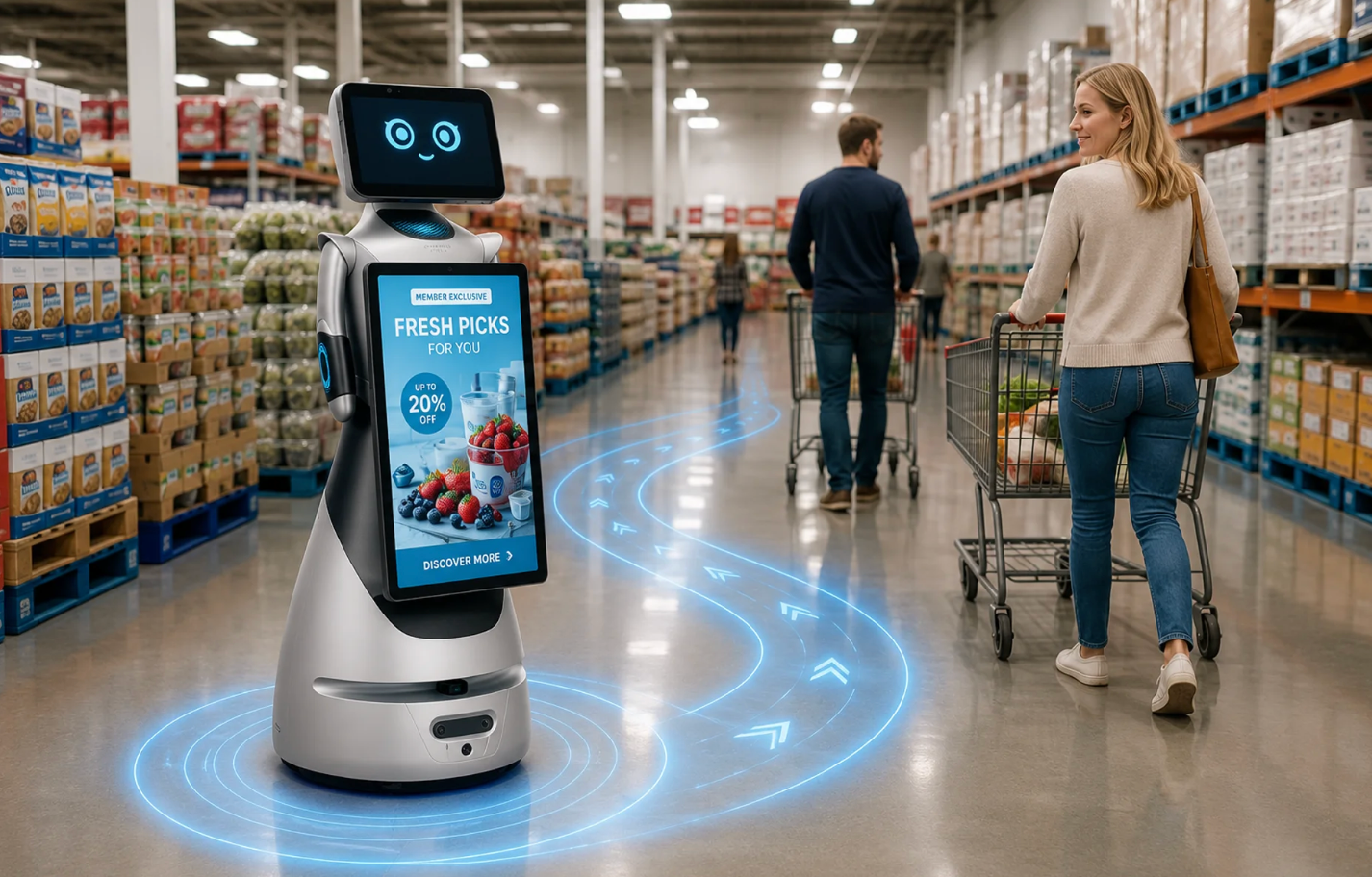
Supermarkets operate as high-footfall, promotion-dense venues where customer attention is split among countless visual stimuli. In these demanding environments, the main jobs of a greeting robot for grocery retail are greeting shoppers at the entrance, broadcasting in-store promotions, and steering shoppers to the right queue, aisle, or service counter. Store trading hours dictate long daily running windows, typically stretching from twelve to fourteen hours, which means runtime, charging, and fleet scheduling have to be judged on a full trading day rather than on a brief demonstration. Facility managers must look beyond basic automation to solve core operational challenges, balancing the need for highly visible digital engagement with the physical agility required to navigate shopping carts, end-cap displays, and unpredictable pedestrian traffic.
Establishing a clear comparison framework helps procurement teams align hardware capabilities with specific retail challenges. Display architecture forms the foundation of customer engagement, where robots either utilize single face-tracking screens for highly interactive virtual concierge applications or deploy multi-screen setups that combine smaller interactive touch interfaces with large body-mounted digital signage panels for simultaneous wayfinding and promotional broadcasting. Navigational agility dictates where the robot can operate effectively, with ultra-compact designs requiring roughly fifty to fifty-five centimeters of clearance for narrow spaces, while mid-to-large service chassis need roughly sixty to sixty-five centimeters to maintain stability under heavy loads. Payload capacity directly influences functional focus, separating high-capacity multi-layer systems engineered for heavy-duty promotional distribution from minimal-payload architectures dedicated strictly to front-of-house greeting. Power autonomy remains a critical logistical consideration, as standard-capacity architectures providing roughly eight to nine hours of continuous operation will necessitate planned mid-shift charging periods, whereas extended-capacity battery systems deliver prolonged runtimes spanning roughly ten to 12.5 hours. Whenever a model relies on camera-based recognition, voice capture, mapping, or cloud data processing to achieve these capabilities, operators must verify the applicable data-protection rules before deployment.
Positioned as a humanoid retail greeter, the OrionStar GreetingBot AD is purposefully built for supermarket entrances, promotional aisles, and the customer service desk. This large-screen edition distinguishes itself by pairing a substantial 21.5-inch full high-definition chest information display with a 14-inch head touch screen, enabling it to broadcast visual promotions while simultaneously handling direct customer inquiries. Interaction is handled by the on-board conversational platform and can be extended through secondary development, which lets the robot answer questions and provide wayfinding assistance in busy retail lobbies. To accommodate the physical dimensions of the newly added chest display, the manufacturer configures the arm motion capabilities to ship in a default-off state, preventing any mechanical interference during operation.
To support continuous operation throughout a demanding retail shift, the platform incorporates an upgraded 20 Ah battery designed to deliver between eight and ten hours of runtime, depending on workload and ambient conditions. Charging is managed efficiently via a higher-output 8 A adapter, ensuring the robot can replenish its power reserves reasonably quickly between peak shopping hours. Weighing 32.5 kg, the chassis requires a minimum path clearance of 60 to 65 cm, providing the necessary stability for its dual-screen architecture while maintaining centimeter-level positioning accuracy for safe navigation across hard indoor surfaces.
The Pudu BellaBot Pro serves as a premium delivery and advertising robot, making it particularly suited to entrance greeting and fresh food departments where robust sample distribution is required. Standing 1.29 meters tall, the system divides its engagement tools between a 10.1-inch interactive screen for direct shopper communication and an 18.5-inch advertising screen designed to broadcast store specials to passing foot traffic. Voice interaction is listed as a core capability of this platform, while the specific language coverage is not detailed by the manufacturer. To manage the inherent risks of navigating high-density environments, the platform implements unique crosswalk caution technology, which projects ground patterns near blind intersections to actively alert approaching shoppers and carts.
The physical architecture emphasizes heavy promotional distribution, featuring a multi-tray delivery configuration that supports a substantial total payload of up to 40 kg. This significant carrying capacity requires a slightly wider operational footprint, demanding a minimum path clearance of 65 cm to ensure safe passage through supermarket aisles. Power autonomy is rated at up to eleven hours under no-load conditions according to manufacturer data, meaning fully loaded sample distribution tasks will proportionally affect overall runtime and necessitate strategic mid-shift charging during a standard trading day.
Engineered as a supermarket promotion specialist, the Keenon DinerBot T10 is optimized for navigating promotional aisles and broadcasting store-news to a wide audience. It features the largest dedicated advertising screen in this group at 23.8 inches, which is paired with a separate 11.6-inch interaction screen to manage shopper interactions and operational commands. The system enhances its physical presence through adaptive head movements that respond naturally to environmental stimuli, creating an animated greeting presence at the front of the store. Its voice prompts and customisable voice options are listed as core capabilities, but how multilingual dialogue is technically implemented is not detailed by the manufacturer.
Designed to manage substantial physical tasks alongside its digital marketing duties, the robot features an open-access tray design supporting a robust 40 kg payload capacity, which is ideal for heavy product sampling or assisting with localized restocking. Despite its heavy 58 kg net weight, the chassis maintains a relatively efficient path clearance requirement of 59 cm. It provides an extended runtime of nine to 12.5 hours under laboratory conditions, covering the vast majority of a retail trading day and relying on an overnight charging cycle to prepare for the next operational shift.
Operating as an ultra-compact mobile marketing ambassador, the Pudu KettyBot Pro is engineered specifically for narrow shelf aisles and crowded checkout zones where space is at a premium. The robot utilizes a forward-leaning C-shaped body to minimize its physical footprint while presenting an 18.5-inch centered advertising screen angled to match a customer's line of sight. It actively performs greeting and escorting functions, using customizable prompts and digital content to steer shoppers toward specific seasonal promotions or service counters. Conversational features are delivered through the vendor's open platform, which allows expressions, voice and content to be customised for local needs; how multilingual dialogue is technically implemented varies by vendor and is not detailed by the manufacturer.
The platform offers high navigational agility by operating within a tight 52 cm clearance, allowing it to weave through congested supermarket environments with ease. This streamlined design trades heavy bulk for efficiency, offering a moderate payload capacity of 10 kg per layer, which is highly effective for continuous roaming and agile snack distribution. The system delivers up to nine hours of runtime under no-load conditions, a specification that requires facility managers to implement multi-robot fleet rotation or planned mid-shift charging to ensure uninterrupted service throughout a full store trading day.
The temi V3 operates as a lightweight, video-oriented personal artificial intelligence assistant, ideally suited to the customer service desk and dedicated checkout information points. Rather than relying on large static broadcast panels, the system employs a 13.3-inch face-tracking display that autonomously tilts from negative fifteen to positive fifty-five degrees to maintain eye contact with shoppers. The vendor currently states that the platform speaks English, with further languages announced as coming, so multilingual coverage should be confirmed before rollout. Its defining software feature is a fully open software development kit that allows grocery retailers to build highly custom, interactive loyalty-program applications or virtual concierge services tailored to their specific brand requirements.
At just 12 kg, the physical chassis is among the most compact in its class, featuring a zero turn radius that allows it to pivot seamlessly in tight reception areas. This sleek design eliminates heavy transport capabilities entirely, providing only a minimal 3 kg rear tray capacity, thereby restricting the robot to pure digital engagement and wayfinding tasks rather than product distribution. The power architecture supplies up to eight hours of battery life, necessitating strategic downtime for charging to ensure the assistant remains available during the store's most critical high-traffic periods.
Selecting the appropriate automated assistant for a supermarket environment requires balancing digital marketing potential with physical site constraints. Retailers prioritizing maximum broadcast visibility and heavy promotional distribution should lean toward mid-to-large service chassis equipped with dual screens and robust payload capacities, provided their aisles can accommodate wider operational clearances. Conversely, facilities struggling with congested checkouts and narrow promotional zones will benefit most from ultra-compact agile designs that prioritize a minimal turning footprint over heavy payload capacity. Ultimately, power autonomy remains the defining logistical factor for long retail shifts, requiring procurement teams to carefully map out overnight charging capabilities and mid-shift top-up strategies to maintain continuous floor presence.
Third-party product specifications are based on publicly available information and are presented as up to specific limits, under laboratory conditions, or according to manufacturer data, and actual performance may vary in real-world retail environments. All product names, trademarks, and registered trademarks are the property of their respective owners. If any product deployment involves camera-based recognition, voice recording, environmental mapping, or cloud-based data processing, operating entities must strictly verify compliance with the General Data Protection Regulation and other applicable privacy frameworks prior to installation in public commercial spaces. Certain features, such as independent arm motion or remote cloud-based management, may require secondary development, custom configuration, or explicit opt-in data policies by the deploying entity to ensure full compliance with local operational and privacy frameworks.
Independent robotics industry guidance indicates a typical payback period of 6 to 18 months, depending on the size of the initial investment. In grocery retail, the business case is usually built on customer-facing outcomes—such as increased advertising exposure on promotional aisles, improved in-store wayfinding, and reduced staffing pressure at the customer service desk—rather than direct labor substitution. Procurement leads must remember that the total cost of ownership (TCO) also includes training, programming, integration, warranty, and maintenance. Therefore, calculating ROI purely on the hardware purchase price will understate the true financial commitment required for a successful deployment.
For robots operating in publicly accessible retail spaces, the legal basis for camera processing is typically "legitimate interest" under Article 6(1)(f) of the GDPR, which strictly requires a documented Data Protection Impact Assessment (DPIA) for systematic monitoring. To comply with data minimization principles, modern platforms prioritize processing data directly on the device, immediate de-identification, and short retention periods (such as ring buffers) rather than permanent, incident-free recording. Furthermore, audio recording is highly intrusive in public environments and must be switched off by default; any audio capture requires an evidenced, justified need and clear transparency notices for shoppers.
Under the EU AI Act, systems that interact directly with people fall into the limited-risk tier, which carries specific transparency obligations for retail deployers. End-users must be clearly informed that they are interacting with an AI system at or before the time of their first interaction, unless the context makes it completely obvious. Facility managers can fulfill this requirement through multi-tiered information strategies, such as clearly visible labeling and status lights on the robot itself, complemented by physical signage or QR codes stationed near the supermarket entrance or customer service desk.
Yes, but physical passability depends heavily on the specific robot model and your store's layout constraints. The OrionStar GreetingBot AD requires a minimum corridor clearance of 60–65 cm, which accommodates standard grocery aisles, while ultra-compact competitor models like the Pudu KettyBot Pro can navigate tighter clearances of ≥52 cm. Equipped with advanced sensor suites—including LiDAR, depth cameras, and wheel odometry—these systems can safely cross minor floor bumps up to 10 mm and dynamically reroute around shopping carts and pedestrians in high-traffic zones.
Most high-end commercial service robots offer a runtime ranging from 8 to 12.5 hours on a single charge, meaning strategic mid-shift charging is often necessary to cover a full supermarket trading cycle. For instance, the OrionStar GreetingBot AD utilizes an upgraded 20 Ah lithium ternary battery to deliver approximately 8–10 hours of operation, requiring roughly 6 hours to recharge while powered on. Operations directors should plan dedicated charging logistics near the customer service desk or entrance to manage these downtimes effectively without disrupting peak-hour floor promotions.
Premium retail robots integrate multi-modal hardware to serve as both dynamic digital signage and conversational assistants simultaneously. The OrionStar GreetingBot AD utilizes a 21.5-inch FHD chest display for broadcasting high-visibility promotions in fresh food aisles, paired with a 14-inch head touch screen for direct customer queries and interactive wayfinding. Supported by a 6-microphone circular array with 360° sound source localization and a dedicated head pitch motor, the robot can detect an approaching shopper's direction and physical height, adjusting its posture for natural face-to-face interaction.