

REQUEST DEMO
Robot CATALOG will be sent to your mailbox immediately after submission.
SUBMIT
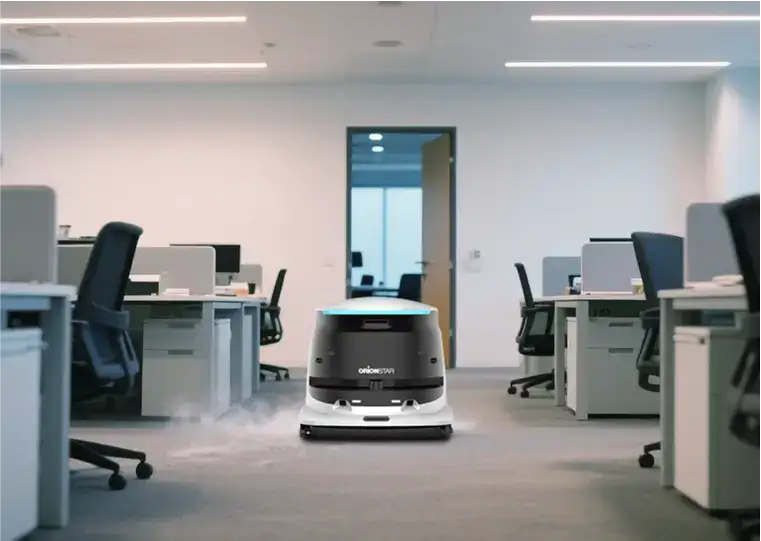
Facility managers, workplace services teams, and building service contractors are currently operating under strict labor constraints. Industry benchmarking surveys indicate that custodial employee turnover frequently exceeds 26.2%, and recruiting qualified cleaning staff remains a primary operational hurdle. Because commercial cleaning is traditionally priced per square foot, maintaining profitability and service quality while dealing with wage pressure requires a shift in how routine tasks are executed.
An automatic floor scrubber provides a practical method to bridge this gap, allowing human workers to focus on higher-value tasks like detailed sanitization and restroom maintenance. This guide evaluates how the OrionStar CleaniBot S55 Pro aligns with the physical, operational, and compliance demands of modern commercial buildings.
Commercial buildings are not uniform environments. A standard square-foot pricing model often fails to account for the varying maintenance requirements of distinct sub-spaces. Lobbies experience high foot traffic and constant soil track-in, canteens deal with frequent spills, and open-plan offices require continuous but quiet dust control.
The OrionStar CleaniBot S55 Pro addresses this environmental variability by integrating multiple cleaning functions into a single platform. Rather than deploying separate machines for different zones, facility teams can utilize its automated mode switching. According to manufacturer data, the unit offers:
Unlike closed warehouses, commercial buildings are highly dynamic. Elevator lobbies experience sudden influxes of people, and corridor layouts frequently change as temporary signage or furniture is moved.
To operate safely without manual supervision, the OrionStar CleaniBot S55 Pro is equipped with a multi-sensor navigation system. According to product specifications, it utilizes LiDAR (supporting map construction of up to 10,000 m²), a stereo camera for cliff and step detection, and ultrasonic sensors for obstacle avoidance. Line lasers assist the robot in cleaning within a typical configuration of 10 cm from walls (adjustable to 5 cm), ensuring comprehensive edge coverage in long corridors while preventing collisions with pedestrians or architectural elements.
The core operational rationale for an automatic floor scrubber is extending floor-care coverage without extending employee shifts. The CleaniBot S55 Pro supports this objective through long runtime and low-intervention maintenance features.
Under defined test conditions, the battery supports up to 4.5 hours of continuous scrubbing and can extend up to 28 hours in the lower-draw dust mop mode. By handling the bulk of open-floor maintenance autonomously, building service contractors can maintain service level agreements even when short-staffed. Furthermore, the robot is designed for straightforward daily upkeep, featuring modular cleaning tools that require no instruments to swap out, and a fully washable, removable 15 L wastewater tank to help reduce odor and bacterial buildup.
Workplace management increasingly requires data-backed service-level reporting rather than narrative checklists. The CleaniBot S55 Pro features Wi-Fi and 4G connectivity, enabling remote deployment, cloud-based maintenance, and operational reporting. This allows facility managers to track exact cleaning times, covered square footage, and route completion remotely.
However, the introduction of connected cameras and LiDAR into commercial buildings requires strict data governance. Because the robot processes spatial and sensor data for navigation and obstacle avoidance, workplace services teams must verify that its deployment complies with the GDPR and any applicable local data protection regulations. Facility managers should work closely with suppliers to understand where map and sensor data is stored, ensure appropriate data processing agreements are in place, and confirm that the machine is physically and digitally restricted from entering secure zones, such as executive floors or data centers.
Deploying the OrionStar CleaniBot S55 Pro provides a structured response to the ongoing labor shortages and complex cleaning requirements in commercial environments. By automating the most time-consuming floor care tasks, facility teams can maintain consistent cleanliness standards while optimizing their workforce deployment. Because individual facilities have varying architectural layouts and scale requirements, the broader OrionStar CleaniBot series offers multiple models to accommodate different operational scopes and building sizes.
Can the robot navigate through narrow spaces like congested meeting rooms? According to manufacturer specifications, the S55 Pro requires a minimum passing width of 700 mm. While it is highly capable in lobbies, broad corridors, and open-plan offices, heavily congested meeting rooms with tightly packed chairs may still require manual spot cleaning or a smaller supplementary device.
How does the robot handle transitions between different floor types? The machine can automatically switch cleaning modes based on designated zones mapped during the initial setup. This means it can transition from scrubbing a hard-floor canteen to vacuuming a low-pile carpeted corridor, provided the zones are properly configured in its mapping system.
What infrastructure is required to support the robot? The S55 Pro requires access to its charging dock, a standard power supply, and a dedicated location for operators to manually fill the 22 L clean water tank and empty the 15 L wastewater tank, as this specific model relies on manual tank management rather than an automatic refill station.