

REQUEST DEMO
Robot CATALOG will be sent to your mailbox immediately after submission.
SUBMIT
Managing floor care in medical facilities presents complex operational challenges, particularly when balancing the distinct spatial constraints and acoustic demands found across different areas of hospitals. Environmental services teams must navigate diverse environments ranging from congested outpatient departments to expansive service corridors, all while maintaining rigorous routine maintenance schedules. Because commercial cleaning robots for hospitals utilize cameras, spatial mapping, and cloud-based data processing to navigate these environments, facility operations teams must verify compliance with data protection regulations, including GDPR, in collaboration with the vendor prior to deployment.
These automated machines are strictly commercial floor-cleaning robots working inside the hospital cleaning workflow. They are not medical devices and should never be viewed as substitutes for manual terminal cleaning or validated infection-control procedures. They do not reduce hospital-acquired infection rates, and any disinfection functionality they possess serves merely as one conservative step within a broader cleaning workflow, not as a pathogen-elimination claim. Before integrating these platforms, the environmental services team and infection prevention lead of the medical facilities must confirm that the chosen robot is entirely compatible with hospital-approved detergents, disinfectants, floor finishes, and established standard operating procedures.
When evaluating these systems, form factor and navigation footprint represent the primary selection criteria. Ultra-compact units are engineered to navigate tight outpatient departments and congested waiting areas where larger machines cannot physically operate safely. Conversely, heavy-duty industrial configurations are scaled for vast back-of-house logistics and service corridors where maximum coverage is the sole priority. Mid-sized platforms occupy the middle ground, providing sufficient agility for general patient corridors and public lobbies while maintaining the ability to pass through standard commercial doorways alongside pedestrian traffic.
Cleaning modality and surface application dictate how effectively the robot aligns with the varied flooring types found within medical facilities. Dedicated vacuuming systems focus on carpeted environments like administrative offices, while dedicated hard-floor scrubbing platforms apply liquid solutions and recover dirty water in high-traffic public areas. Multi-surface integrated systems combine sweeping, scrubbing, vacuuming, and mopping capabilities into a single modular platform, allowing operators to address hard patient corridors, delicate polished floors, and low-pile carpeted zones without procuring separate dedicated machines.
Fluid capacity and operational autonomy determine the practical deployment length of a scrubbing robot during a shift. Agile, low-capacity systems prioritize a minimal physical footprint but require frequent manual intervention for draining and refilling. High-capacity industrial units minimize human intervention over long shifts to provide uninterrupted floor care in logistical zones. Additionally, the acoustic profile directly influences patient environment impact. Standard commercial acoustic profiles are suitable for bustling daytime lobbies, whereas ultra-low noise modes are mandatory for deployments near active patient wards or during night shifts to avoid violating hospital noise policies.
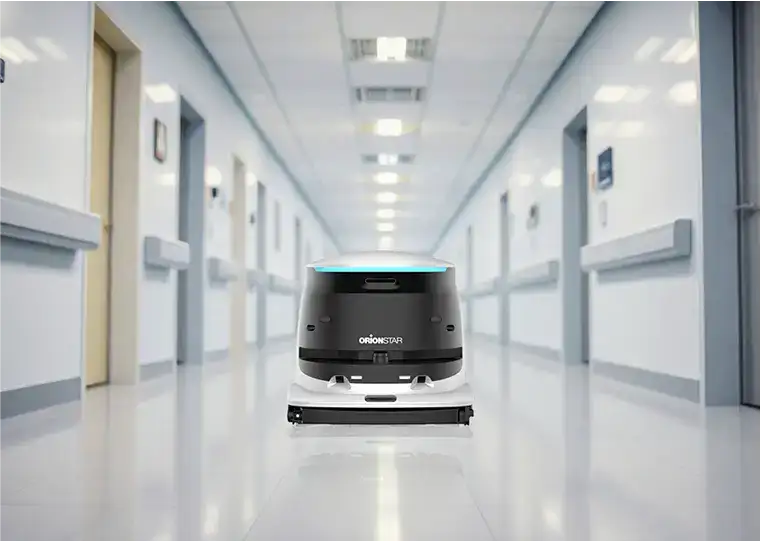
The OrionStar CleaniBot S55 Pro operates as a compact multi-mode autonomous floor-care robot specifically configured for hospitals. This system integrates sweeping, scrubbing, vacuuming, mopping, self-cleaning, and a disinfection-related workflow step into one versatile platform, allowing environmental services teams to maintain multiple floor types with a single machine. The physical design features a minimum passing width of up to 700 mm, according to manufacturer data, which enables the robot to navigate narrow patient corridors and standard doorways safely while avoiding pedestrian traffic.
Beyond its multi-surface capabilities, the machine supports zone-based mode switching and utilizes LiDAR mapping capable of covering areas of up to 10,000 square meters, according to manufacturer data. It maintains a highly discreet acoustic footprint, operating at up to 55 dB during standard scrubbing and dropping to up to 45 dB in its dedicated dust-mopping mode. These ultra-low noise levels make it highly suitable for continuous operation in occupied waiting areas and night-shift deployments near active patient wards. The system also supports an auto-recharge function to optimize daily autonomous routines across diverse hospital environments.
The ICE Co-Botics Cobi 18 functions as a highly compact autonomous scrubber equipped with a narrow cleaning path designed for highly constrained hospital layouts. This platform is scaled specifically for tight ward areas, narrow patient corridors, and small outpatient departments where mid-sized or industrial automated scrubbers cannot physically maneuver. Its agile design allows it to navigate complex spaces, applying continuous floor care to areas that typically rely on manual mopping operations.
The robot utilizes route-teaching navigation to establish its cleaning paths, adapting to environmental changes in active hospital corridors. Fleet management is handled via integrated cloud software, allowing operational teams to monitor cleaning performance and map coverage over time. The platform is backed by published deployment evidence demonstrating its application in medical facilities, operating at productivity rates of up to 800 square meters per hour and running for up to 90 minutes per charge, according to manufacturer data.
The Avidbots Neo 2 serves as an AI-driven multi-application autonomous floor scrubber engineered for large public areas and expansive patient corridors within medical facilities. This heavy-duty system automatically adjusts its cleaning head pressure to manage diverse hard-floor conditions across mid-size departments and multi-floor hospital buildings. The platform is highly suitable for medical facilities that prioritize comprehensive operational transparency, as it provides detailed sector-level coverage reporting and extensive productivity data through its web-based fleet-management platform.
To maintain continuous operational uptime in demanding hospital settings, the machine utilizes interchangeable batteries that deliver runtimes of up to 6 hours on a single charge, according to manufacturer data. It maneuvers using a sophisticated navigation system powered by advanced dynamic planning and real-time obstacle avoidance, achieving productivity rates of up to 3,900 square meters per hour, according to manufacturer data.
The SoftBank Robotics Whiz operates as a collaborative commercial robot vacuum designed specifically for carpeted environments within medical facilities. It fills a specialized operational gap by providing automated floor care for dry-debris zones such as administrative offices, carpeted waiting areas, and staff facilities where wet scrubbing is not required. Utilizing BrainOS teach-and-repeat routes, the vacuum navigates programmed paths autonomously while actively avoiding obstacles in active office and lobby environments.
The machine focuses heavily on indoor air quality, which is critical for medical facilities, by incorporating HEPA-grade filtration designed to capture fine particles during its routine vacuuming cycles. The platform operates at a quiet noise level of up to 62 dB and achieves a cleaning rate of up to 1,500 square meters per hour with a battery life extending up to 3 hours, according to manufacturer data.
The Tennant T16AMR functions as an industrial-grade battery ride-on robotic floor scrubber built to handle the most expansive floor plans within medical facilities. It features exceptionally large solution and recovery tanks paired with a wide cleaning path, prioritizing raw tank capacity and vast area coverage over tight maneuverability. This makes the heavy-duty platform highly suitable for main lobbies, wide service corridors, loading areas, and large public floors in the back-of-house areas of hospitals.
Operating autonomously with robust AI navigation, the system offers continuous cleaning capabilities designed for extensive shifts. The machine provides heavy-duty scrubbing with a solution tank capacity of up to 190 liters and continuous run times of up to 5.5 hours, according to manufacturer data. Because of its massive footprint and heavy weight, it is strictly applicable for logistical and service zones rather than congested patient corridors or outpatient departments.
Evaluating and procuring commercial cleaning robots for hospitals requires a strict alignment between the machine's capabilities and the physical realities of medical facilities. Facility managers must match the form factor and fluid capacity to the specific layout of the target hospital zones, ensuring the machine can navigate narrow patient corridors or cover expansive service areas efficiently. Acoustic profiles must be heavily scrutinized to ensure operations near active wards do not disrupt patient rest. Most importantly, hospital environmental services teams must verify chemical compatibility and SOP alignment prior to use, and IT teams must rigorously audit the vendor's cloud mapping systems for strict GDPR compliance before any robotic deployment occurs.
Deploying commercial cleaning robots can reduce utility costs by saving electricity compared to traditional corded equipment and precisely controlling chemical solution dispensing to minimize waste. Rather than replacing frontline environmental services associates, these robots function as a supplementary resource that can run multiple shifts a day, helping facilities manage staff shortages and unexpected surges in infectious diseases. This automated routine maintenance allows human staff to focus on more complex, high-priority tasks like validated terminal cleaning of patient rooms. Additionally, utilizing visible autonomous technology in public areas has been shown to improve the public's perception of cleanliness, which can positively influence a hospital's HCAHPS scores.
No, these machines are strictly commercial floor cleaners designed for routine facility maintenance and must never be used as a substitute for terminal cleaning or validated infection-control procedures. While some robots offer disinfection add-ons or support conservative disinfection-related workflow steps, like the CleaniBot S55 Pro, they do not reduce hospital-acquired infection rates on their own and cannot make medical sterilization claims. Before deployment, the hospital's infection prevention team must verify that the robot is compatible with hospital-approved EPA-registered disinfectants and existing floor finishes. Terminal cleaning requires meticulous manual processes starting from clean to dirty and high to low, which automated floor scrubbers are not mechanically designed to perform.
Because autonomous cleaning robots utilize onboard cameras, LiDAR sensors, and cloud-based processing for spatial mapping and obstacle avoidance, they inherently collect environmental data as they navigate. Facility operations and IT teams must verify that the robot's data handling complies with all applicable privacy regulations, including GDPR, before allowing it to map patient corridors or waiting areas. For instance, systems like the CleaniBot S55 Pro use Wi-Fi and 4G network connectivity for remote deployment and data reporting, requiring a thorough review of the vendor’s cloud infrastructure and data retention policies. Verifying that the system restricts unauthorized access to camera feeds and safely processes spatial mapping data is a mandatory procurement step for any healthcare environment. Ensure the system processes spatial data locally for obstacle avoidance without capturing personal health information (PHI) or facial imagery, maintaining strict GDPR compliance.
The physical dimensions of a cleaning robot dictate its safe operation, with ultra-compact models like the 48 cm wide ICE Cobi 18 being ideal for navigating congested outpatient waiting areas. Conversely, heavy-duty industrial units weighing over 600 kg, such as the Tennant T16AMR, are strictly engineered for expansive back-of-house logistics, wide service corridors, and loading docks. For general patient corridors, public lobbies, and mixed-use areas, mid-sized platforms provide the best balance of area coverage and agility. The CleaniBot S55 Pro, featuring a 580 mm width and a minimum passing width of up to 700 mm, is specifically scaled to clean these broad commercial floors safely alongside pedestrian traffic.
Acoustic suitability depends entirely on the specific robot model and its operating mode, as standard commercial machines typically generate between 60 dB and 72 dB, which is only appropriate for bustling daytime lobbies. To operate near active patient wards, during night shifts, or in administrative quiet zones, facilities require robots equipped with ultra-low noise profiles. The CleaniBot S55 Pro addresses this requirement by operating at 55 dB during standard scrubbing and dropping down to a discreet 45 dB in its dedicated Dust Mopping mode. Matching these low-decibel cleaning modes to sensitive hospital zones ensures that floor maintenance can continue around the clock without disturbing resting patients.
Many hospital cleaning robots are dedicated single-surface machines, such as the SoftBank Whiz which strictly vacuums carpets using HEPA filtration, or the Avidbots Neo 2 which exclusively scrubs hard floors. However, multi-surface integrated systems are available that combine sweeping, scrubbing, vacuuming, and mopping into one modular automated platform. The CleaniBot S55 Pro utilizes an InstantClean Floor Care System that allows operators to seamlessly switch between hard-floor scrubbing, which cleans up to 1,197 m²/h, and a Sweep & Vacuum mode intended for low-pile carpets. This versatility allows environmental services teams to maintain multiple flooring types across the facility without needing to procure and store separate specialized robots.
Third-party product specifications are based on public data (up to, under laboratory conditions, according to manufacturer data, under defined test conditions) and may vary. Product names and trademarks belong to their respective owners. If any product involves cameras, voice recording, mapping, or cloud data processing, the operating party must verify GDPR compliance prior to deployment.