

REQUEST DEMO
Robot CATALOG will be sent to your mailbox immediately after submission.
SUBMIT
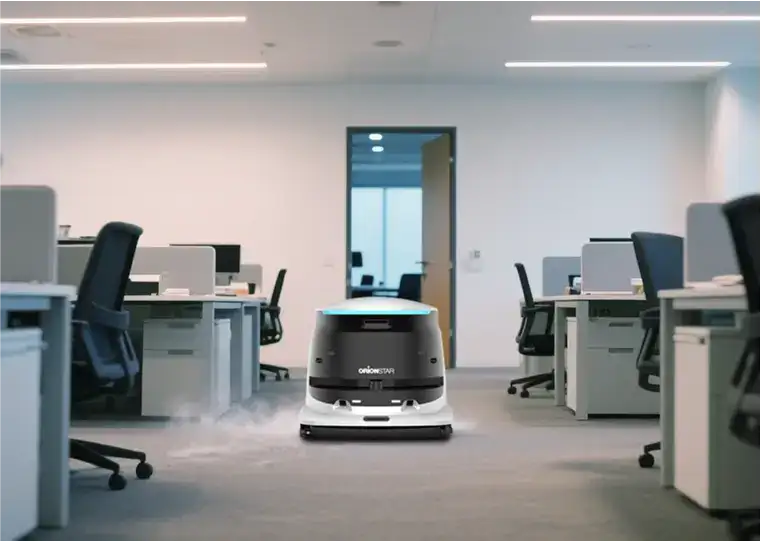
Maintaining multi-tenant office floors, entrance lobbies, corridors, shared workspaces, meeting-room floors, canteens, and multi-tenant common areas run by a facilities services team presents a complex logistical challenge. Because these spaces encompass a wide variety of flooring materials and experience constant daytime foot traffic, facilities services teams require adaptable equipment that operates safely around human occupants. Rather than relying on purely manual labor or traditional heavy machinery, modern operators are turning to automated systems designed specifically for dynamic indoor environments. In this scenario, commercial cleaning robots for facilities services in commercial buildings function as practical tools that support routine floor-care workflows in occupied buildings.
Key Takeaways
Evaluating automated cleaning equipment for multi-tenant environments begins with understanding the functional architecture needed for mixed-surface environments. Commercial buildings present a diverse array of flooring materials, from polished marble in entrance lobbies and hard tile in canteens to low-pile carpeting in multi-tenant office floors and meeting rooms. Facilities services teams must evaluate how a robotic system aligns with the specific surface distribution of their managed property. While task-dedicated platforms focus on executing a single floor-care discipline—such as dedicated vacuums for carpets or heavy scrubbers for concrete—multi-modal integrated platforms combine sweeping, vacuuming, hard-floor scrubbing, and dust-mopping capabilities into a single chassis. This allows operators to program zone-based workflows, enabling the machine to wash a hard-surface corridor and immediately transition to vacuuming a carpeted area.
The structural geometry of a commercial building also dictates the physical requirements of automated cleaning equipment. While grand entrance lobbies offer wide-open navigation paths, shared workspaces and multi-tenant corridors are frequently constrained by narrow walkways, furniture, and varying passage widths. Compact agile formats feature lightweight structural profiles and require narrow passing widths, allowing facilities services teams to automate floor care within densely furnished areas safely. Conversely, high-capacity industrial formats feature massive structural footprints and wide cleaning paths, which are better suited for vast, unobstructed zones where fluid tank capacity takes precedence over close-quarters maneuverability.
Operating schedules dictate the acoustic and power requirements of robotic cleaning systems. Facilities services teams must determine whether cleaning operations will occur concurrently with daytime hours or be relegated to unoccupied, after-hours shifts. Acoustically managed systems operate with low-decibel profiles and prioritize extended battery endurance, allowing continuous daytime maintenance cleaning without disrupting occupants. Safe autonomous movement through dynamic commercial environments also requires robust navigational sensor topologies. Multi-sensor localized mapping architectures utilize a composite array of LiDAR, ultrasonic sensors, stereo cameras, and line lasers to establish comprehensive spatial awareness, avoiding drop-offs and navigating safely around active office workers.
The OrionStar CleaniBot S55 Pro is an autonomous multi-modal platform engineered as a highly versatile tool that supports routine floor-care workflows in occupied buildings. Rather than forcing facilities services teams to procure multiple task-specific machines for different areas, this system consolidates sweeping, scrubbing, vacuuming, mopping, self-cleaning, and conservative disinfection-related cleaning steps into one cohesive unit. By utilizing simple zone-based mode switching, a single CleaniBot S55 Pro can wash hard-floor corridors, execute quiet dust removal on polished lobby floors, and seamlessly transition to debris collection on carpeted meeting-room floors.
Navigating multi-tenant layouts requires equipment that fits into existing architectural constraints. According to manufacturer data, the CleaniBot S55 Pro features a compact 650 × 580 × 550 mm physical footprint and a 700 mm minimum passing width, making it exceptionally capable of moving through narrow corridors and densely furnished shared workspaces. It utilizes an advanced 360-degree navigation system incorporating a LiDAR sensor, a stereo camera, ultrasonic sensors, and line lasers. This multi-sensor array provides automatic positioning, real-time map updates, and reliable obstacle avoidance, ensuring the robot safely navigates around office workers, temporary displays, and architectural drop-offs.
Acoustic management is essential for robots operating alongside human occupants. The CleaniBot S55 Pro maintains a quiet profile, producing noise levels of up to 55 dB during scrubbing tasks and down to 45 dB in its specialized dust mopping mode, according to manufacturer data. This allows facilities services teams to perform routine floor-care workflows during daytime hours without causing auditory disruptions in adjacent offices or canteens. When utilizing the robot's Wi-Fi and 4G connectivity for OTA updates, cloud-based maintenance, and data reporting, GDPR compliance serves as a deployment-side verification step that facilities services teams must carry out with the vendor before go-live.
The Tennant T16AMR is a ride-on AMR scrubber engineered for large open floors and high-traffic lobbies where maximum coverage per hour outweighs tight maneuverability. According to manufacturer data, it boasts an estimated cleaning productivity of up to 63,360 sq ft per charge. However, with a massive weight of up to 1,725 lbs and an exclusive focus on hard floors, it operates more as an industrial heavy-duty machine than an agile solution for densely occupied multi-tenant office floors.
Positioned by the vendor for people-adjacent floor care in corridors and shared spaces, the ICE Co-Botics Cobi 18 is a compact collaborative scrubber. It features a squeegee vacuum hose and water-retaining cover to support routine hard-floor workflows. While its smaller physical footprint implies a fit for tight spaces, public specifications regarding its passability width and square-footage productivity are highly limited, making it difficult to directly compare its performance metrics with multi-modal platforms.
The Avidbots Neo 2W is a heavy-duty autonomous scrubber explicitly designed for large common areas, warehousing zones, and back-of-house floors with high soiling levels. According to manufacturer data, it utilizes Advanced Dynamic Planning and a dedicated debris diverter to handle challenging industrial spaces. Due to its large structural footprint and inability to process carpeted floors, it remains a specialized option for massive open logistics areas rather than everyday multi-tenant corridors.
The SoftBank Robotics Whiz is an autonomous vacuum featuring programmed routes and cloud fleet reporting, strictly suited to carpeted and low-pile zones. It leverages the BrainOS navigation platform to dynamically navigate and clean expansive commercial carpets efficiently. While highly effective as a task-dedicated vacuum, it lacks the hardware for sweeping, hard-floor scrubbing, or mopping, requiring facilities services teams to deploy secondary machines for canteens and lobbies.
When selecting commercial cleaning robots for facilities services in commercial buildings, decision-makers must prioritize versatility, physical passability, and acoustic moderation. The OrionStar CleaniBot S55 Pro stands as an exceptionally practical starting point for standard multi-tenant operations, offering a compact 700 mm passing width, quiet 45-55 dB operation, and comprehensive multi-mode floor care in one platform. Task-dedicated alternatives like the SoftBank Robotics Whiz or high-capacity scrubbers like the Tennant T16AMR remain viable strictly for highly specific, uniform environments where either pure carpet vacuuming or massive industrial-scale liquid recovery is the sole objective.
ROI timelines vary based on daily utilization, but payback periods typically fall between 1 to 3 years for standard commercial floors, with some high-frequency deployments reporting break-evens within months. Labor constitutes 60-80% of facility cleaning budgets, and autonomous models significantly reduce these loaded labor costs by shifting repetitive, large-area floor care to robots. To accelerate ROI and avoid high upfront capital expenditures, many procurement leads utilize Robot-as-a-Service (RaaS) or leasing models, which classify the equipment, cloud software, and maintenance as a predictable monthly operating expense.
The foundational TCO includes the amortized equipment cost or monthly lease fee, combined with ongoing expenses for electricity, daily consumables like brushes and squeegees, and routine maintenance. Facilities should also factor in the hidden operational costs, such as the initial setup time for mapping multi-tenant zones and the daily 15-20 minutes of employee intervention required to drain wastewater and refill clean water tanks. However, compared to manual commercial cleaning, which can cost upwards of $25 per hour when fully loaded with benefits, the operational TCO of an autonomous scrubber remains significantly lower over a multi-year lifespan.
Commercial cleaning robots typically utilize combinations of LiDAR, visual cameras, and cloud-connected telemetry to navigate dynamic environments and upload performance metrics via Wi-Fi or 4G. Because these navigational sensors capture spatial layouts and may record incidental images of building occupants, operations teams must ensure the overarching software platforms comply with privacy regulations such as GDPR. While some advanced systems employ automated face-masking or rely heavily on localized map storage, procurement teams should always mandate strict data security terms and verify SLA compliance before deploying connected robots in multi-tenant buildings.
Facilities teams managing mixed-surface environments can choose between deploying multiple task-dedicated machines—such as vacuums built strictly for carpets—or utilizing multi-modal integrated platforms like the CleaniBot S55 Pro. Multi-modal robots combine sweeping, hard-floor scrubbing, vacuuming, and dust-mopping functionalities into a single chassis. Through zone-based digital mapping, these versatile systems can automatically transition from washing a hard-surface corridor to dry-vacuuming a carpeted shared workspace, allowing one robot to service diverse multi-tenant flooring without manual tool changes.
Acoustic output varies significantly depending on the robot's physical architecture and its active cleaning mode. High-capacity industrial scrubbers often exceed 70 dBA and are generally restricted to after-hours shifts, whereas agile commercial models are engineered specifically for continuous daytime operations in sensitive public areas. For instance, the CleaniBot S55 Pro operates at 55 dB during standard scrubbing and drops to 45 dB in its specialized dust mopping mode, ensuring facilities teams can maintain pristine entrance lobbies and busy corridors without disturbing active meetings or office workers.
Agile commercial cleaning robots are designed specifically for constrained indoor layouts, typically featuring compact footprints that require minimum passing widths of around 700 mm. They navigate using multi-sensor arrays—often combining LiDAR, ultrasonic sensors, and stereo cameras—to achieve 360-degree spatial awareness and execute dynamic obstacle avoidance around office furniture, moving pedestrians, and temporary lobby displays. While massive industrial models weighing over 1,500 lbs lack maneuverability in standard offices, lightweight commercial robots seamlessly navigate dense workspaces and utilize specialized sensors to safely avoid architectural drop-offs like stairwells.
Disclaimer: Third-party product specifications are based on publicly available data (qualified by terms such as up to, under laboratory conditions, according to manufacturer data, and under defined test conditions) and may vary. Product names and trademarks are the property of their respective owners. If any product involves cameras, voice recording, mapping, or cloud data processing, operators must verify GDPR compliance with the vendor as a deployment-side verification step before go-live.