

REQUEST DEMO
Robot CATALOG will be sent to your mailbox immediately after submission.
SUBMIT
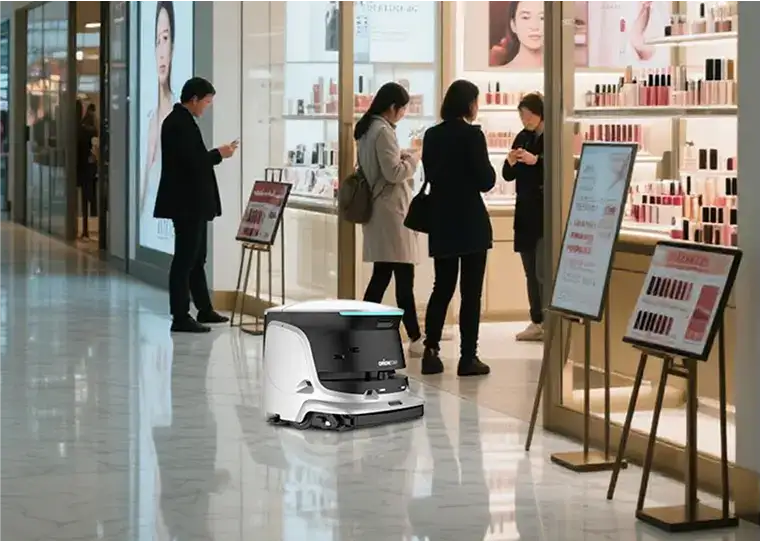
Operating retail stores in the consumer electronics sector across Europe, the United States, and Asia presents distinct operational challenges that heavily influence facility maintenance strategies. Tech retail environments experience sharp fluctuations in guest flow, with unpredictable peaks driven by new product launches and mid-day lulls that offer brief windows for facility upkeep. Because these locations cannot shut down during trading hours for deep cleaning, facility managers face the impossibility of closing showrooms and must rely on continuous daytime operation to maintain brand standards. This dynamic is further complicated by intricately zoned layouts where highly polished hard floors in the main entrance transition abruptly into low-pile carpets in high-end home theater demo rooms or staff break areas. Additionally, the physical density of tech retail spaces creates a challenging navigational environment for any automated maintenance equipment. Store layouts are frequently reconfigured with seasonal promotional stacks, new interactive smartphone demo tables, and freestanding accessory racks, meaning that fixed cleaning paths quickly become obsolete. Retail chains also operate under intense sales-per-square-foot pressure with lean staffing models, leaving sales associates with little capacity to manage or troubleshoot complex robotic equipment. Procurement teams must therefore evaluate solutions that can autonomously adapt to these evolving constraints without introducing mechanical noise that disrupts high-value customer consultations and audio demonstrations.
Establishing a procurement comparison framework for these dynamic environments requires assessing several core dimensions that directly impact daytime usability and operational compliance. Spatial agility and dynamic navigation form the foundation of this evaluation, as high-density showrooms demand ultra-compact chassis architectures capable of passing through tight aisles or executing tight turning radii around fragile acrylic display plinths. Alternatively, large-format flagship stores may require high-speed, wide-path architectures to cover expansive main walkways rapidly during short, low-footfall windows. Regardless of the form factor, the ability to maneuver dynamically around moving shoppers and unmapped temporary promotional islands is a non-negotiable requirement for safe daytime deployment. Acoustic profiles and multi-surface versatility represent equally critical factors for protecting the in-store experience across zoned retail layouts. Multi-modal low-decibel systems offer specialized ultra-quiet settings suitable for daytime maintenance near product demonstration areas, whereas acoustically dampened dedicated machines maintain a consistent sound profile for continuous wet cleaning without breaching acceptable ambient noise thresholds. Furthermore, integrated multi-function platforms allow a single machine to transition between wet scrubbing for polished entrance tiles and dry vacuuming for carpeted breakout zones. Conversely, high-pressure dedicated systems focus entirely on hard-floor presentation, utilizing heavy downward force to remove stubborn scuffs from high-traffic areas. Finally, buyers must weigh autonomy levels and chain-wide fleet oversight, balancing fully integrated infrastructure autonomy that requires minimal staff intervention against simplified manual maintenance paired with robust cloud analytics for multi-location performance tracking. When utilizing camera-equipped models or cloud-based platforms that transmit mapping imagery and operational data across regions, operators must ensure that backend data processing complies with GDPR and regional privacy regulations before deployment.
The OrionStar CleaniBot S55 Pro is positioned as a highly adaptable solution for small to mid-sized tech retail environments where mixed flooring and severe space constraints dictate cleaning operations. Its highly compact walk-behind-class body, measuring 650 by 580 by 550 millimeters and weighing 70 kilograms, provides the necessary spatial agility to navigate the tightly packed layouts typical of consumer electronics showrooms. With a minimum passing width of 700 millimeters, this unit can easily clean between densely arranged smartphone demo tables, accessory racks, and glass entrance partitions without risking collision. The machine utilizes a 550-millimeter main brush alongside a 22-liter clean water tank and a 15-liter wastewater tank, ensuring sufficient capacity for regular maintenance cycles in standard specialty stores while remaining small enough to avoid obstructing narrow customer walkways.
To accommodate the zoned layouts and daytime operating requirements of retail stores, this model features six zone-based cleaning modes that handle both hard and carpeted surfaces. According to manufacturer data, it achieves a cleaning efficiency of up to 1,197 square meters per hour in active scrubbing modes, and up to 1,368 square meters per hour when utilizing dry or combined modes like Sweep & Vacuum. Crucially for preserving the in-store customer experience, it maintains an ultra-low noise profile of 55 decibels during standard scrubbing and drops to just 45 decibels during dust mopping, minimizing acoustic interference with in-store audio product demonstrations. Supported by a LiDAR mapping capacity of up to 10,000 square meters, automatic recharging capabilities, and Wi-Fi or 4G network connectivity for cloud-based maintenance and over-the-air updates, it offers reliable chain-wide fleet oversight with minimal local staff intervention.
The Gausium Scrubber 50 targets the vast majority of small to mid-sized tech retail chains by emphasizing extreme spatial agility and hands-free infrastructure autonomy. Its ultra-compact chassis architecture, featuring dimensions of 872 by 714 by 1,033 millimeters and an empty weight of 150 kilograms, is engineered to operate within high-density showrooms. The machine's ability to navigate 800-millimeter passable aisles allows it to access narrow gaps between display plinths and temporary promotional islands that are often inaccessible to larger commercial equipment. Its 510-millimeter cleaning path, supported by a 24-liter clean water solution tank and an 18-liter wastewater recovery tank, balances maneuverability with a maximum cleaning efficiency of up to 1,800 square meters per hour, according to manufacturer data.
Supporting continuous daytime operation in bustling retail environments, this model maintains an acoustic output of under 65 decibels to prevent disruptions to sales consultations and customer interactions. It leverages an advanced sensor fusion system combining LiDAR and 3D depth cameras to achieve dynamic obstacle avoidance, allowing it to reroute smoothly around moving shoppers and unexpected layout changes common during new product launch events. Furthermore, this model features full workstation auto-docking capabilities that automate charging, clean water refilling, and wastewater discharging. This fully integrated infrastructure autonomy reduces the need for manual staff intervention during its up to 3-hour runtime, directly supporting the lean staffing models prevalent in modern electronics retail stores.
The Nilfisk Liberty SC50 provides highly reliable, standardized hard-floor maintenance for multi-location tech retail chains that require mature fleet oversight and consistent daytime acoustic performance. This model features a well-established, acoustically dampened architecture that operates at 63 decibels in standard mode, ensuring that its continuous wet scrubbing operations do not breach the ambient noise thresholds necessary for a premium in-store shopping experience. Measuring 1,380 by 610 by 1,180 millimeters with a weight of 337 kilograms, it balances a substantial cleaning capacity with a relatively compact turning radius. According to manufacturer data, its 1.05-meter turn aisle width allows it to navigate gracefully around product display tables and seasonal merchandising stacks without trapping itself in dead ends.
Equipped with a 510-millimeter scrubbing path and symmetric 50-liter solution and recovery tanks, this machine supports extended autonomous cleaning shifts to manage fluctuating guest flows throughout the day. Under laboratory conditions, it delivers a theoretical cleaning efficiency of up to 1,620 square meters per hour alongside an impressive runtime of up to 5.5 hours, reducing the frequency of required docking intervals in mid-sized showrooms. The unit is powered by a widely utilized navigation system and managed through a robust fleet management platform, which together provide the cloud analytics and remote task scheduling necessary for regional facility directors to monitor compliance across geographically dispersed specialty retail locations.
The Tennant T7AMR is an autonomous ride-on scrubber engineered for large-format tech retail showrooms and big-box tech retail environments that demand high-pressure scrubbing to maintain pristine hard-floor presentations in heavy footfall entrance zones. As an autonomous ride-on body measuring 1,651 by 851 by 1,448 millimeters and weighing 492 kilograms, it utilizes heavy downward brush pressure to effectively remove stubborn scuffs and heavy soil from polished tile and marble surfaces. According to manufacturer data, it utilizes a wide 650-millimeter cleaning path fed by massive 110-liter solution and recovery tanks to achieve an autonomous cleaning efficiency of up to 1,980 square meters per hour. This high-capacity architecture allows it to cover expansive open walkways rapidly, powered by a lithium-ion battery system that provides up to 4.5 hours of continuous runtime.
While its larger footprint makes it less suited for extremely narrow accessory aisles, its dual-mode capability provides operational flexibility for complex retail environments. Store staff can switch to manual operation for targeted spot cleaning around sudden spills near interactive demo units, then return the machine to its fully autonomous route during low-footfall windows. To protect the in-store acoustic environment during operating hours, the machine features a dedicated Quiet-Mode that operates at 65 decibels. This multi-modal approach, combined with sophisticated multi-sensor obstacle avoidance, ensures that the unit can safely navigate around moving customer groups and frequently updated promotional displays while delivering intensive cleaning to the showroom's most demanding areas.
The Avidbots Neo 2W is a large-format wide-path scrubber positioned for massive, multi-brand tech retail flagship stores that require high-speed, wide-path architectures to manage expansive main walkways and very high volumes of pedestrian traffic. This large-format machine measures 1,526 by 843 by 1,361 millimeters and weighs 472 kilograms, utilizing an expansive 812-millimeter scrubbing path to maximize area coverage during the brief lulls between major customer rushes. According to manufacturer data, it achieves a maximum cleaning efficiency of up to 3,900 square meters per hour, supported by a 119-liter clean water tank and a 135-liter wastewater tank. Combined with a runtime of up to 6 hours, this heavy-duty capacity allows it to execute continuous, long-duration cleaning shifts across sprawling retail footprints without requiring frequent dock returns.
To handle the extreme dynamic complexity of flagship retail environments, this machine is equipped with a highly sophisticated multi-sensor 3D obstacle avoidance suite that dynamically reroutes around unpredictable crowds and shifting temporary product islands. However, buyers must carefully evaluate its acoustic profile, as its noise output can reach up to 73 decibels, making it primarily suitable for after-hours deep cleaning or deployment in very large, acoustically forgiving spaces where mechanical noise will not disrupt sales pitches. Fleet oversight is comprehensively managed through a centralized platform, granting national operations directors deep real-time visibility and cross-site performance analytics to ensure stringent cleaning standards are upheld across top-tier retail locations.
Procuring an automatic floor scrubber for tech retail environments demands a careful alignment between the physical realities of the showroom and the operational capabilities of the robotic platform. Facility managers and procurement teams must match their specific store footprint, average aisle width, and floor material composition with the appropriate machine class to ensure successful daytime deployment. For small to mid-sized specialty stores featuring dense display layouts, narrow passable aisles, and mixed flooring zones, ultra-compact walk-behind-class units with multi-surface versatility and low-decibel modes provide the necessary spatial agility and acoustic discretion. Conversely, expansive flagship locations with wide, open walkways and high-traffic polished entrances will benefit more from high-capacity, wide-path architectures capable of applying heavy scrubbing pressure and delivering high-speed area coverage. Ultimately, prioritizing adaptable multi-sensor navigation and secure cloud-based fleet oversight will empower lean retail teams to maintain pristine brand environments while safeguarding the core customer experience.
Industry data indicates that retail facilities typically achieve full ROI on autonomous floor scrubbers within 12 to 24 months. This timeline is driven by reallocating human staff from repetitive floor maintenance to higher-value customer service and inventory roles during trading hours. Total Cost of Ownership (TCO) is further optimized by reducing water and chemical usage, alongside lower staff turnover costs for facility management teams. Cloud-connected reporting also ensures that Service Level Agreements (SLAs) with internal teams or third-party cleaning contractors are consistently verified and met.
Because autonomous scrubbers utilize 3D depth cameras, LiDAR, and cloud-connected fleet management platforms to navigate public showrooms, data privacy is a critical procurement factor. European and global operators must verify that the robotic systems process visual data locally for navigation without storing or transmitting personally identifiable information (PII) of shoppers. Most enterprise-grade models utilize anonymized data strictly for mapping and dynamic obstacle avoidance. Procurement teams should require vendors to provide explicit GDPR compliance documentation before deploying camera-equipped units in EU locations.
Yes, enterprise-grade autonomous scrubbers feature integrated 4G or Wi-Fi connectivity to support centralized cloud management platforms. Facility directors can remotely schedule tasks, track real-time cleaning progress, and access cross-site performance analytics without relying on local store staff to report metrics. Systems across major brands provide digital oversight tools that allow operators to manage entire fleets and deploy over-the-air (OTA) updates remotely. This centralized management ensures standardized floor care quality across all national or regional tech retail branches with minimal on-site intervention.
Tech retail environments require highly agile robots with minimum passing widths ranging from 700 mm (like the CleaniBot S55 Pro) to 800 mm (typical of leading compact scrubbers) to navigate tight spaces between smartphone demo tables and glass entrance partitions. These machines utilize advanced multi-sensor navigation, including 2D/3D LiDAR, ultrasonic sensors, and stereo cameras, to dynamically reroute around unexpected obstacles or moving shoppers in real time. They also feature automatic positioning and real-time map updating capabilities to accommodate seasonal layout changes without requiring manual reprogramming. Larger industrial models with wide turning radii are generally unsuitable for these densely merchandised specialty stores.
Modern commercial scrubbers are specifically engineered with quiet operation modes to allow daytime cleaning while maintaining a premium customer experience. Noise levels for compact retail scrubbers generally range from as low as 45 dB in dust mopping modes up to 55-65 dB in standard scrubbing modes across leading models like the CleaniBot S55 Pro and standard mid-sized commercial scrubbers. This acoustic profile is comparable to low background conversation, ensuring that the machines do not interfere with sales consultations or audio equipment demonstrations. Units lacking dedicated quiet modes, which can exceed 70 dB, risk disrupting the shopping environment and are better suited for after-hours use.
Leading autonomous retail scrubbers combine multiple floor-care functions into a single robotic platform to handle mixed-surface environments efficiently. Models equipped with versatile cleaning systems offer zone-based mode switching, allowing the robot to perform wet scrubbing on polished showroom tiles and automatically switch to dry sweep-and-vacuum modes for low-pile carpets in staff rest areas. The ability to program different cleaning behaviors based on mapped zones eliminates the need for facility teams to purchase and store separate specialized machines for small store footprints. However, buyers should carefully verify specific model capabilities, as some units are strictly configured for hard-floor scrubbing only.
Footnote: Third-party product specifications are based on publicly available data (up to, under laboratory conditions, according to manufacturer data) and may vary. All product names and trademarks belong to their respective owners. If any product involves cameras, voice recording, mapping, or cloud-based data processing, operators must verify GDPR compliance prior to deployment.