

REQUEST DEMO
Robot CATALOG will be sent to your mailbox immediately after submission.
SUBMIT
Hard facility management providers operating across multi-tenant office towers, shopping malls, and parking garages face increasing pressure to deliver verifiable cleaning outcomes under strict Service Level Agreements (SLAs). Managing a diverse portfolio means contractors must efficiently allocate labor while proving to building owners that daily coverage and operational hours meet contractual obligations. In demanding environments like grocery chain stores, loading docks, and back-of-house service areas, cleaning teams consistently deal with high foot traffic, challenging food debris, and persistent oil spills. Relying solely on manual labor to address these varied scenarios often leads to inconsistent results and difficulty in tracking exact productivity metrics.
To address these operational bottlenecks, contractors are increasingly integrating commercial cleaning robots for hard fm services into their fleets. These advanced machines provide a data-driven approach to facility maintenance, utilizing sophisticated sensors and centralized management platforms to navigate complex environments safely. By deploying autonomous solutions, hard FM service providers can ensure unsupervised night shift operations and safe daytime routing around pedestrians, while generating the precise coverage heat maps required for SLA verification. The following models represent leading options designed to meet the rigorous demands of modern facility management portfolios.
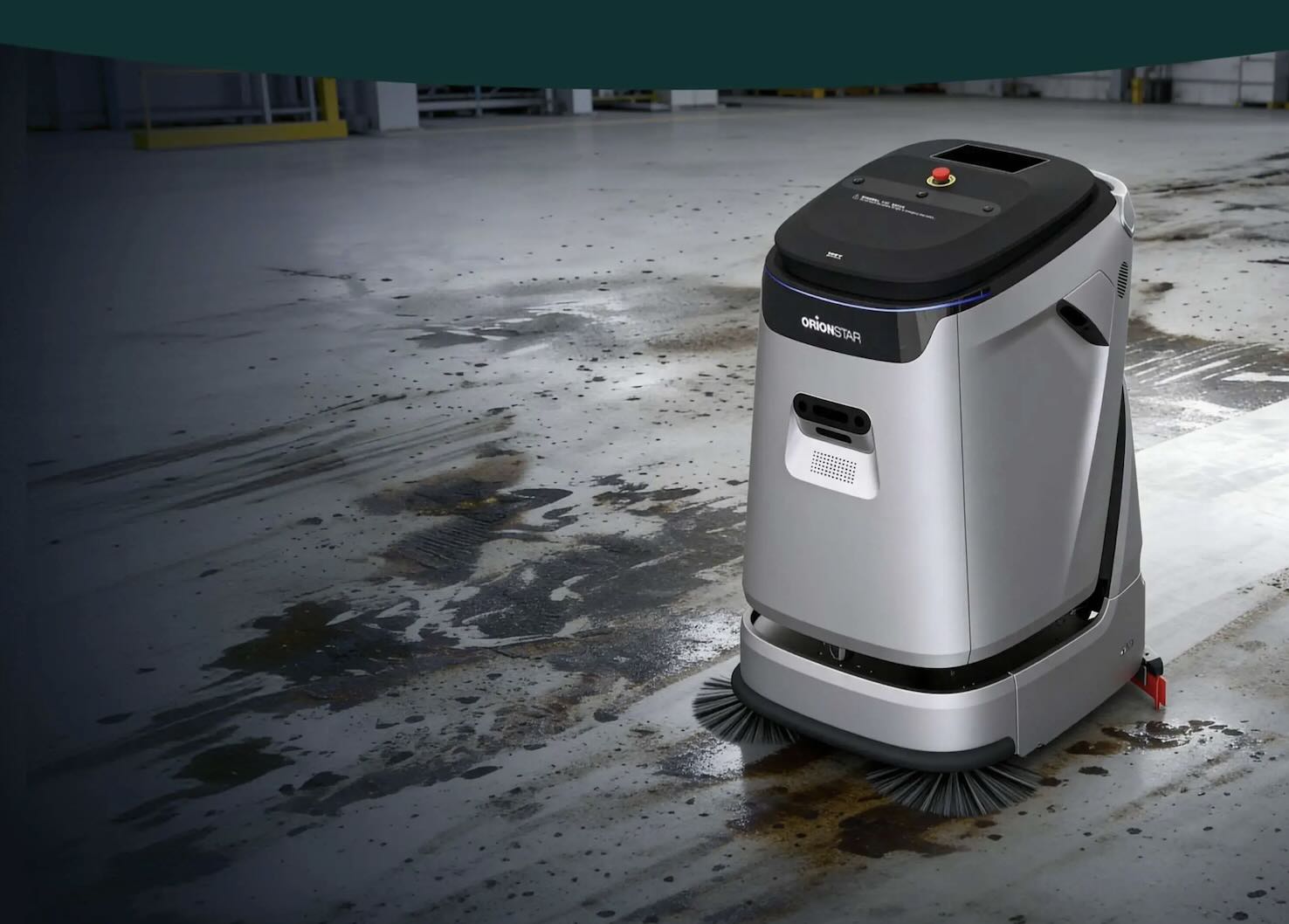
The OrionStar CleaniBot C5 is designed as a versatile solution for hard FM environments, featuring a 550 mm cleaning width and an operational efficiency of up to 1,980 m²/h under laboratory conditions. Weighing approximately 170 kg, this machine incorporates 90 L combined water tanks, balancing substantial capacity with a compact physical footprint. Its minimum passing width of roughly 880 mm allows it to navigate narrow corridors and densely populated retail spaces effectively. The robot is built to integrate seamlessly into diverse commercial buildings, offering agility across multi-tenant office towers and shopping mall lobbies.
To support the rigorous tracking required by facility owners, the CleaniBot C5 features an automatic docking station that enables self-cleaning and unsupervised charging. This autonomy is crucial for contractors who rely on night shifts to complete heavy scrubbing tasks without human intervention. Operating at a low noise level of <68 dB(A), the machine can also function during daytime hours without disturbing patrons in grocery chain stores. The robot provides sustained performance, delivering up to 3 hours of scrubbing or up to 8 hours of mopping according to manufacturer data, which directly supports the fulfillment of comprehensive daily SLAs.
The Tennant T7AMR addresses the needs of expansive commercial spaces as a mid-size autonomous rider scrubber, weighing roughly 495 kg. It is equipped with a 650 mm cleaning path and large 110 L solution and recovery tanks, designed for extended deployments in vast areas such as parking garages and wide shopping mall promenades. Driven by the BrainOS autonomy stack, the machine utilizes 3D cameras, 2D lidar, and ultrasonic sensors to interpret complex, dynamic environments. This robust sensor array allows the scrubber to handle continuous operations safely amidst pedestrian traffic and structural obstacles.
For hard FM providers, the primary value of the T7AMR lies in its ability to prove cleaning performance through BrainOS Fleet Management. The platform generates automated SLA reports and detailed coverage heat maps, allowing contractors to present objective data to building owners regarding shift completion and operational hours. The machine holds a CSA/ANSI 336 certification, verifying its safety for autonomous operation in public spaces. Capable of up to 4 hours of runtime at a quiet 67 dB(A), it supports both intensive nighttime cleaning and discreet daytime maintenance across high-traffic facilities.
The Nilfisk Liberty SC50 is a mid-size autonomous scrubber-dryer weighing approximately 400 kg, equipped with a 20-inch (508 mm) cleaning deck. It operates on the BrainOS autonomy stack, which provides consistent navigation and obstacle detection across complex retail and facility-services portfolios. The machine is engineered to manage the daily wear and tear of commercial buildings, offering reliable water distribution and mechanical scrubbing pressure. Its durable construction allows it to tackle varying floor types found across multi-tenant facilities and large-scale public lobbies.
Contractors utilizing the SC50 benefit significantly from its comprehensive fleet management and coverage reporting capabilities. By tracking every cleaning session, hard FM providers can easily extract performance data to validate SLA compliance and monitor operational efficiency. The robot is frequently deployed in demanding environments like grocery chains and back-of-house service areas, where proving shift completion is just as critical as the physical cleaning. Its integration into centralized reporting systems simplifies remote oversight for service providers managing multiple site locations.
Weighing approximately 285 kg, the Karcher KIRA B 50 is an autonomous scrubber-dryer that utilizes a 22-inch (550 mm) cleaning deck. It relies on advanced LiDAR-based mapping to navigate intricate commercial environments, establishing reliable routes through office corridors and expansive retail spaces. The system is backed by a strong European hard FM install base and a comprehensive service network, offering contractors responsive support for their equipment fleets. This stability is particularly beneficial for regional service providers who require consistent machine uptime to meet demanding daily schedules.
An optional docking station allows the KIRA B 50 to autonomously manage its water exchange and battery charging processes. This capability significantly reduces the need for manual intervention, making it highly effective for unsupervised night shifts in closed commercial buildings. When operators arrive for daytime shifts, the robot has already completed its scheduled routes and recorded the corresponding coverage data. The seamless integration of this autonomous cycle helps facility managers optimize their labor allocation and maintain high cleanliness standards without continuous oversight.
The Avidbots Neo 2W is built for highly demanding hard FM environments, presenting a heavy-duty autonomous scrubber that weighs around 472 kg. It features a compact scrubbing width configurable between 26 and 32 inches, optimized for heavy-duty commercial and industrial floors. This robust design makes it highly suitable for tackling tough accumulations of dirt, food debris, and oil spills commonly found in loading docks, back-of-house areas, and busy grocery chains. Its structural weight and downward brush pressure are specifically engineered to lift stubborn grime that lighter machines might leave behind.
Managing multiple Neo 2W units across different locations is streamlined through the Avidbots Command Center cloud platform. This unified interface allows service providers to execute remote management, dispatching robots and monitoring diagnostic alerts across diverse building portfolios from a single location. The platform captures vital operational data, providing hard FM contractors with the precise documentation needed to prove SLA fulfillment to stakeholders. By combining aggressive scrubbing power with advanced remote tracking, it supports consistent SLA compliance across demanding facility environments.
Evaluating and implementing the correct autonomous cleaning strategy fundamentally changes how hard FM contractors fulfill their SLA obligations. Success depends on aligning the physical capabilities of the robots with the specific debris profiles, foot traffic patterns, and spatial constraints of the managed properties. Whether a site requires the agile navigation of compact models for tight corridors or the heavy-duty scrubbing power necessary for loading docks, data-driven reporting remains the critical unifying factor.
Ultimately, the ability to generate verifiable coverage maps and remotely oversee multiple units dictates the long-term viability of these deployments. Facility managers must carefully assess their entire building portfolio to determine which autonomous platforms provide the right balance of physical cleaning power and software intelligence. By making informed selections, service providers can elevate their operational transparency, optimize labor resources, and consistently meet the rigorous demands of their commercial clients.
Facility management providers typically see a return on investment (ROI) within 12 to 18 months, depending on the scale of deployment and local labor costs. By automating repetitive floor scrubbing and sweeping in large areas like parking garages and shopping malls, FM contractors can reallocate staff to high-value touchpoint cleaning. This hybrid workforce model stabilizes long-term operational costs and significantly reduces the total cost of ownership (TCO) over the standard 3-5 year lifespan of the robot. Many vendors also offer Robotics-as-a-Service (RaaS) leasing models, allowing FM companies to adopt the technology as an operating expense (OpEx) rather than a large upfront capital expenditure.
Modern cleaning robots are equipped with cloud-based fleet management systems that generate real-time performance reports. These platforms track exact square footage cleaned, water usage, task duration, and missed areas, exporting the data directly into centralized FM dashboards. This automated reporting provides verifiable documentation of execution, allowing hard FM providers to maintain total transparency with building owners and support consistent SLA compliance without relying on manual logs. By digitizing the cleaning verification process, procurement teams can easily validate vendor performance during routine contract renewals.
Leading commercial cleaning robots are designed with strict data privacy protocols that support GDPR compliance in European and global markets. The built-in LiDAR and RGB cameras used for autonomous navigation are engineered to process navigation data locally without storing identifiable facial data or personal information of building tenants and visitors. All operational data transmitted to cloud servers is anonymized, heavily encrypted, and hosted on secure regional servers. This ensures that facility managers can safely deploy these devices in high-traffic lobbies, retail centers, and corporate offices without exposing the building owner to legal or privacy liabilities. To fulfill GDPR notification obligations, facility managers must place visible CCTV or robot monitoring signs in the cleaning areas.
Advanced cleaning robots utilize sophisticated 3D LiDAR, depth cameras, and ultrasonic sensors to autonomously navigate dynamic, high-traffic commercial spaces. They can automatically detect and avoid moving obstacles such as pedestrians in lobbies or delivery pallets in loading docks without any human intervention. Furthermore, they feature dynamic path planning capabilities that allow them to instantly reroute when a corridor is temporarily blocked, ensuring the cleaning cycle is completed safely. If a building layout changes significantly, operators can easily remap the area in minutes through an intuitive touchscreen interface.
Cleaning robots handle complex commercial layouts using specialized side brushes and close-proximity sensors specifically designed for tight grocery store aisles and narrow corridors. High-performance models like the CleaniBot C5 can clean in close proximity to walls, display racks, and baseboards, ensuring comprehensive edge-to-edge coverage. If an area is too narrow to enter or completely obstructed by temporary fixtures, the robot will record the missed zone and report it to the fleet management system. This allows human FM staff to precisely target these specific uncleaned spots during their shift, ensuring the overall facility meets required hygiene standards.
Most commercial-grade cleaning robots offer a continuous operating time of 3 to 6 hours per charge, enabling extensive coverage per shift. They typically clean between 1,000 and 1,500 square meters per hour, making them highly efficient for expansive hard floors in multi-tenant towers and back-of-house service areas. To support continuous autonomous operations, advanced units automatically return to their dedicated docking stations to recharge their batteries and exchange dirty water for clean water. This self-managing capability drastically reduces the physical workload on FM personnel, allowing a single operator to seamlessly manage multiple robots across a large commercial complex.
Third-party product specifications are based on public data (up to, under laboratory conditions, according to manufacturer data) and may vary. All performance metrics, including cleaning efficiency, battery runtime, and noise levels, depend on the operating environment, floor type, debris profile, and pedestrian density, so real-world results may differ. Product names and trademarks are the property of their respective owners. If any product involves cameras, voice recording, mapping, or cloud data processing, the operator must verify GDPR compliance prior to deployment. Data processing and storage features require acceptance of the respective manufacturer's End User License Agreement (EULA) and Data Processing Agreement (DPA).