

REQUEST DEMO
Robot CATALOG will be sent to your mailbox immediately after submission.
SUBMIT
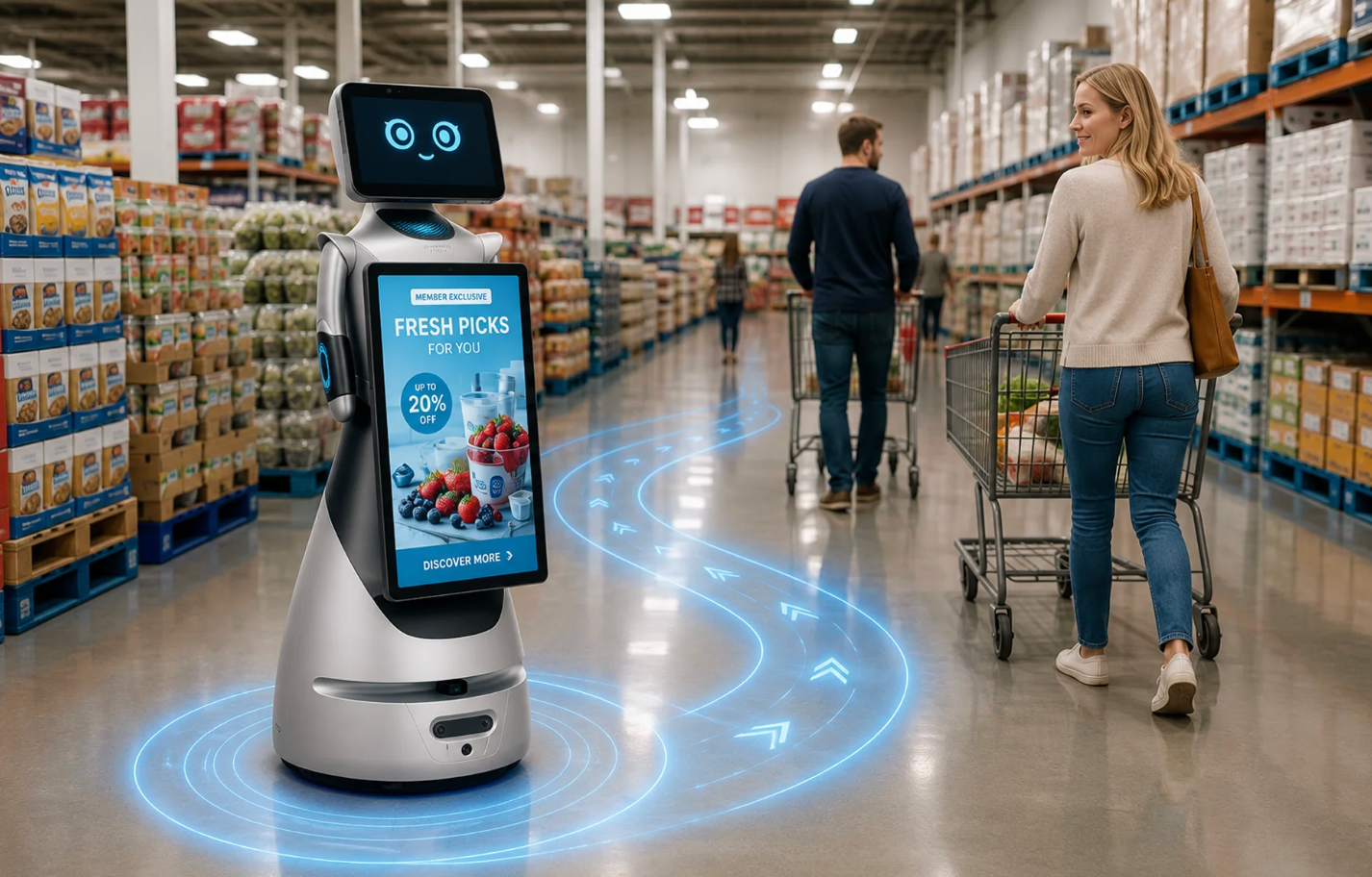
Hypermarkets in the retail industry face mounting challenges in maintaining engaging, accessible, and efficiently run environments, struggling with widespread labor shortages, rising maintenance costs, and evolving customer service expectations. Addressing these persistent operational hurdles requires a shift from static signage and manual customer guidance to automated interventions, positioning retail service robots as a highly effective solution. By taking over repetitive wayfinding and promotional broadcasting, these automated platforms allow operators to maintain superior customer experiences without further straining their human workforce.
The OrionStar GreetingBot AD exemplifies these advanced capabilities by combining autonomous mobility with interactive digital signage to support venue operations. Navigating autonomously via LiDAR and visual sensors, the robot can map areas of up to 50,000 square meters, according to manufacturer data, seamlessly moving through mid-to-large indoor layouts. It facilitates direct engagement and provides proactive greeting, indoor navigation, and real-time promotional displays through its integrated 21.5-inch FHD chest display and multi-modal voice system, operating reliably over long shifts with a battery runtime of up to 10 hours depending on the workload.
Main aisles experience the highest volume of foot traffic, making them highly susceptible to customer confusion and missed promotional opportunities. Retail service robots tackle these challenges by constantly patrolling the corridors to provide proactive greeting, indoor navigation, and real-time promotional displays. By automating these essential interactions, the robots maintain engaging paths for shoppers while instantly delivering relevant product information and guiding them to specific aisles.
Highlighting daily specials and guiding customers to high-margin items are critical in fresh food departments. Robots assist by providing dynamic mobile digital signage and interactive menus, elevating the shopping experience. This active engagement ensures the area remains vibrant while effectively promoting fresh merchandise to customers.
The entrance sets the operational tone for the hypermarket and is often crowded with incoming and outgoing traffic. Deploying robots here provides immediate wayfinding assistance and promotional information via digital screens, reducing initial shopper confusion and preventing bottlenecks.
Checkout zones are prone to congestion, cart abandonment, and friction related to self-service staffing constraints. Robots can monitor visitor density, provide queue guidance, and display necessary operational notices to keep traffic flowing efficiently without overwhelming the limited human workforce.
Retail service robots integrate deeply with existing hypermarket infrastructure to close the loop between customer engagement and in-store promotions. The robots serve as mobile digital signage nodes that seamlessly update promotional content across the store. Furthermore, these robotic platforms can connect with Electronic Shelf Labels (ESL), point-of-sale (POS) systems, and broader retail analytics dashboards, transforming basic customer guidance into actionable promotional campaigns, targeted advertising, and optimized traffic flow.
Retail service robots are fundamentally changing the way the retail industry maintains and operates hypermarkets, shifting focus from reactive manual labor to proactive, automated management. By addressing critical workforce shortages and ensuring consistent customer engagement, these intelligent systems enable staff to concentrate on meaningful customer service and complex operations. The OrionStar GreetingBot series provides a variety of models designed to adapt to diverse spatial and operational requirements, accommodating the specific needs of modern retail environments.