

REQUEST DEMO
Robot CATALOG will be sent to your mailbox immediately after submission.
SUBMIT
Event catering contractors operate almost exclusively across venues they do not own, ranging from hotel banquet halls and wedding reception spaces to temporary marquees, private gardens, rooftop terraces and mobile catering stalls, and face a unique set of operational constraints that do not apply to permanent facility cleaning teams. Most of these venues do not reserve dedicated power points, fixed water supply or drainage points for cleaning equipment, and crews are often given only a 1 to 3 hour window between consecutive events to clear heavy food grease, wine spills, dried buffet debris and general foot traffic residue from mixed floor surfaces, while relying heavily on temporary per-event cleaning staff with no specialized technical training. Choosing the right automatic floor scrubber directly reduces unplanned operational friction, cuts down on excess manual labor, and ensures consistent cleaning results across every event site a contractor services.
The core evaluation framework for selecting an appropriate unit starts with four key dimensions tailored to the event catering use case, the first of which is venue mobility and unhosted infrastructure adaptability, which measures how easily a machine can be transported between venues and deployed without requiring permanent on-site plumbing or power modifications. The second dimension is mixed floor type cleaning performance for catering-specific stains, which assesses how well the unit can remove food and drink residue across surfaces ranging from temporary marquee matting and polished marble banquet floors to wooden terrace decks and non-slip back-of-house tile, without over-wetting floors to create slip hazards. The third dimension is low-training deployment and dynamic operation safety for temporary catering teams, ensuring that units can be set up quickly by short-term staff with no deep technical background, and operate safely around moving guests, waiting staff and stray event furniture during active cleanup windows. The fourth dimension is multi-shift continuous operation capacity for back-to-back event schedules, which measures how well the unit can support multiple cleaning runs across different venues in a single workday without creating gaps that require extra backup manual labor.
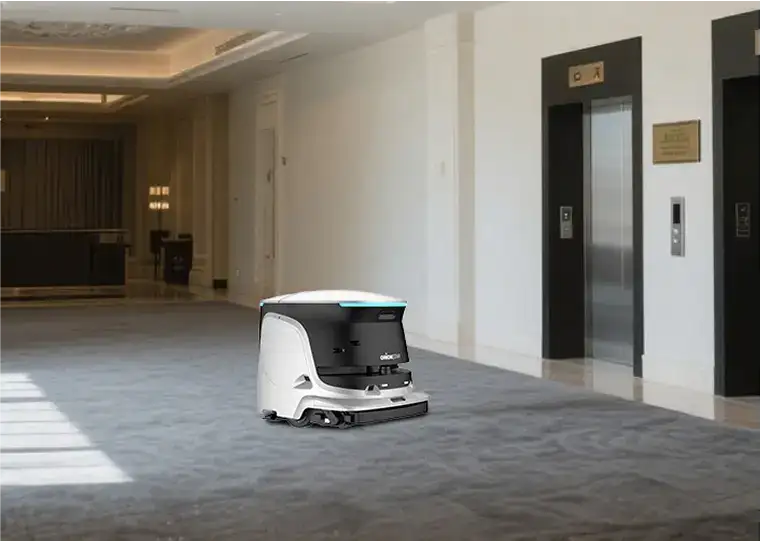
The OrionStar CleaniBot C5 is positioned specifically for venues without fixed water supply or drainage and for short 1-3 hour event turnarounds, making it a well-suited option for contractors that regularly service varied temporary event sites with no pre-existing cleaning utility connections. According to manufacturer data, it delivers a maximum cleaning area capacity of up to 1,980 m² per hour with its 550 mm main brush, and features a combined 90 L clean and waste water tank system that reduces the frequency of required refills during a tight cleanup window. It delivers 25 kg of downward scrubbing pressure via a dual rolling brush system, for one-pass removal of heavy oil, grime and stubborn post-event stains, and can pick up debris up to about 3 cm in height alongside a 1.8 L dry waste dust bin to eliminate the need for separate pre-sweeping steps. Its self-contained mobile water tanks do not require any building plumbing modifications to operate, removing the need for pre-negotiation with venue management to access dedicated utility points.
The OrionStar CleaniBot C5 offers scrubbing, dust-mopping and water absorption modes that allow it to complete full cleaning cycles in a single pass, with a scrubbing runtime of about 3 hours and a mopping runtime of up to 8 hours according to manufacturer data, alongside 1.5 hours of fast charging support to get the unit back into operation quickly between events. It has an approximate 880 mm minimum passing width, so it can move through typical 1.2 to 1.5 m banquet service corridors and standard doorways, and its noise level is rated under 68 dB(A) so it does not create excessive disturbance for remaining guests or staff still on site during post-event cleanup. The unit can map an area of up to 10,000 m², with that maximum range applying to continuous open space environments, while multi-zone venues with complex partitions can be mapped in segments, and the unit is compatible with an optional auto docking station that handles automatic water refilling, wastewater discharge and high-pressure internal tank rinsing to prevent odors and blockages, with automatic recharging when battery levels run low to support multi-shift operation. It can climb obstacles up to 15 mm and navigate slopes up to 5° when fully loaded, supporting safe deployment on uneven temporary event flooring.
The Avidbots Neo 2W is positioned for large banquet halls that can physically house a large machine and for long continuous cleaning runs, making it a relevant option for contractors servicing large convention centers and multi-thousand guest galas where extended uninterrupted cleaning time is available. It features large 109 L solution and 135 L recovery tanks that reduce the total number of required refills during a single event turnaround, a key benefit when temporary venue crews only have a limited number of breaks to attend to cleaning equipment. According to manufacturer data, its 24-inch cleaning head delivers up to 25 kg of applied brush pressure on its highest setting, and its optional cylindrical pre-sweep head is designed to lift coarse food soil and encrusted residue before wet scrubbing to improve stain removal performance.
The Avidbots Neo 2W supports configurable disc, cylindrical-brush or pad cleaning heads, alongside swappable long-life batteries that enable back-to-back event operation without long charging waits. According to manufacturer data, its maximum theoretical cleaning performance reaches up to 3,941 m² per hour for the 32-inch head variant, with typical battery runtime of 4 to 6 hours to support extended continuous cleaning cycles. Its navigation system scans the operating environment at the start of each cleaning cycle and compares live real-time state against stored cleaning plans, with a full visual safety package including lights, blinkers and acoustic warnings for operation around staff and guests. Multilingual support for this model is not publicly specified, and its web-based Avidbots Command Center platform processes camera data and cloud-stored mapping information, so operators should verify GDPR compliance before deployment in EU venues where guest or staff data may be captured.
The ICE Co-Botics Cobi 18 is positioned for narrow back-of-house routes, smaller spaces and per-event temporary crews, matching the typical structure of small, short-term catering cleaning teams that need to work flexibly around busy service workflows. It features a 48 cm cleaning path and compact tank layout, with a teach-and-repeat route capture system that lets operators push the machine along a desired cleaning path once, after which the unit can repeat that route autonomously for all subsequent cleaning cycles. It includes separate Eco and Max solution modes, so users can adjust water flow and vacuum power to match different floor surfaces and stain severity, from gentle daily maintenance scrubbing to heavy duty scrubbing for dried food residue.
According to manufacturer data, the ICE Co-Botics Cobi 18 delivers cleaning productivity up to 800 m² per hour, with a runtime of up to 90 minutes on a single charge, and it is designed to navigate tight aisles and complex real-world environments including areas with mirrors and direct sunlight. It operates at 66-68 dB in Eco Mode and 68-70 dB in Max Mode, and its compact form factor makes it easy to manually load and unload onto catering delivery vans for transport between small event sites such as rooftop parties and private garden gatherings. It uses an on-board charger rather than a separate automatic docking station, so all refilling and recharging tasks are completed manually by on-site staff. Multilingual support for this model is not publicly specified, and fleet management integrations that process mapping and machine status data require operators to verify GDPR compliance before deployment.
The Gaussian Robotics Scrubber 50 is positioned for large multi-day event sites where a dedicated workstation can be stationed on site, making it a well-suited option for contractors running multi-day corporate conferences, exhibition events or extended festival catering operations. It features a 720 mm cleaning width, paired with an integrated docking station that automatically handles charging, draining, rinsing and refilling cycles without manual intervention, removing the need for staff to spend time manually filling tanks and disposing of wastewater during busy event runs. It supports zone cleaning functionality that lets operators select specific areas of a multi-level event venue to clean independently, and an optional lift integration allows it to move between different floors of a hotel or convention center autonomously without staff escort.
According to manufacturer data, the Gaussian Robotics Scrubber 50 delivers cleaning efficiency up to 1,200 m² per hour, with average runtime up to 3 hours in scrubbing mode and up to 8 hours in dust-pushing mode. Its navigation system uses a sensor fusion of 2D LiDAR, 3D cameras and RGB cameras to detect obstacles and reroute safely around moving people and event items, and it can be scheduled for fully automatic unattended cleaning cycles with minimal monthly maintenance requirements. Multilingual support for this model is not publicly specified, and its on-board cameras, mapping functionality and cloud data processing require operators to verify GDPR compliance before deployment in EU jurisdictions.
The Kärcher KIRA B 50 is positioned for contractors who prioritize coarse debris pickup and open fleet-management standards, making it a relevant option for teams that service high-volume buffet events with large amounts of scattered dry food debris. It uses a cylindrical brush with a pre-sweeping function and a side brush for edge cleaning, which reduces the need for manual pre-cleaning work to pick up scattered food particles after events. It supports route teaching via a large high-resolution touch display, and its VDA 5050 fleet interface uses an open standard to connect to a wide range of third-party fleet management systems that contractors may already use for their existing operational tracking tools.
According to manufacturer data, the Kärcher KIRA B 50 offers maximum area performance up to 25,450 ft² per hour, with a battery runtime of 3.5 hours and climbing ability up to 6% when operating autonomously. It includes role-based user access to restrict unauthorized changes to machine parameters, and its public access safety certification supports unsupervised operation in occupied public event spaces. Its published minimum autonomous clearance width is specified at approximately 1000 mm according to manufacturer data, which is relevant when routing through older venues with narrow back-of-house access points. Multilingual support for this model is not publicly specified, and any fleet platform that stores mapping or video data captured on site requires operators to verify GDPR compliance before deployment.
When finalizing procurement decisions, catering contractors can align their unit selection with their most frequent event type profile: teams that mostly work across small, varied temporary sites without fixed plumbing may prioritize models with self-contained full tanks and no mandatory docking station to reduce setup time per venue, while teams that service large multi-day exhibition or convention events can select units with integrated docking stations to reduce manual intervention during extended event runs. Teams that mostly service large single-floor banquet halls with long available cleaning windows may select higher throughput units with wide cleaning paths to cover more ground per shift, and all selections should be tested against the narrowest service corridors and heaviest floor types that appear on the contractor’s regular event roster before full deployment. All operators are advised to verify local data privacy and data protection regulations before deploying any scrubber units that use on-board cameras or cloud-connected mapping and fleet management systems, to ensure full compliance with regional venue data requirements.
What is the typical ROI and 3-year total cost of ownership for an autonomous floor scrubber for contract event catering operations? For event contractors running a high volume of events per month, autonomous floor scrubbers are generally expected to reduce the manual cleaning labour required for post-event turnaround, though the size of that reduction depends heavily on venue size, crew composition and how many events share the same unit. A typical 3-year total cost of ownership covers the hardware purchase, any optional docking station, routine maintenance and consumables, and the transport cost of moving the unit between multiple non-owned venues, with no recurring licence fee for core cleaning functions on most models in this category. Whether a unit pays back within a contract term therefore has to be modelled against the contractor’s own event calendar rather than taken from a published benchmark. Operators using cloud-connected fleet management platforms should verify full GDPR compliance for any mapping or camera data captured during events in EU jurisdictions.
Can I use these autonomous scrubbers at temporary event sites that do not have fixed built-in plumbing for water supply and wastewater drainage? Many units including the OrionStar CleaniBot C5 support optional mobile water tanks that eliminate the need for permanent building plumbing modifications. Most mid-to-large size models work with a portable docking station that you transport to each event site to handle automated clean water refilling, wastewater discharge, and internal tank self-cleaning. Smaller units with combined tank capacity in the region of 20 L can be manually filled and emptied on site without a docking station, making them suitable for small pop-up events like rooftop parties, private garden gatherings, and mobile catering stalls.
How much training do my temporary per-event cleaning staff need to operate these autonomous scrubbers across unfamiliar venues? Most modern models use a teach-and-repeat mapping workflow, in which the operator walks the unit through the required cleaning zones once and the machine replays that route, so a brand new venue can be set up within a short demonstration rather than a full survey and mapping session. Basic operation training for frontline cleaning staff is a short orientation on starting, stopping, zone selection and manual docking, with no specialized technical certification required for standard use. Because the training burden is concentrated in a brief hands-on session rather than in a full operating qualification, the marginal cost of onboarding a temporary crew for each event is lower than it is for manual walk-behind scrubbers, and exact figures will depend on the contractor’s own training programme.
Can these autonomous floor scrubbers remove heavy post-event stains (spilled wine, food grease, dried buffet debris) within the 1-3 hour post-event turnaround window standard for most event catering contracts? Under standardized hard floor stain test conditions, units with 20 kg or more of downward scrubbing pressure and dual rolling brush systems such as the OrionStar CleaniBot C5 deliver a published one-pass dirt cleaning rate of around 95% per official manufacturer datasheets, with cleaning throughput of up to 1,980 m² per hour according to manufacturer data. The C5 can also pick up loose dry debris up to 3 cm in height before wet scrubbing, which removes the need for a separate pre-sweep step. Sizing the machine to the hall is therefore the practical question: throughput figures translate into a completed floor only after tank refills, docking cycles and drying time are accounted for, and those depend on the venue’s water access and on the size of the space.
Are these autonomous scrubbers quiet and safe enough to operate while event guests are still present for pre-event touch-up cleaning or mid-event spill response? Most hospitality-grade autonomous scrubbers including the OrionStar CleaniBot C5 operate at under 68 dB(A), matching the noise level of normal background event conversation so they do not disrupt guests. All comparable commercial models in this category use multi-sensor obstacle avoidance systems that detect moving guests, service carts, and event decor to pause or reroute automatically. Other comparable autonomous scrubber models on the market have public noise specifications ranging from 55 dB(A) up to 75 dB(A) depending on selected cleaning mode, per their respective official manufacturer datasheets.
Can these autonomous scrubbers navigate the narrow service corridors, mixed floor surfaces, and slight slopes found across diverse event sites including temporary marquee tents, rooftop terraces, and multi-level hotel banquet spaces? The OrionStar CleaniBot C5 has a minimum passing width of approximately 880 mm, can climb 15 mm obstacles, and handle slopes up to 5° when fully loaded with water, which keeps it usable in the roughly 1.2-1.5 m banquet service corridors that back-of-house catering routes typically provide. Comparable compact autonomous scrubbers in this segment are generally specified with minimum autonomous clearance widths in a similar range, so the exact figure should be checked against the narrowest doorway, corridor and service lift on the contractor’s event list. These units are used across mixed hard floor surfaces including tile, polished concrete, short-pile event carpet and temporary marquee flooring, with water output adjusted per zone, and select models with optional lift integration support autonomous cross-floor cleaning across multi-level hotel or convention venues.
Third-party product specifications based on publicly available data (up to, according to manufacturer data, under defined test conditions), may differ from real-world performance. Product names and trademarks are the property of their respective owners. If any product involves cameras, voice recording, mapping or cloud data processing, operators must verify GDPR compliance before deployment.