Introduction
In full service restaurants, staging areas serve as the central hub where plated dishes are temporarily held after kitchen prep before front-of-house pickup, alongside dirty dish collection points and bar beverage prepping counters, and these high-traffic zones regularly face understaffing gaps, rising labor costs for back-of-house transit roles, and pressure to align operations with FDA Food Code requirements for safe food handling during transfer, creating unnecessary bottlenecks that slow down table service and reduce overall guest satisfaction, making restaurant robots a targeted, scalable solution to ease these recurring operational pains.
The growing need for smarter transit in staging areas
- The staffing hole sits at the kitchen end. The National Restaurant Association’s State of the Restaurant Industry 2025 reports full-service restaurant employment still more than 150,000 jobs below pre-pandemic levels by the end of 2025, and 78% of full-service operators have trouble filling chef and cook roles. Kitchen managers are the ones absorbing that gap, and staging areas are where it shows.
- Peak-hour transit is the first thing to degrade. When the kitchen finishes several orders together, staff availability at the pass and at the table does not line up. One documented deployment measured roughly 210 daily food-running and dish-return movements, with an estimated 55% assessed as eligible for robot transport.
- Labour cost is the top line on the operator scorecard. Full-service operators rank labour costs as their single biggest challenge for 2025, ahead of food costs, and average restaurant wages are up more than 30% from 2019. In the 2024 review, 97% of full-service operators cited labour costs as significant.
- Margin is too thin to simply add runners. 39% of operators said their restaurant was not profitable in 2024, and 61% reported declining customer traffic between 2023 and 2024, so staffing has to be spread thinner over the same floor rather than replicated per unit. The same pressure is felt physically: in a Norwegian deployment, a 20-guest table required ten waiter round trips without a robot, versus two robot trips plus two waiter trips with one.
How restaurant robots can help
- Restaurant robots leverage visual SLAM navigation to create accurate, real-time maps of full service restaurant floor plans, including dynamic changes to staging area layouts during peak hours.
- These systems support multi-tray open-tray delivery to move multiple dishes or sets of used tableware across different staging sub-spaces in a single trip.
- Restaurant robots operate across multiple configurable modes including fast delivery, low-vibration soup transport, cruise patrol, and multi-point collection to match varying operational needs in busy staging areas.
- Leading models come with 240-degree 3D all-around obstacle recognition, according to manufacturer data, to avoid collisions with moving staff, stacked dishes, and dropped items in narrow, high-foot-traffic staging zones.
- Integrated smart dish detection functionality lets the robots track delivery status and confirm when trays are picked up by front-of-house staff, reducing lost or misrouted orders.
- Many deployed units add automatic charging docks and cable charging so a robot can cover a full service shift without manual plug-in cycles. Because these units map and navigate food-handling zones, operators should verify how mapping and operational data are handled against the FDA Food Code food safety requirements and, where relevant, data protection rules such as GDPR.
A closer look: OrionStar LuckiBot Pro in action
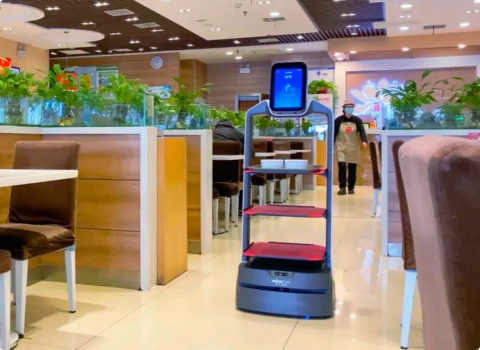
As a flagship unit in the category, the OrionStar LuckiBot Pro delivers on all the core universal capabilities for staging area operation outlined above, with a series of hardware and software upgrades built for high-volume full service restaurant environments. According to manufacturer data, the unit carries up to 60 kg total payload across an adjustable 3 to 4 tray configuration, with up to 15 kg on a single tray. In a typical cruising scene it runs up to 12 hours on a single charge, and actual runtime depends on load and floor conditions. Per official marketing data, moving efficiency is up to 3x that of the previous generation, which lets it cover repeated staging-to-table runs without the manual wait times a fixed staffing plan leaves behind. A quasi-circular chassis and Torsion Bar Suspension are designed for pass-through routes where floor transitions and dropped items are common.
Benefits for full service restaurant teams
- A Measurable Drop in Manual Movement In a six-week pilot at an anonymized full-service restaurant in Barcelona, scoped to food transport to staffed handoff zones plus controlled dish returns, manual transport movements fell from roughly 210 to roughly 101 per day in the stabilized phase, with 97.6% task completion across 52 robot cycles a day.
- Time That Converts to Service, Not Transit That same pilot released roughly 104 staff minutes per day, or about 624 hours a year, of which 510 were avoided peak scheduling and 114 were deliberately reinvested in service capacity rather than booked as cash savings. Peak-period server walking fell 18%.
- Faster Pass-to-Table Handoff Kitchen-pass-to-handoff time in that deployment fell from 4.9 to 4.3 minutes and average table-reset time from 8.7 to 7.8 minutes, while manual interventions dropped from 4.8 to 2.4 per 100 cycles with no major robot-related safety incidents recorded in the pilot window.
- Fewer Manual Interventions on Busy Shifts Handoff discipline turned out to matter most: requiring a confirmed ready receiver before dispatch cut average handoff waiting from 2.4 to 0.9 minutes, and fixed tray assignments plus batch-dispatch rules cut underloaded cycles from 31% to 12%.
- Lower Risk of Spills and Cross-Contamination Low-vibration soup delivery modes and non-contact transfer reduce how often staff hand-carry hot, unstable trays and how often plates are touched in transit. Teams deploying robots should still confirm that equipment contact surfaces meet local food-contact safety specifications and that transfers keep plated food within the temperature windows the FDA Food Code requires for their menu.
- Data-Backed Operational Visibility Documented deployments report that managers gain cycle, waiting, blockage, intervention, charging, and exception data from the transport system, letting them see staging-area bottlenecks that a busy shift normally hides. Note that the Barcelona pilot delivered a 7.8% first-year return on hard savings under a Robotics-as-a-Service model, and its own sensitivity analysis showed that whether released time converts into an avoided, budgeted labour cost matters more than robot speed.
Real-world applications
The Pass and Plating Line
The pass and plating line is the busiest point in staging areas, where finished plated dishes pile up rapidly during peak service, creating clutter that blocks kitchen staff from accessing their stations. Restaurant robots can pull finished dishes directly from the end of the plating line to the next staging handoff zone, preventing overcrowding on the narrow line surface and cutting the risk of accidental dish drops. Width is the practical limit here: in the documented Barcelona deployment the longest approved one-way route ran 29 metres, the narrowest shared guest route was 1.25 metres, and the narrowest back-of-house passage was 0.95 metres, so operators should measure their own circulation before assuming a route.
The Expo Handoff Zone
The expo handoff zone is the designated staging point where food runners collect finished orders to deliver to dining guests, and it often becomes a crowded bottleneck when multiple staff rush to pick up dishes at the same time. Restaurant robots can drop off pre-sorted order batches at the expo handoff zone at regular, staggered intervals, eliminating sudden surges of foot traffic that cause congestion and order mix-ups.
The Back-of-House Dish Return Staging Area
The back-of-house dish return staging area often piles high with dirty tableware during post-shift collection rushes, creating tripping hazards for staff moving through the narrow adjacent aisles. Restaurant robots can autonomously collect stacked dirty dishes from the dining room and drop them off at the dish return staging area at a steady pace, preventing large unmanageable piles of tableware from building up at the zone.
The Bar and Beverage Staging Counter
The bar and beverage staging counter is a high-precision zone where mixed drinks and alcoholic beverages are lined up for pickup, and spills here can cause costly product waste and create safety hazards for staff. Restaurant robots with low-vibration transport modes can move finished drinks directly from the bar staging counter to the expo handoff zone without requiring bartenders to step away from drink preparation tasks.
Integration with other smart systems
Integration for staging areas starts with the order and dispatch stack rather than the building systems: the operative layers are the POS, the kitchen display system (KDS), order-aggregation platforms, and runner-facing ticket views. On a typical KDS workflow, a cashier or server enters the order in the POS, each station sees its assigned items, cooks bump them as they finish, and expo or runner staff check status on screen for the handoff. A delivery robot that plugs into this flow can read order identity, confirm handoff, and reconcile dish returns, and open hardware platforms with universal data and power interfaces plus SDK APIs are what make that kind of connection practical. Integration is also the hardest part of the project: research on restaurant robots names integration with often outdated hospitality systems as a central barrier to adoption, alongside unit prices in the USD 20,000 to 100,000 range and maintenance windows of three to five days. Operators are therefore advised to involve staff in planning robot routes, remove stairs and doorsteps during front-end facility design rather than retrofitting them later, and test the workflow before committing to a fleet-wide rollout.
Supporting ESG and sustainability goals
- Bounded hot-holding exposure. The FDA Food Code places food in the temperature danger zone between 41°F and 135°F (5°C to 57°C) and requires that time in that range be minimized. Every minute a plated dish waits on a staging surface is a minute counted against that exposure, so shortening and bounding the wait through scheduled, traceable transport is a food-safety measure before it is a productivity one.
- Less food and dishware waste. Digital ticketing has been documented to improve order accuracy and reduce food waste, because lost tickets and missed modifiers turn into remakes and comps. The same logic applies at the pass, where an unrouted or late dish becomes a remake.
- Work that augments rather than replaces. In National Restaurant Association 2024 technology research, 69% of surveyed operators said restaurant technology would augment rather than replace human labour, which is the framing operators use when they move transit work off the floor without cutting staff. Documented deployments make the same boundary explicit: the restaurant team retains responsibility for dish verification, food safety, loading, handoff and exception response, while stairs, allergen-sensitive exceptions and special presentation stay with trained employees.
Taken together, these changes support a fuller ESG position for a full service restaurant by making food-safety compliance auditable, reducing avoidable waste, and improving working conditions for staff assigned to back-of-house and front-of-house transit roles. Published, quantified sustainability metrics for transport robots in full service restaurant staging areas are not yet publicly available, so operators should measure their own baseline before and after deployment.
Closing
Restaurant robots are steadily reshaping how full service restaurants maintain efficient, low-congestion operation of their staging areas, eliminating long-standing bottlenecks that have slowed service and raised operating costs for decades. The OrionStar LuckiBot series offers a range of different models with varying payload, runtime, and interaction feature sets to match the unique staging area layout and throughput needs of restaurants of all sizes, for teams looking to evaluate options that align with their specific operational requirements.