REQUEST DEMO
Resources > Blogs > Beyond Manual Pallet Moves: Intralogistics Robots for FMCG Manufacturing Finished Goods Storage

Beyond Manual Pallet Moves: Intralogistics Robots for FMCG Manufacturing Finished Goods Storage

2026-10-20 12:22 OrionStar

Beyond Manual Pallet Moves: Intralogistics Robots for FMCG Manufacturing Finished Goods Storage

Introduction

FMCG manufacturing facilities operating finished goods storage spaces face overlapping operational pain points including persistent labor shortages for repetitive heavy-lifting transport roles, elevated risk of musculoskeletal injuries for frontline warehouse staff, strict regulatory compliance requirements for safe materials handling, and steadily rising long-term costs tied to fully manual pallet movement workflows, making intralogistics robots a targeted, low-disruption scalable solution that addresses these overlapping challenges without requiring full overhauls of existing daily warehouse operations.

The growing need for automated material handling in finished goods storage

  • Plant managers face consistent understaffing for heavy finished goods transport shifts, leading to unplanned delays in order dispatch and missed delivery commitments for retail and distribution partners.
  • Supply chain and logistics managers struggle to align variable manual transport capacity with fluctuating FMCG production peaks, especially during seasonal promotional periods when finished goods volumes rise sharply and then fall back within weeks.
  • Finished goods warehouse supervisors must keep every unit-load movement inside OSHA’s warehousing and materials handling rules, including the requirement that only trained and certified workers operate powered industrial trucks, alongside the backover and under-ride crushing hazards OSHA flags in storage areas.
  • Intralogistics engineers are tasked with upgrading legacy material handling systems without costly facility retrofits, as most FMCG finished goods storage spaces were not originally designed for fixed automation infrastructure like rail-guided AGVs.

How intralogistics robots can help

  • Intralogistics robots support marker-free VSLAM navigation that eliminates the need for pre-installed guidance infrastructure across warehouse floors.
  • These systems integrate LiDAR and depth-camera based obstacle detection to identify both static stored pallets and moving personnel or equipment in active warehouse aisles.
  • Centralized autonomous fleet scheduling software enables seamless multi-robot cooperation to avoid bottlenecks at high-traffic zones like dock doors and aisle intersections.
  • Most modern intralogistics robots feature automatic charging and auto-recharge functionality that supports continuous operation across shifts without scheduled manual intervention for battery management.
  • The systems support both fixed point-to-point delivery routes and flexible multi-point cruise paths that can be adjusted remotely to match shifting storage layout requirements.
  • Open API architecture allows direct, low-friction integration with existing WMS, WES, and MES platforms that FMCG facilities already use to track finished goods inventory.
  • On-board touchscreen operation and real-time performance monitoring give on-site warehouse teams visibility into robot activity without requiring specialized technical training.
  • All operations involving on-board visual perception sensors must be reviewed by facility operational teams to confirm full alignment with applicable OSHA (US warehousing and materials handling regulations) requirements for site safety data collection.

A closer look: OrionStar CarryBot D150 in action

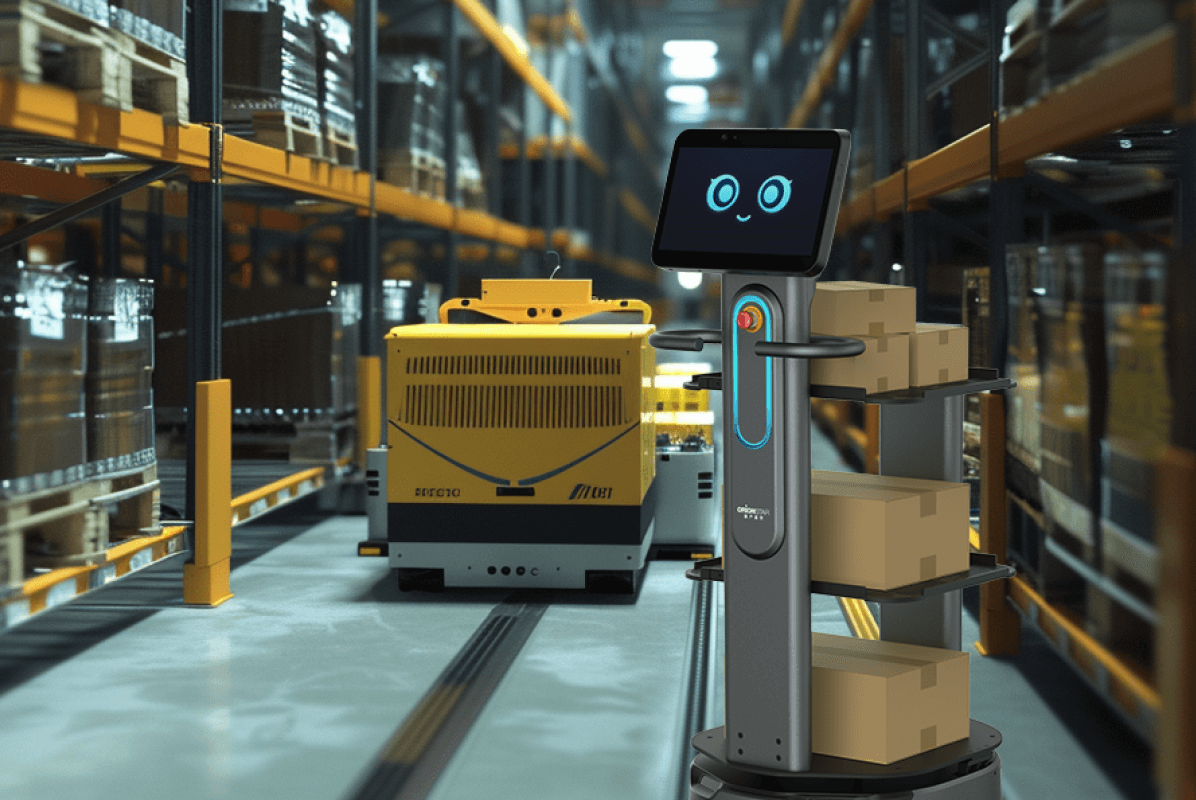
The OrionStar CarryBot D150 delivers the core intralogistics robot capabilities outlined above on a VSLAM 2.0 platform that supports rapid deployment without facility modifications, with a net payload capacity of up to 150 kg according to manufacturer data to suit most standard packaged FMCG finished goods transport tasks. According to manufacturer data, the robot runs up to 12 hours on a single charge when tested with a 100 kg load on a marble floor, and its stated positioning accuracy of up to 1 cm under those same defined test conditions supports consistent drop-off of pallets and goods even in narrow storage aisles. It is offered in three configurable top module variants to match different transport workflows, including a flat platform, a multi-tray setup, and an integrated shelf configuration, to accommodate the wide range of packaging formats common to FMCG finished goods.

Benefits for plant managers, supply chain and logistics managers, finished goods warehouse supervisors, intralogistics engineers

  • Reduced reliance on manual labor for heavy transport tasks: FMCG facilities can reallocate existing warehouse staff to higher-value, less repetitive tasks such as quality inspection and order verification, addressing persistent industry labor shortages.
  • Lower risk of workplace injury and OSHA non-compliance: Taking staff off the highest-risk heavy lifting and unit-load moving workflows reduces exposure to the ergonomic and powered industrial truck hazards OSHA documents in warehousing, which in turn lowers worker’s compensation caseloads and injury-related downtime. According to manufacturer data, labor intensity in transport tasks can be reduced by up to 80%.
  • Consistent, predictable material handling throughput: Unlike manual teams whose performance varies across shifts, intralogistics robots deliver consistent transport speeds; according to manufacturer data, cycle time in transport workflows can be reduced by up to 50%.
  • Measurable reduction in long-term operational costs: According to manufacturer data, operating cost in transport workflows can be cut by up to 50% compared with fully manual handling, and productivity in material movement can improve by a factor of two to three.
  • Data-driven intralogistics performance visibility: Fleet management software logs all transport routes, task completion times, and robot performance data to give teams actionable insight into bottlenecks across the finished goods storage space.
  • Flexible, low-disruption deployment: Marker-free VSLAM intralogistics robots can be fully mapped and operational in as little as one day according to manufacturer data, with no requirement for costly facility retrofits that would interrupt ongoing finished goods storage and dispatch operations.

Real-world applications

Pallet Racking Aisles

FMCG finished goods storage pallet racking aisles often have narrow clearances that leave limited space for traditional forklift movement, creating high collision risks with stored pallets and nearby staff. Intralogistics robots with a compact footprint and on-board obstacle detection can work in passages as narrow as 65 cm according to manufacturer data, with actual clearances varying by on-site pallet and personnel activity, transporting finished goods directly between pick faces and drop locations without blocking adjacent storage positions.

Pallet Staging and Laydown Zones

These high-traffic open zones are often cluttered with half-staged pallets, empty packaging, and temporary equipment that creates constant, unpredictable obstacles for manual transport teams. Intralogistics robots can dynamically adjust their navigation paths in real time to avoid newly placed obstacles, ensuring consistent delivery of finished goods to and from staging areas even as layout changes occur throughout the work shift.

Loading Docks

Loading dock operations are time-sensitive, with strict windows to transfer finished goods from warehouse storage to waiting over-the-road delivery vehicles. Intralogistics robots can run across multiple shifts to shuttle pallets from nearby storage locations directly to dock doors, reducing gaps in transport capacity that cause delays in truck turnaround times.

Dispatch Marshalling Areas

These dedicated zones are used to group finished goods by outgoing delivery route, requiring frequent, repeated transport of partial pallets and individual order batches across short distances. Intralogistics robots can run pre-configured multi-point cruise routes across marshalling zones to automatically drop off goods at pre-assigned waypoints, reducing the need for staff to walk long distances carrying heavy packaged items.

Integration with other smart systems

Intralogistics robots are designed to integrate with existing FMCG manufacturing facility systems, leveraging open API frameworks to connect to warehouse management systems (WMS), warehouse execution systems (WES), and manufacturing execution systems (MES) to pull real-time task data automatically, eliminating the need for manual task entry by warehouse staff. When a new finished goods batch is marked as completed on the production line in the MES, a connected robot fleet can receive a task to move the batch to the designated finished goods storage location, with task completion status synced back to the WMS to update inventory records. On-site IoT sensor networks for temperature and humidity monitoring are commonly present in FMCG finished goods storage, and operators typically wire that data into the same supervisory layer so that human supervisors can decide how robot routes should adapt to conditions appropriate for sensitive products such as food or personal care items.

Supporting ESG and sustainability goals

  • Reduced emissions from material transport operations, as battery-powered intralogistics robots avoid the on-site combustion emissions generated by fossil fuel-powered forklifts, which OSHA also flags as an indoor air quality hazard in warehouses.
  • Lower overall waste rates for finished goods, as the consistent, controlled movement of robots reduces the risk of pallet drops, product damage, and packaging breakage that contributes to unnecessary waste across FMCG supply chains.
  • Improved energy efficiency across warehouse operations, as newer automation equipment is designed to run more efficiently than older handling equipment, and coordinated fleet routing avoids unnecessary travel across the facility.

When combined, these automation benefits help FMCG manufacturing facilities make measurable progress against their public ESG targets for reduced emissions, lower waste, and more efficient use of energy resources across operational workflows.

Closing

Intralogistics robots are steadily transforming how FMCG manufacturing teams move and manage finished goods across storage facilities, addressing longstanding gaps in manual transport capacity, safety, and operational consistency that have limited warehouse performance for decades. The OrionStar CarryBot series offers multiple payload and top module configurations to suit a wide range of FMCG finished goods transport requirements, allowing facilities to select the variant that aligns best with their specific operational layout and workflow needs.