

REQUEST DEMO
Robot CATALOG will be sent to your mailbox immediately after submission.
SUBMIT
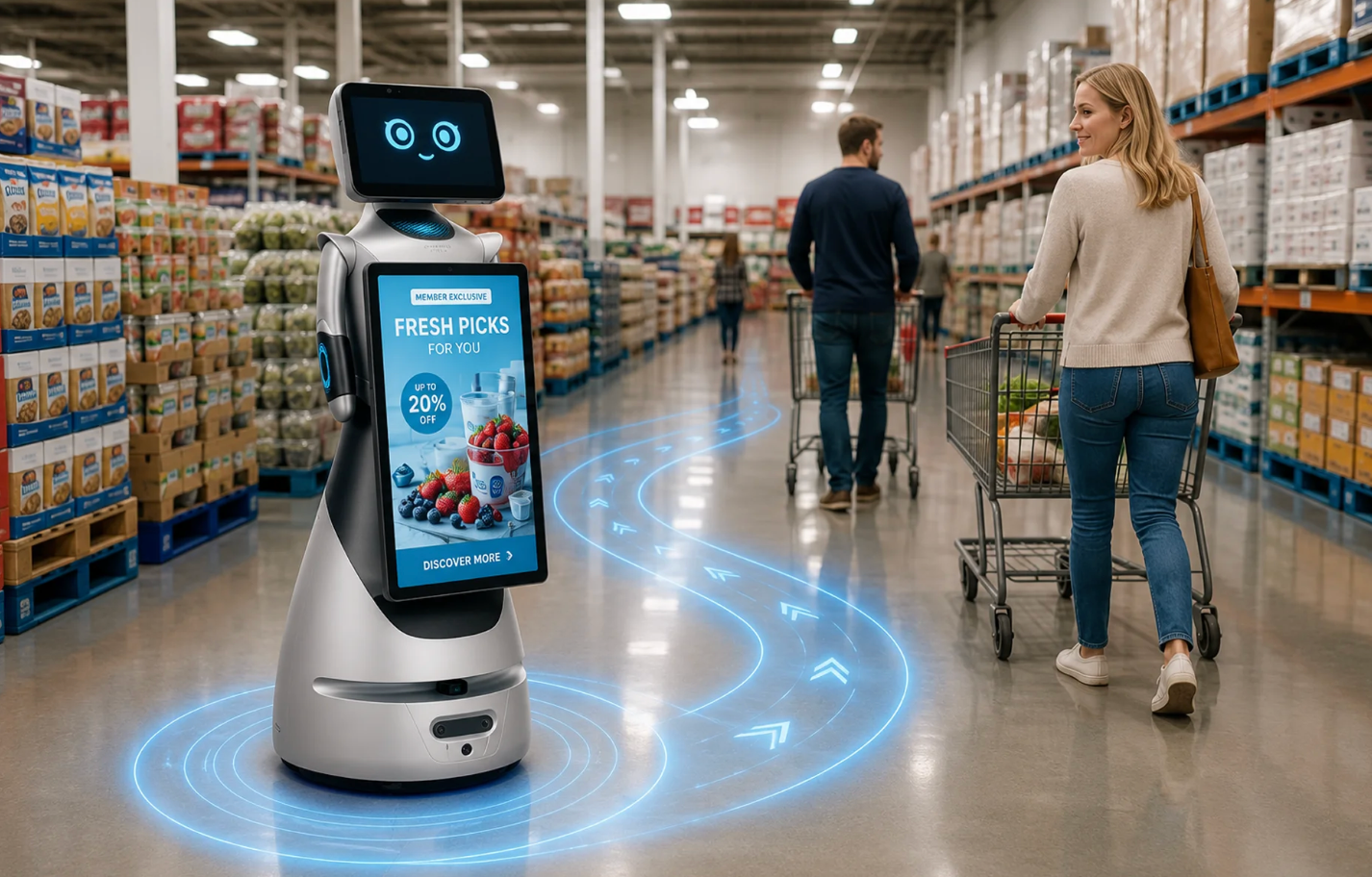
For retail operations managers and in-store experience leads running large-format big box stores, front-of-house service gaps are not minor inconveniences: as of 2025, the U.S. retail sector recorded roughly 531,000 unfilled frontline positions, and industry data shows 5 in 10 poor customer experiences directly lead to reduced shopper spending. The scale of big box footprints (often 8,000 m² or larger with over 100,000 SKUs) amplifies common pain points: shoppers get lost in long building-materials aisles, static signage goes out of date after remodels, and trained associates for high-consideration zones (appliances, power tools, garden equipment) are frequently pulled away to answer basic wayfinding questions. This guide breaks down how the OrionStar GreetingBot AD can address these layered challenges without adding unmanageable operational overhead.
Unlike smaller retail locations, big box stores face structural service constraints that even additional seasonal hiring rarely resolves fully:
These pain points are not isolated to single locations: leading big box chains already operate fleets of autonomous mobile robots for shelf scanning and floor cleaning, proving the operational model of persistent in-store automation is already widely adopted across the sector.
A reception robot fills a middle ground between fixed digital kiosks and overstretched human associates, acting as a mobile concierge that can move across different store zones to meet shoppers where they are. Unlike static signage that stays in a single location, a mobile unit can greet customers at the front entrance, guide them through main aisles to specific bays, and share updated promotional content in high-footfall areas without requiring staff to walk across the store. This model aligns with existing deployments in adjacent large-format venues including airports, hospitals, and shopping malls, where mobile guide robots have been used to reduce visitor confusion at peak hours.
The GreetingBot AD is built specifically to prioritize the features that deliver the most value for large retail environments, rather than carrying unnecessary features that add operational complexity.
According to manufacturer specifications, the GreetingBot AD supports centimeter-level positioning with LiDAR mapping that covers up to 50,000 m², a range that fits the full footprint of nearly all standard big box locations. Under defined test conditions, the unit can navigate corridors as narrow as 60 cm, making it suitable for the tight, inventory-stacked aisles common in garden and building-materials bays. With the optional elevator control module, the same robot can move between ground-floor front entrances and upper-level appliance zones, eliminating the need for separate static kiosks in every department. It can cross 10 mm ground bumps and 20 mm floor seams, performing reliably across the mixed hard surfaces common in big box layouts, from cement in hardware zones to polished marble at customer-service desks.
The model’s signature 21.5-inch FHD chest display, paired with a 14-inch head-mounted capacitive touch screen, supports two layers of customer interaction that no single fixed kiosk can match. Shoppers can tap the smaller head screen to ask for directions or look up product details, while the larger chest display can run rotating promotional content, high-consideration product specifications, or in-store event information visible from several meters away. The 6-mic 360° circular microphone array supports far-field voice pickup, so shoppers can ask questions from a distance without waiting to approach the unit directly.
Powered by a 20 Ah lithium ternary battery, the GreetingBot AD delivers typical runtime of 8–10 hours under normal retail workloads, enough to cover nearly a full standard store shift without mid-operation manual charging. The unit uses LiDAR-based autonomous docking to return to its charging station during off-peak hours, requiring no staff intervention to maintain uptime across opening hours.
The unit runs on a customized Android 13-based OS with 8 GB of RAM and 128 GB of ROM, supporting concurrent workloads for navigation, voice interaction, and content streaming. Centralized remote management and OTA update functionality allow operations teams to roll out consistent content updates or firmware patches across an entire fleet of robots across multiple store locations, with built-in audit logs that track every content change for compliance tracking.
Before rolling out the GreetingBot AD across locations, retail teams should review all use cases for on-board cameras, voice recording, and cloud data processing against GDPR, CCPA, and local biometric privacy regulations such as Illinois BIPA, to ensure all personal data processing follows applicable notice, consent, and data minimization requirements. The platform’s native separation of operational robot telemetry and customer-identifying imagery simplifies compliance record-keeping for most regional regulatory frameworks. Note that arm motion is disabled by default on this model to avoid physical interference with the 21.5-inch chest display, so the unit is optimized for guidance and content delivery rather than physical item handling out of the box.
Deploying a reception robot in a big box store reduces the number of basic wayfinding and promotional content requests that pull trained associates away from high-consideration product zones. Industry research notes that mobile guide robots eliminate the delays associated with manual printed signage updates, allowing marketing teams to roll out promotional campaigns across all locations at the same time, no on-site staff visits required. For teams evaluating multiple automation options, the broader OrionStar GreetingBot series includes multiple models with different feature sets, so operators can select configurations that match their specific store layout, service priorities, and budget constraints.
Under defined test conditions, the robot can pass through corridors as narrow as 60 cm. Operators can mark permanent inventory blockages as no-go zones during initial map setup, and the unit’s integrated obstacle handling sensors will dynamically adjust its path around temporary stacked items during normal operation.
The unit supports autonomous charging, remote monitoring, and scheduled content updates, so it can be managed by existing in-store operations teams with minimal dedicated training. This matches the existing operational pattern most big box chains already use to manage their existing fleets of cleaning or shelf-scanning AMRs.
Yes, once the full store map is updated with exact SKU locations, the robot can autonomously guide shoppers from the entrance, main aisles, or customer-service desks directly to the correct shelf position, reducing the time shoppers spend wandering through large bays looking for specific items.