REQUEST DEMO
Resources > Blogs > Reclaiming Peak Hour Productivity: Food Delivery Robots Transforming Coffee Shop Reception Areas

Reclaiming Peak Hour Productivity: Food Delivery Robots Transforming Coffee Shop Reception Areas

2026-10-18 01:43 OrionStar

Reclaiming Peak Hour Productivity: Food Delivery Robots Transforming Coffee Shop Reception Areas

Introduction

Coffee shop reception areas, the central operational hub for order processing and handoff, face overlapping pressures from persistent frontline labor shortages, volatile peak-hour demand, and rising requirements for order hygiene and guest satisfaction, all of which create operational bottlenecks that directly erode revenue and brand reputation. Food delivery robots have emerged as a targeted, low-disruption solution to redistribute repetitive transport work away from skilled staff, without requiring full overhauls of existing café workflows.

The growing need for smarter delivery workflows in reception areas

  • Severe frontline labor shortages, documented by the U.S. Chamber of Commerce as one of the most acute pain points in the hospitality sector, leave coffee shops chronically understaffed during high-traffic windows even with competitive pay packages.
  • Concentrated peak-hour demand between 7:30 a.m. and 10 a.m. stretches small front-of-house teams thin, as staff are expected to process orders, handle payments, pour drinks, hand off food, and clear waste simultaneously to keep queue times low.
  • Repetitive transport work makes up roughly 30% of a front-of-house employee’s total steps per shift, taking valuable time away from high-value tasks like customer engagement, custom drink preparation, and quality control.
  • Staff juggling multiple orders under rush pressure are far more likely to cause spills, order mix-ups, or hygiene lapses that lead to negative customer reviews and reduced repeat visit rates.

How food delivery robots can help

  • Multi-tray carrying designs that allow simultaneous transport of multiple drink and food orders across different zones of the venue.
  • Built-in vibration-dampening transport modes that keep hot beverages and prepared food stable and spill-free even during peak speed operation.
  • Combined LiDAR and vision SLAM navigation systems that enable autonomous, real-time path planning around moving guests and unexpected obstacles.
  • Multi-mode operation settings that can be toggled to match different venue priorities, from fast peak-hour delivery to low-speed cruise patrol.
  • Integrated voice interaction and customer-facing display features that support direct, low-friction communication with guests in the reception space.
  • All robots using visual mapping or camera-based perception that captures personal identifiable data in public guest spaces require operators to verify full GDPR compliance, including proper data retention policies and public signage as required.

A closer look: OrionStar LuckiBot Pro in action

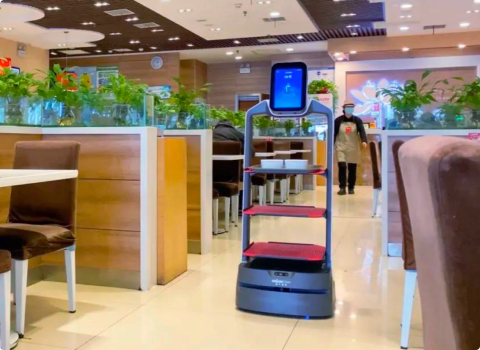
The OrionStar LuckiBot Pro is engineered to deliver all the core delivery robot capabilities outlined above, with hardware and software upgrades tailored for high-foot-traffic coffee shop reception environments. According to manufacturer data, the unit offers up to 60 kg of total payload across its adjustable multi-tray configuration, supports up to 12 hours of continuous operation on a single charge to cover full peak and midday service windows, and uses a 240-degree 3D all-around obstacle recognition system to navigate crowded queue areas without disrupting guest flow. Its built-in exclusive low-vibration liquid delivery mode significantly reduces the probability of drink spills during fast movement between the order counter and dine-in seating zones.

Benefits for coffee shop owners, café operators, front-of-house staff

  • Recovered staff labor capacity: Deployments at similar F&B venues show food delivery robots can release approximately 104 minutes of usable service capacity per front-of-house employee every day, by eliminating the need for non-skill-based transport tasks.
  • Peak hour throughput improvement: By cutting down the 30% of total shift steps front-of-house staff spend on running orders, coffee shops can increase total order processing speed without hiring extra temporary staff during morning rush windows.
  • Consistent order delivery quality: Automated transport removes human error caused by rush-hour fatigue, supporting a 97.6% task completion rate in stabilized deployments that reduces spills, mix-ups, and customer complaints.
  • Predictable ROI for small venue operators: Real-world pilot data from European F&B deployments shows typical 7.8% first-year hard-savings ROI, with most medium-volume coffee shops reaching full breakeven within 12 to 18 months of deployment.
  • Reduced repetitive strain for frontline teams: Cutting unnecessary walking trips across the venue reduces cumulative physical strain for baristas and front-of-house staff, lowering turnover risk and supporting better documented workplace ergonomics.
  • Extended guest interaction opportunities: With transport tasks automated, front-of-house teams can redirect their full attention to greeting guests, customizing drink orders, and resolving special requests to boost overall customer satisfaction.

Real-world applications

Order Counters

The order counter is the busiest fixed point in the coffee shop reception area, with baristas juggling drink preparation, payment processing, and order handoff at all times. Food delivery robots can dock directly at the counter to pick up finished orders as soon as they are marked complete on the kitchen display system, eliminating the need for baristas to step away from the espresso machine to drop off drinks at other zones.

Pickup Zones

Shared pickup zones for both in-store guests and third-party delivery couriers often become cluttered and disorganized during peak hours, leading to misplaced orders. Delivery robots can transport fully prepared orders directly to dedicated pickup shelves, using their integrated displays to show order names and details that help guests and couriers locate their items quickly without asking staff for help.

Dine-in Seating Zones

Dine-in seating adjacent to the reception area frequently sees staff walking back and forth to deliver drinks and clear empty cups, creating foot traffic bottlenecks that slow down queue movement near the counter. Delivery robots can navigate narrow gaps between tables to drop off orders directly to seated guests, and carry stacks of used cups and dishes back to the counter for cleaning in a single trip.

Takeaway Handoffs

Takeaway handoff points for pre-ordered mobile orders often experience long lines during morning rush, as guests stop to confirm their order details with staff. Food delivery robots can carry batches of pre-packaged takeaway orders to the dedicated handoff area, using voice prompts to alert waiting guests that their order is ready, reducing crowding around the main reception counter.

Integration with other smart systems

Food delivery robots designed for coffee shop reception areas can seamlessly integrate with existing connected F&B infrastructure, including mainstream POS systems such as Square, Toast and Lightspeed, and connected kitchen display systems that automatically dispatch new delivery tasks as soon as orders are marked ready by baristas. The robots can sync their internal venue maps with local Wi-Fi networks to receive real-time updates, such as temporary no-go zones around spill sites or event setups, and connect to building BMS and elevator APIs in multi-floor or multi-tenant venues such as coffee shops located inside office lobbies or hotel grounds. Cloud-connected fleet management dashboards also integrate directly with existing operational analytics workflows, allowing operators to pull task completion, battery health, and throughput reports that align with existing management KPIs without requiring new data tracking tools.

Supporting ESG and sustainability goals

  • Reducing unnecessary staff walking trips cuts down on ad-hoc elevator use and repeated opening of refrigeration units that would otherwise idle while staff are away from their stations, lowering overall venue energy consumption and reducing Scope 2 emissions for the business.
  • Automating repetitive, high-wear transport tasks reduces cumulative physical strain on front-of-house staff, improving workplace ergonomics and supporting documented progress against decent work metrics that are increasingly required in standard hospitality ESG audits.
  • Local map storage and configurable data retention settings on modern delivery robots support full GDPR compliance, eliminating unneeded data processing of guest personal information and reducing the operational risk of non-conformity with regional data privacy regulations.

Taken together, these automated workflow upgrades help coffee shops build transparent, auditable ESG disclosures that align with global hospitality industry sustainability and workforce welfare standards.

Closing

Food delivery robots are steadily reshaping how coffee shops manage operations in their high-traffic reception areas, by taking over repetitive transport tasks that previously pulled skilled front-of-house staff away from core customer-facing work. The OrionStar LuckiBot series offers a range of models with varying load capacities, interaction features, and integration capabilities that can be matched to different coffee shop sizes, foot traffic volumes, and unique layout requirements for operators exploring deployment options.