Introduction
Storage facilities operating receiving areas face a persistent set of overlapping operational challenges, from widespread frontline labor shortages and unplanned unloading bottlenecks, to steep trailer detention fees, extreme seasonal volume fluctuations, and rising cross-border data compliance requirements that drag down overall facility throughput and operational predictability. For decades, receiving workflows have remained heavily dependent on manual labor even as other warehouse segments adopted targeted automation, leaving facility operators exposed to rising labor costs and consistent service level gaps. Warehouse robots have emerged as a flexible, purpose-built solution to address these long-unmet pain points for teams running high-volume inbound operations.
The growing need for smarter material handling in receiving areas
- According to 2024 public survey data released by the American Logistics Industry Association, 78% of storage facility leaders report significant difficulty hiring and retaining qualified warehouse staff, with 500,000 open logistics roles remaining unfilled in the U.S. alone, creating constant understaffing risks for receiving operations.
- Inbound unloading and dock-to-stock transport are classified as two of the most physically demanding warehouse workflows, leading to high rates of worker fatigue, musculoskeletal injury, and unplanned absenteeism that disrupt daily receiving schedules.
- Uncoordinated receiving workflows and dock congestion can generate costly trailer detention and demurrage charges, while under standardized peak business test scenarios, downstream delays reduce overall facility productivity by up to 25% during peak inbound periods.
- Under standardized peak business test scenarios, peak season inbound volumes can surge 200-400% above baseline levels, putting unautomated receiving teams under extreme pressure that leads to higher inventory handling errors and 1.4% average annual inventory shrinkage as a share of total revenue.
How warehouse robots can help
- VSLAM+ navigation technology enables marker-free mapping and operation, eliminating the need for pre-installed physical guides or permanent facility modifications.
- Autonomous path planning allows units to dynamically adjust routes in real time to adapt to changing receiving area layouts, temporary obstacles, and unplanned workflow disruptions.
- Multi-robot cooperation functionality lets fleets of units operate seamlessly in shared spaces without manual routing, scaling up or down to match fluctuating receiving volumes.
- Auto-charging and docking capabilities can support near 24/7 continuous operation without manual intervention to swap batteries or plug in units under regular operating scenarios.
- 5-layer obstacle avoidance systems integrate multiple sensor types to detect static and dynamic hazards, reducing collision risks even in crowded, high-foot-traffic receiving zones.
- Real-time monitoring functionality feeds operational data back to central fleet management platforms, and all operators deploying these systems are advised to verify full GDPR compliance for any data captured via on-board cameras, location trackers, or connected inventory scanning tools. All data collection activities must comply with the privacy regulations in the region of operation, and users need to confirm that they have obtained all necessary personal information collection authorization before deployment.
A closer look: OrionStar CarryBot D150 in action
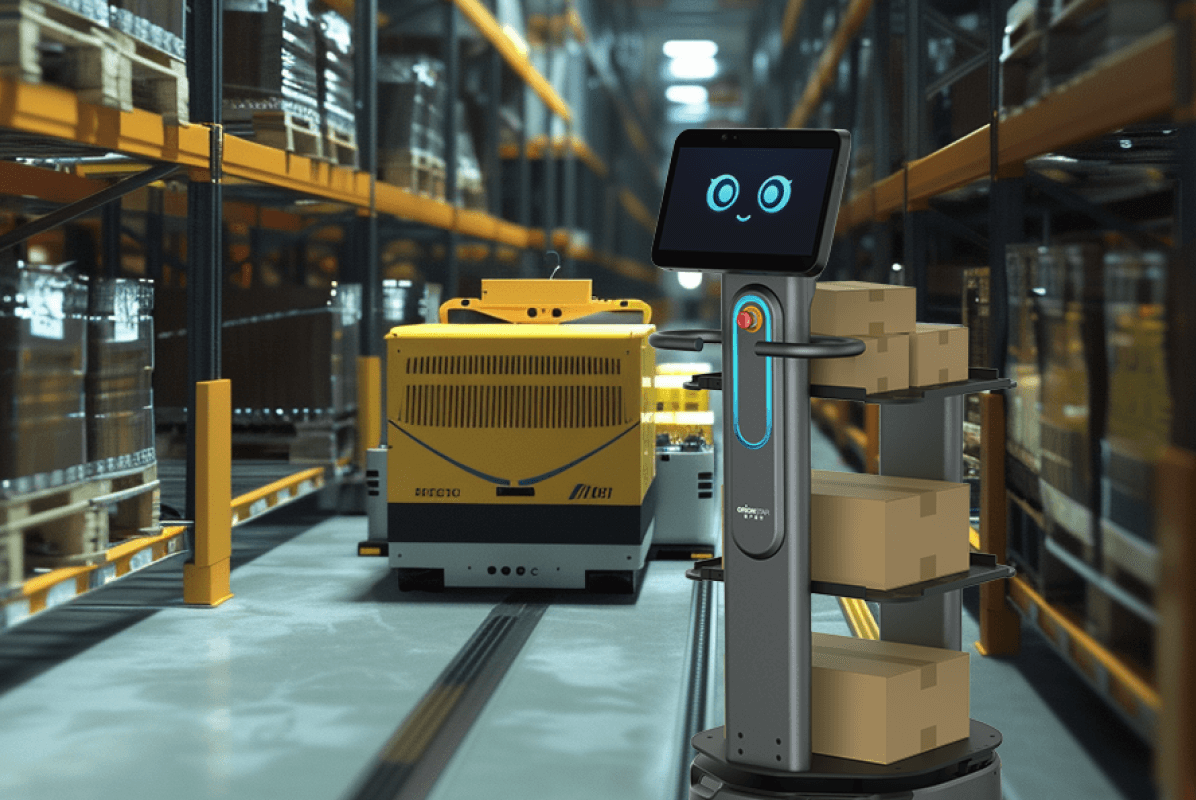
The OrionStar CarryBot D150 implements all of these core warehouse robot capabilities in a purpose-built unit designed for high-throughput receiving workflows, with performance metrics verified per manufacturer published data. Leveraging VSLAM 2.0 navigation alongside a multi-sensor 5-layer safety system, the unit delivers up to 1 cm positioning accuracy for precise material drop-off across all receiving sub-spaces, with a maximum net payload of up to 150 kg suitable for moving full carton loads and heavy pallets. According to official product specifications, the D150 supports up to 12 hours of continuous runtime when carrying a 100 kg load, with a minimum passage clearance of 65 cm that lets it navigate even narrow dock-to-stock corridors that would block larger material handling equipment.
Benefits for storage facility operators, warehouse supervisors, receiving leads, inventory control coordinators
- Reduced labor dependency for high-strain tasks: Automating repetitive dock-to-stock transport cuts manual travel time by 80% and frees existing warehouse staff to focus on higher-value tasks including freight inspection and customer-facing coordination.
- Lower operational costs for inbound workflows: Deployments of warehouse robots in receiving areas deliver an average 50% reduction in overall operation costs, eliminating overtime expenses associated with understaffed unloading shifts.
- Stable, predictable throughput even during peak surges: Scalable robot fleets can handle 200-400% higher inbound volumes during pre-holiday peak seasons without requiring temporary, hard-to-hire seasonal labor.
- Eliminated avoidable detention and dwell time fees: Faster, more consistent dock-to-stock transport reduces trailer wait times at unloading docks, cutting costly demurrage charges and improving carrier relationship quality.
- Measurable efficiency gains across all receiving workflows: Under standardized peak business test scenarios, human-robot collaborative teams deliver 2-3x higher productivity than all-manual receiving operations, cutting overall inbound cycle times by 50% per published industry benchmarks.
- Improved inventory accuracy across inbound stock flows: Automated transport reduces manual handling errors, helping facilities cut average annual inventory shrinkage from the 1.4% industry baseline to significantly lower levels.
Real-world applications
Unloading Docks
Unloading docks are the highest-traffic point in the entire receiving workflow, where mixed pallets, loose cartons, and frequent foot traffic create constant safety and throughput challenges. Warehouse robots can transport unloaded goods directly from the trailer doorstep to adjacent processing areas, eliminating the need for workers to carry heavy loads across uneven dock surfaces and reducing unplanned tripping or lifting injuries.
Staging Zones
Staging zones often experience temporary layout shifts as new freight arrives and awaits downstream processing, making fixed automation solutions impractical. Marker-free VSLAM navigation lets warehouse robots adapt to last-minute staging layout changes without reconfiguration, ensuring consistent transport even when pallets are stacked in new temporary positions.
Inspection Bays
Inspection bays require continuous, steady flow of incoming goods to avoid backlogs that delay downstream putaway workflows. Robots can shuttle uninspected freight from staging zones to inspection bays, then move inspected, approved stock directly to the next processing step, eliminating idle wait time for quality control staff.
Dock-to-Stock Corridors
Dock-to-stock corridors are often narrow, shared spaces used by both foot traffic and other material handling equipment, leading to frequent bottlenecks. Warehouse robots with 65 cm minimum passage clearance can navigate even narrow corridor configurations, and their multi-layer obstacle avoidance systems automatically pause or reroute to avoid collisions with passing staff or other equipment.
Integration with other smart systems
Modern warehouse robots for receiving areas are built to integrate seamlessly with existing storage facility software stacks, including core Warehouse Management Systems (WMS), Warehouse Control Systems (WCS), Yard Management Systems (YMS), and broader ERP platforms, pulling real-time task data directly from these systems to align transport routes with scheduled carrier arrivals, dock door assignments, and pre-configured putaway locations. Connected integrations eliminate manual task entry work, sync robot fleet data with existing inventory tracking tools to reduce blind spots, and support full end-to-end visibility across all inbound receiving workflows, with open API frameworks enabling custom connections to existing IoT scanning, RFID, and barcode verification tools that facilities already operate.
Supporting ESG and sustainability goals
- Automated receiving workflows reduce unnecessary manual travel and idle truck wait times at congested docks, cutting associated fuel consumption and transport emissions to help facilities progress toward ISO 14001 and Science Based Targets initiative decarbonization commitments.
- Warehouse robots eliminate the need for workers to perform repetitive heavy lifting and long-distance walking across receiving areas, reducing rates of work-related musculoskeletal injury and supporting the social governance pillar of ESG by improving workplace safety for frontline teams.
- Digitized robot transport logs create fully auditable, error-free records for all inbound freight movements, simplifying compliance reporting for global market requirements including GDPR, and reducing the risk of inventory errors that lead to unnecessary product waste and reverse logistics emissions.
When combined, these improvements let storage facilities turn their receiving area automation deployments into measurable, auditable progress against their published ESG targets, rather than treating sustainability as a secondary operational priority.
Closing
Warehouse robots are steadily redefining how storage facilities design and operate their receiving areas, turning long-overlooked, labor-dependent inbound workflows into flexible, high-throughput, predictable operations that can adapt to shifting market demands. The OrionStar CarryBot series includes multiple purpose-built models with varying payload capacities and configuration options, to support facilities of different sizes and use case requirements as they evaluate their own inbound automation roadmap.


