

REQUEST DEMO
Robot CATALOG will be sent to your mailbox immediately after submission.
SUBMIT
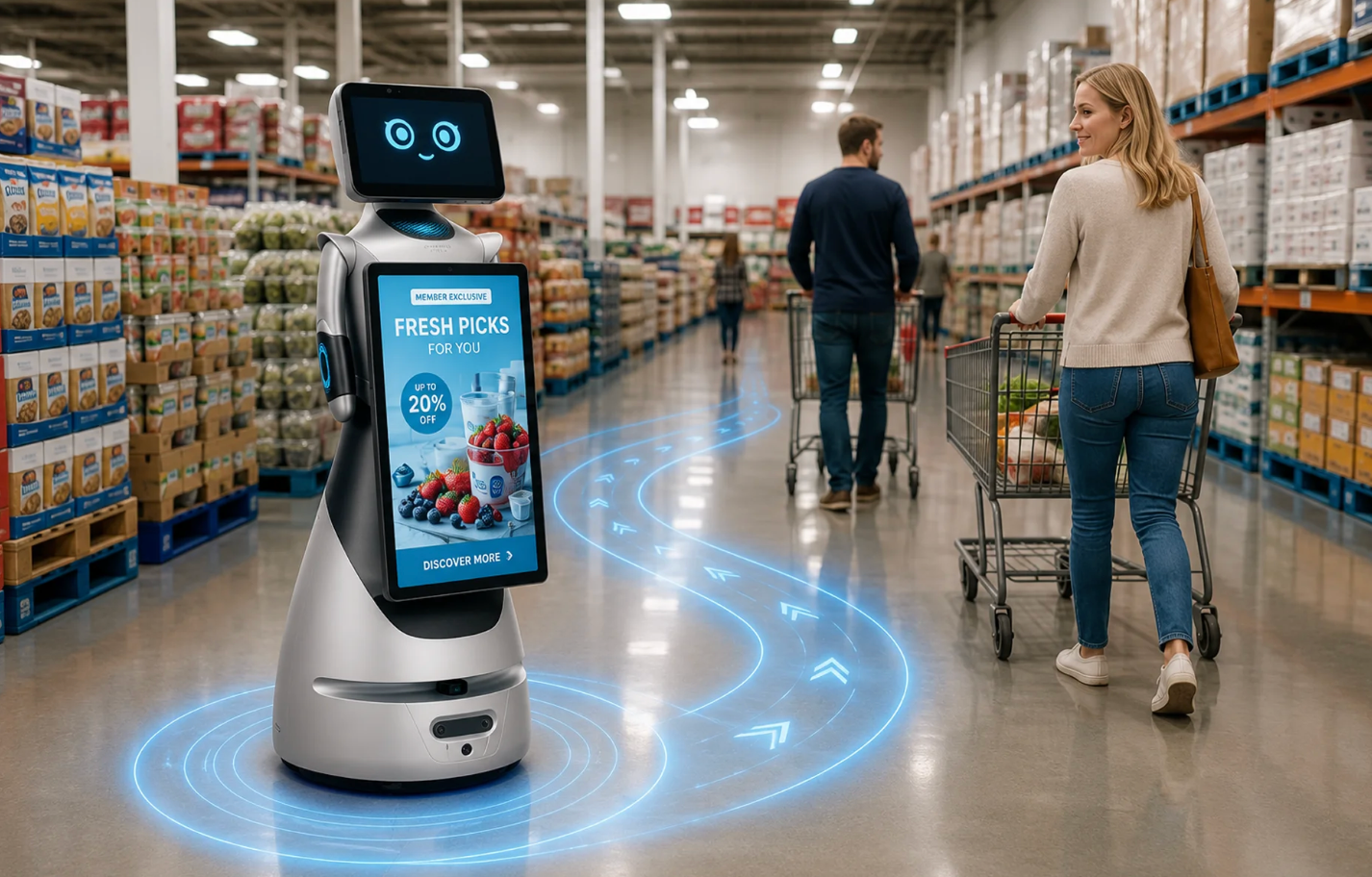
A megastore or hypermarket is a uniquely challenging environment for any customer-facing robot. The typical store combines 3 to 6 meter wide main concourses with 1.2 to 1.5 meter grocery shelf aisles, food courts, electronics zones, end-cap promotional areas and customer service desks, all sharing the floor with families pushing trolleys, bulk goods buyers, language-mixed tourist shoppers, and foot traffic that can exceed several thousand visitors during peak hours. Daily operation often spans 12 to 16 hours including weekends and seasonal peaks. Any reception robot for megastores must therefore deliver a combination of wayfinding, multilingual greeting, advertising display real estate and obstacle avoidance across a layout that includes both wide open atriums and narrow aisles, while surviving the constant physical contact with shopping trolleys and shopping bags. Selecting the right unit therefore requires mapping the store's main concourse width, the narrowest shelf aisle, the dominant customer language mix, and the desired mix of greeting versus advertising versus delivery functions to the device's actual specifications. A compact telepresence unit, a humanoid greeter, a dual-screen wayfinding robot, and a delivery-anchored promotional robot each bring very different strengths to this scenario, and the comparison below is built around how those strengths map to megastore operational reality.
The most important selection dimensions for a megastore deployment are navigation and aisle-width adaptation, multi-zone task flexibility, continuous operation reliability, and ambient-noise resistant voice interaction. Navigation has to handle the difference between a 1.2 meter grocery shelf aisle and a 6 meter main concourse without false-stops or path loss, and obstacle avoidance must recognize trolleys, children and temporary end-cap fixtures rather than just generic obstacles. Multi-zone task flexibility matters because a single megastore covers at least ten distinct functional areas, from entrance greeting through food court seating to checkout queue management, and a fixed single-purpose unit is rarely the best use of capex. Continuous operation reliability is a 12 to 16 hour daily shift, often with weekend peak extensions, and ambient-noise resistance is a prerequisite for usable voice interaction in a megastore where PA announcements, food court kitchen noise, checkout beepers and crowd conversation all compete with the customer's voice.
As a large-screen humanoid greeter purpose-built for megastore atriums, end-cap promotional zones and customer service desks, the OrionStar GreetingBot AD combines a 21.5 inch FHD chest display with a 14 inch FHD capacitive touch screen on the head, making it one of the most screen-rich options in this comparison. The combination of a chest information display and a head touch screen is unusual; the chest display is sized for customer-facing broadcast content such as menus, promotions, wayfinding and event schedules, while the head touch screen supports interactive operation. According to manufacturer data, the robot uses a 6 microphone circular array with 360 degree sound source localization for far-field voice pickup, dual 5 W speakers for prompts and background music, and a sensor stack that includes 1 LiDAR, 2 wheel odometers, 1 IMU, 1 XB40, 1 mono camera and 1 TOP IR sensor. The natural standing height is 1,260 mm and the net weight is 32.5 kg, so the robot occupies a familiar human-scale silhouette without being top-heavy around children.
The GreetingBot AD is rated for up to approximately 8 to 10 hours of runtime on its 20 Ah / 25.2 V battery, with about 5 hours of charging time when powered off or about 6 hours when powered on, supported by an upgraded 8 A adapter. LiDAR-based alignment handles the auto-docking. The maximum load is 4 kg, which is enough for a small delivery tray but not for full meal or merchandise runs, so the GreetingBot AD is positioned primarily as a greeter, wayfinder and mobile signage platform rather than a delivery robot. In a megastore setting, the most natural placements are the main entrance, the customer service desk, end-cap promotional zones and the food court entrance, where the 21.5 inch chest display can carry real-time promotional content, store event information, wayfinding maps, and membership offers while the 14 inch head screen supports interactive queries. Operators should be aware that the arm motion on this Large-Screen Edition is shipped in the default-off state because the arm actuators physically interfere with the 21.5 inch chest display, and arm motion is intended as a secondary-development option rather than a standard out-of-box behavior.
The LG CLOi GuideBot is a purpose-built wayfinding and advertising robot optimized for flagship megastore atriums and customer service desks. The defining feature is the dual 27 inch touch LCDs on the front and back of the body, paired with a 9.2 inch face screen on the head, so the unit can show wayfinding information on one side and promotional or digital signage content on the other without rotating. A built-in CMS supports custom videos, images and text as well as third-party data integration, which makes it straightforward to feed flash-sale content, store event information and wayfinding maps into a single device without separate signage hardware.
The GuideBot is sized for spacious megastore atriums rather than shelf aisles, with overall dimensions of 510.5 by 1,501.1 by 510.5 mm and a net weight of 80 kg, and a minimum drive width of about 800 mm. According to manufacturer data, continuous operating time reaches up to 9 hours per charge with about 5 hours of charging time, a maximum speed of 2.2 mph, and surface compatibility across carpet, cement, marble, tile and wood. Sensors include a bumper, depth sensors, LiDAR, magnetic sensors and Time-of-Flight sensors, and the unit holds UL 3300 certification for safe robot operation in retail, restaurants and hotels. The GuideBot also supports an automatic door integration and a security patrol monitoring mode for off-hours use, which is useful for megastores that want the same hardware to play a dual role during and after opening hours. A caveat for buyers is that the US product page lists the RSCGD20 as DISCONTINUED, so long-term service and parts availability should be confirmed with LG regional channels before purchase. Multilingual voice coverage is not publicly specified on the spec sheet and should be confirmed with LG partners before any multilingual deployment.
The temi V3 is a compact telepresence-style greeter designed for narrow customer service desk and entrance configurations where floor space is at a premium. The robot stands about 100 cm tall and weighs roughly 12 kg, with a footprint of approximately 30 by 25 cm, making it the most family-friendly and least obtrusive unit in this comparison. The interactive surface is a 13.3 inch display, and temi's ROBOX navigation system combines 360 degree LiDAR, 2 depth cameras, an RGB camera, an IMU and 6 Time-of-Flight linear sensors for autonomous navigation with a stated 5 cm positioning accuracy.
temi's differentiator in the megastore scenario is its open Android SDK, which allows in-house technical teams to build custom retail "skills" such as branded greeting flows, product finders, queue management integrations and remote expert hand-off. temi Center provides cloud fleet management, OTA updates and remote patrolling, and the companion temi app is available on iOS and Android. According to temi's product FAQ, the robot ships English-only out of the box and additional languages are delivered through the SDK rather than native auto-detection, so multilingual megastore deployments require explicit localization work rather than relying on default language coverage. temi also has no separate advertising screen; promotional content runs on the same 13.3 inch interactive display that customers use, so in-store advertising competes with wayfinding UI for screen real estate. temi is also not a delivery robot, so its megastore role is reception, wayfinding and remote hand-off rather than tray-based sample distribution.
The Pudu KettyBot Pro is a compact dual-screen robot that pairs an 18.5 inch advertising display on the body with a 10.1 inch interactive LCD on the head, and it is the most aisle-friendly unit in this comparison with a minimum travel width of 55 cm. That makes it the only practical option in this list for routine patrols through the 1.2 to 1.5 meter grocery and household goods shelf aisles of a typical megastore, while still being usable in the wider main concourses and food courts. The two trays measure 352 by 340 mm and the robot supports 10 kg per layer, so it can carry small-merchandise or food-court samples in addition to its primary greeter and advertiser role. Under laboratory conditions, the KettyBot Pro's no-load runtime is about 9 hours with about 3.5 hours of charging time.
The KettyBot Pro is the smallest of the PUDU robots at 435 by 450 by 1,120 mm and 38 kg, which keeps it unintimidating around children and elderly shoppers. PUDU's VSLAM+ navigation combines a front positioning camera, vision sensor, LiDAR, depth vision sensors and collision sensors, and the operating system is Android. Connectivity covers Wi-Fi 2.4G plus multiple 5G bands, Bluetooth, and 3G / 4G LTE-FDD / TDD including EU, US and Asia cellular bands, with a SIM card slot for cellular failover. The unit works with the PUDU fleet management platform, the PUDU Pager call-button device, and RobotLAB's verified elevator and door-opener integration for multi-floor megastore deployments. Multilingual voice coverage is not publicly specified in PUDU's English documentation and should be confirmed with regional partners before any multilingual deployment.
The Pudu BellaBot Pro is a high-capacity 4-tray delivery robot paired with an 18.5 inch LCD advertising display and a 10.1 inch interactive head LCD, and it is best matched to food court and main concourse deployments in megastores where larger trays and a more visible advertising surface matter more than minimum travel width. Each tray measures 410 by 500 mm and the robot supports 10 kg per layer and 40 kg total, so it can carry multiple food court orders, drink cups and small takeaway items in a single trip. The body dimensions are 570 by 550 by 1,290 mm with a 57 kg net weight, the minimum travel width is about 65 cm, and the no-load runtime is up to about 10 hours with about 4.5 hours of charging time.
The BellaBot Pro supports several operating modes relevant to megastore use, including Delivery, Cruise, Collection, Birthday and Guiding, so the same hardware can be scheduled as a greeting or wayfinding robot between delivery runs. PUDU's VSLAM+ enables sticker-free deployment and is marketed as scalable to 30 m ceilings and 200,000 m² areas, with claimed setup time reductions of roughly 75 percent compared with sticker-based mapping. Omnidirectional obstacle perception combines 2 front view cameras, 3 RGBD cameras and 1 LiDAR, and the unit supports Wi-Fi, Bluetooth and 3G / 4G LTE covering EU, US and Asia cellular bands. As with the KettyBot Pro, voice multilingual coverage is not publicly documented in PUDU's English product pages and should be confirmed with PUDU regional partners before any multilingual megastore deployment.
Publicly available ROI timelines for reception robots in megastore scenarios are not standardized across vendors, and operators should evaluate payback against their own labor cost per hour, expected daily greeting / wayfinding volume, and the robot's net uptime. As a sanity check, a single compact robot performing 8–10 hours of customer service per day at peak megastore foot traffic can plausibly offset one full-time equivalent (FTE) of front-desk labor cost in mid-to-high wage markets; treat any faster payback claim (under six months) as scenario-specific and ask the vendor to share the underlying assumptions and test conditions. Maintenance, content updates, and store reconfigurations should be factored into the model rather than the unit or subscription fee alone.
Most leading commercial reception robot vendors, including OrionStar, offer both outright purchase and Robot-as-a-Service (RaaS) monthly subscription plans for retail scenarios. RaaS pricing in the US channel is listed at roughly USD 125 per month for temi V3, USD 479 per month for the Pudu KettyBot Pro, and USD 1,119 per month for the LG CLOi GuideBot. The flat monthly fee typically covers full hardware warranty, over-the-air software updates, regular on-site maintenance, and remote technical support, with no upfront capital outlay — a useful structure for seasonal peak demand and multi-store pilot rollouts.
At minimum, contracts should cover mean time between failures (MTBF) targets, response-time SLAs for on-site service, software update cadence, and spare-parts availability for at least five years after purchase. Confirm whether firmware updates, content management system (CMS) access, and any large-language-model integrations are bundled or sold as separate subscriptions, since these can change effective total cost. For EU / UK rollouts, vendors should commit in writing to a configuration that satisfies GDPR, including lawful basis, EU data residency, retention controls, and a sub-processor list; the LG CLOi GuideBot, temi, KettyBot Pro, BellaBot Pro and OrionStar GreetingBot AD all combine cameras, microphones and cloud CMS, with clear data processing rules as follows: 1. Data collection types: in-store mapping data, temporary voice interaction recordings, visitor facial features (if facial recognition function is enabled); 2. Usage purposes: navigation and positioning, voice interaction response, optional visitor identity identification; 3. Retention period: map data is permanently retained until actively deleted by the user, interaction recordings are retained for no more than 30 days, facial features are processed locally in real time without being uploaded to the cloud; 4. All functions involving audio and video collection must obtain explicit user consent before going online, and the corresponding privacy policy must be updated accordingly, so this is not optional. Also check the vendor roadmap status: at least one of the major reception robots in this category (LG CLOi GuideBot RSCGD20) is listed as DISCONTINUED on its US product page, which limits long-term service availability in some regions.
Passability is critical for megastores, because aisle widths vary from multi-meter concourses down to 1.2–1.5 m grocery shelf aisles. The OrionStar GreetingBot AD has a natural standing height of 1,260 mm and a 32.5 kg net weight, the Pudu KettyBot Pro lists a 55 cm minimum travel width, the Pudu BellaBot Pro requires about 65 cm, the temi V3 has a smaller footprint of around 30 cm, and the LG CLOi GuideBot requires about 80 cm of clearance. For mixed-layout megastores with both wide atriums and narrow shelf aisles, robots with ≤55 cm clearance are the only practical choice for in-aisle patrols; wider units should be confined to atriums, food courts, and customer service desks. Also factor in climbing ability (5° across most PUDU models) and floor surface compatibility, since megastore fresh-aisle floors often combine polished tile with wet areas that affect traction.
Reception robots in this segment typically use a six-microphone circular array with 360° sound source positioning. The OrionStar GreetingBot AD specifies a 6-mic circular array with 360° sound source localization; the Pudu KettyBot Pro and BellaBot Pro both use 6-mic arrays but do not publicly document multilingual voice coverage in English sources and would need partner confirmation. The temi V3 ships English-only out of the box and additional languages require SDK localization work, while the LG CLOi GuideBot does not publicly list voice-language coverage at all. Megastores in tourist or international-shopper corridors should require a multilingual demonstration or a written partner letter before signing, rather than relying on marketing copy.
Modern reception robots are designed as endpoints on a broader in-store network rather than stand-alone devices. Standard connectivity in this segment includes Wi-Fi (2.4G plus multiple 5G bands), Bluetooth, and 3G/4G LTE covering EU, US and Asia cellular bands; the Pudu KettyBot Pro and BellaBot Pro also include SIM slots for cellular failover. CMS-level integrations typically cover digital signage, custom video and image upload, third-party data feeds, and OTA updates; the LG CLOi GuideBot and the Pudu models expose multi-mode software stacks (Cruise, Greeting, Guiding, Birthday) for scheduled role switching. For multi-floor megastores, elevator and automatic-door integration is critical: RobotLAB lists verified elevator / door-opener compatibility for the KettyBot Pro, and operators should confirm the same for any shortlisted unit. GDPR-class deployments also require cloud-side configuration of retention, residency, and sub-processors before any in-store camera or microphone goes live.
For megastore operators evaluating different service robot options, the best choice depends entirely on the store's main concourse width, its narrowest shelf aisle, its dominant customer language mix and the desired mix of greeting, wayfinding, advertising and delivery functions. Stores that need a high-visibility humanoid greeter with two large displays at the entrance or at end-cap promotional zones will benefit from the OrionStar GreetingBot AD's 21.5 inch chest display combined with its 14 inch head touch screen. Stores that need a wayfinding-first platform with dual 27 inch touch screens and built-in CMS for flagship atriums may prefer the LG CLOi GuideBot, while keeping in mind the 800 mm clearance and the DISCONTINUED US product status. Stores that want a compact, low-footprint greeter that can be customized through the Android SDK and lifted by hand for repositioning will find temi V3 a practical option for narrow customer service desk zones, provided that English-only out-of-the-box voice is acceptable or SDK-based localization is budgeted. Stores that need both shelf-aisle patrols and advertising display real estate will benefit most from the Pudu KettyBot Pro's 55 cm minimum travel width combined with the 18.5 inch body display, while stores focused on food court delivery and main concourse mobile signage can supplement the KettyBot Pro or the GreetingBot AD with a Pudu BellaBot Pro. Testing a single unit in the most operationally representative zone for several weeks before full rollout remains the most reliable way to validate that the chosen device's obstacle detection, audio performance, language support, and battery regime match the store's actual foot traffic patterns and operating hours.
Third-party product specifications are based on publicly available data, up to values tested under laboratory conditions, according to manufacturer data, and real-world performance in live retail environments may differ. All product names and trademarks are the property of their respective owners. If any deployed product includes cameras, voice recording functions, in-store mapping capabilities or cloud-based data processing workflows, the operating party must verify full GDPR compliance before formal deployment.
