

REQUEST DEMO
Robot CATALOG will be sent to your mailbox immediately after submission.
SUBMIT
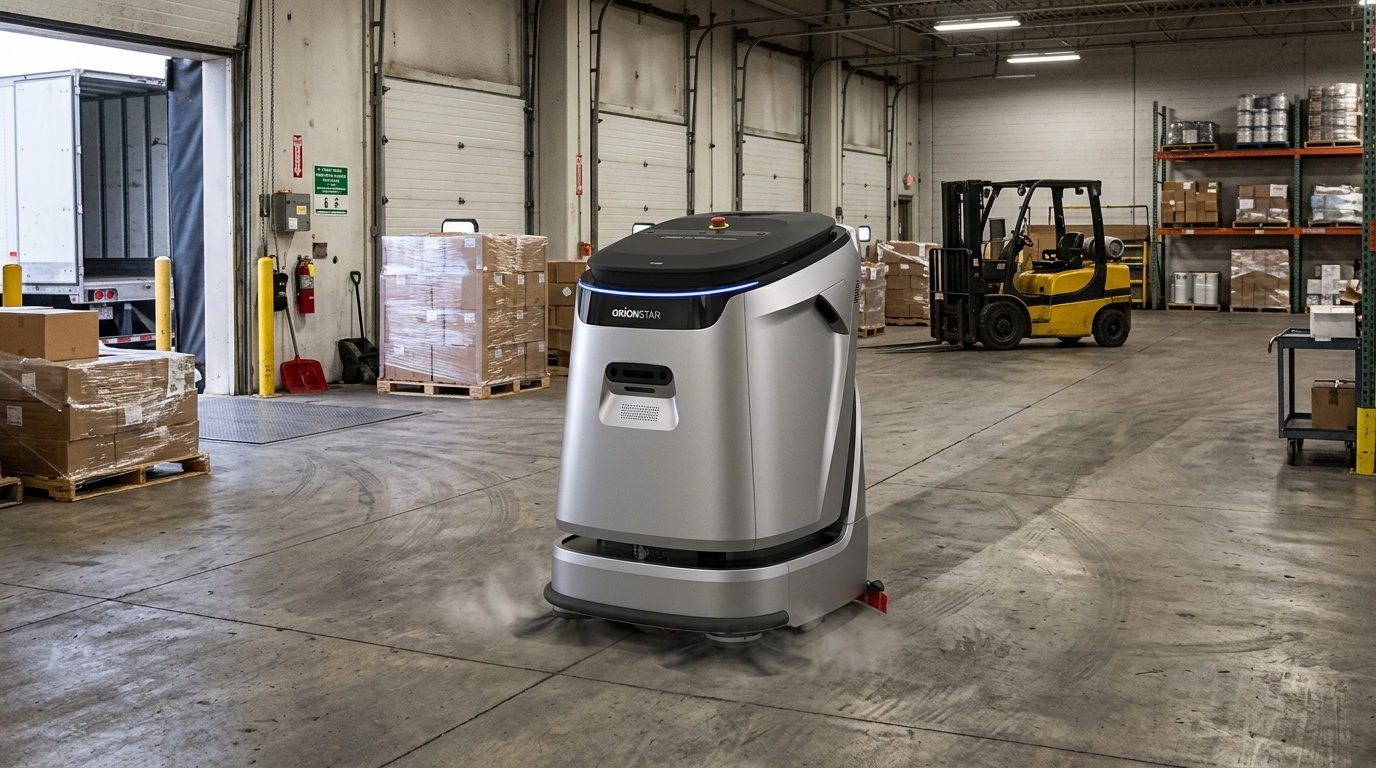
For warehouse floor care, our OrionStar CleaniBot C5’s 550mm main width and 840mm width including side brushes describe different tasks. Preclear wrap and pallet debris, release the aisle and test service access; neither width proves safe coexistence with forklifts.
Warehouse cleaning is rarely one uniform task. Fine dust may collect along rack lines, loose packaging material may appear near picking and packing, tracked-in soil can build near entrances, and heavier debris may concentrate around docks or staging areas. A useful buying decision begins by separating these conditions instead of assuming one route and one cleaning method will address every zone.
We suggest mapping the warehouse into cleaning zones before comparing robots. Mark storage aisles, cross-aisles, receiving areas, packing stations, battery or equipment areas, dock approaches, entrances, and any restricted workspaces. For each zone, note the dominant soil, the floor condition, who controls access, and when the area can be released for cleaning.
This map helps distinguish a robot that may be suitable for routine floor upkeep from a workflow that still needs manual preclear or targeted spot work. Robots should be evaluated around the prepared cleaning task: what is on the floor, where it is allowed to travel, and what must happen before a route begins.
A warehouse floor can look open while still containing material that makes a cleaning route impractical. Loose stretch wrap, broken pallet pieces, straps, labels, shrink film, cartons, and accumulated debris around rack ends all deserve a preclear decision. The question is not whether a robot should be expected to handle every item left on the floor; it is whether the work process removes route-blocking material before the cleaning cycle starts.
Build a simple handoff between warehouse operations and cleaning operations. The route-release owner should know which aisles are available, whether active picks or replenishment are in progress, whether dock doors are being used, and whether a spill or unusual debris condition requires a different response. This keeps a routine cleaning route from becoming a substitute for housekeeping discipline.
For heavier or irregular soil, define the first action rather than relying on a general cleaning pass. That action might be manual removal of bulky debris, a sweep-oriented pass, a scrub-oriented pass, or postponing the route until the area is ready. The right choice depends on the material observed and the site’s own cleaning rules.
| Decision area | What to inspect on site | Operational decision |
|---|---|---|
| Loose debris | Wrap, labels, pallet fragments, straps, cartons, and debris at rack ends | Define what must be removed before a route is released. |
| Fine dust | Dust accumulation in aisles, staging lanes, and perimeter areas | Set a routine appropriate to the dust pattern and housekeeping schedule. |
| Wet or adhered soil | Entrances, workstations, dock approaches, and areas with repeated marks | Decide whether the zone needs a scrub-oriented task and when it can be isolated. |
| Unexpected conditions | Spills, damaged goods, unusual debris, or active loading activity | Use an exception process instead of sending the normal route into the area. |
Aisles are operational spaces, not empty corridors. Their practical availability can change with pallet placement, lift activity, replenishment, picking carts, temporary staging, and shift patterns. A route that appears workable on a floor plan may be unavailable during the hours when warehouse work is most active.
Walk proposed routes at the times cleaning would actually occur. Observe end-of-aisle turns, rack-end congestion, cross-traffic points, doors, charging or staging areas, and places where workers commonly pause. This observation should lead to an operating window: a specific period when the route is released and the responsible team knows it is being cleaned.
Mixed traffic requires operating discipline. Plan around defined route windows, temporary closures where your site uses them, clear communication with affected teams, and a named person who can stop or defer a route when conditions change. Do not base the decision on an assumption that a cleaning robot will solve traffic coordination on its own.
Dock areas deserve separate attention because their operating conditions can differ from internal storage aisles. Door activity, weather-related soil, loading schedules, temporary staging, and changes in floor condition can all affect whether a cleaning route is appropriate at a given time. Include the approach to each dock in the route walk rather than treating it as an extension of a standard aisle.
Inspect changes between floor zones, including thresholds, ramps, doorways, drains, expansion joints, damaged areas, and transitions between interior and dock-side work areas. The purpose is to determine whether the proposed route can be kept consistent and whether any segment needs a separate cleaning plan. If the condition is uncertain, keep that segment out of the initial routine until it has been reviewed on site.
Use CleaniBot C5’s 820 × 680 × 1130mm body and separate 45L tanks to survey start/return approaches, storage and the water-service handoff. Confirm rack-end turns and temporary staging at the actual released cleaning time rather than taking aisle width as availability. A broad warehouse route can be a useful C5 assignment when return travel and water handling remain practical outside logistics movements. If rack-end staging repeatedly blocks service, solve the release or location problem before using cleaning capacity to justify the purchase.
CleaniBot C5’s main cleaning width is 550mm; the width including side brushes is 840mm. Evaluate scrub pass overlap separately from side-brush debris collection, after the defined preclear step. Neither figure authorizes collecting straps, wrap or pallet fragments left in the aisle. That distinction makes C5 relevant to a warehouse program with both routine dry maintenance and defined wet-floor work, provided the task is prepared and the aisle is released. A collection width describes the task mechanism; it is not permission to mix the route with active lift movements.
Where a compact commercial robot is being considered for constrained zones or selected routes, consider OrionStar CleaniBot S55 Pro when its compact positioning and six supported cleaning modes align with the intended operating concept. Six modes do not establish compatibility with every warehouse floor or every soil condition, so the site should still verify the actual surface, route constraints, and task needed in each zone.
If C5 is being considered with a suitable configured workstation, the supported workstation functions include automatic charging, clean-water refill, wastewater discharge, and wastewater-tank self-cleaning. These functions can influence the support-area discussion, but they do not eliminate the need for routine cleaning oversight, route-release ownership, or maintenance planning.
| Candidate question | Why it matters in a warehouse | Decision to make |
|---|---|---|
| What cleaning task is needed? | Dust, loose debris, routine floor washing, and wastewater handling may require different preparation. | Match the candidate’s supported tasks to the prepared cleaning work. |
| Can the area be released? | Traffic and changing logistics activity can make a route unavailable. | Choose defined route windows and an accountable release owner. |
| Are transitions included? | Dock approaches, thresholds, and changing floor conditions can interrupt a routine. | Inspect each transition and exclude uncertain segments from the initial plan. |
| What support setup is planned? | A robot needs a practical start, finish, and routine-care process. | Assign a non-disruptive support location and responsible personnel. |
| Is a configured workstation relevant? | For C5, suitable workstation configuration can support charging, refill, discharge, and wastewater-tank self-cleaning. | Confirm the site can support the intended configuration and ongoing oversight. |
A reusable checklist makes the decision more practical than a one-time demonstration or a floor-plan review. Use it for each route, especially where logistics schedules can change daily. The checklist should be completed by the people who understand both the warehouse work and the cleaning responsibility.
Bring a route map and a realistic operating description to the conversation. Include floor areas, soil patterns, aisle and cross-aisle conditions, dock transitions, preferred cleaning windows, expected preclear steps, available support space, and the role responsible for route release. Ask which water-service alternatives are available for the exact quoted configuration and how filling, wastewater handling and daily inspection would work. Availability and inclusion need confirmation in the proposal.
Ask which supported cleaning tasks apply to the model under consideration, what workstation configuration is suitable if one is planned, what routine operator involvement remains, and what site information is needed to review the proposed workflow. For CleaniBot C5, specifically ask whether the planned workstation configuration is suitable for the intended charging, clean-water refill, wastewater discharge, and wastewater-tank self-cleaning functions.
The strongest candidate is the one that fits a released route, a defined soil condition, and the site’s traffic-management process. High activity alone is not enough to choose a model; review when aisles are available, what debris must be removed first, and who can pause cleaning when operations change.
Define a preclear step for material such as wrap, labels, straps, pallet fragments, cartons, or other route-blocking debris. Treat this as part of the route-release process, with a named person or team responsible for confirming the area is ready.
Possibly, but those zones should be evaluated separately. Storage aisles, dock approaches, and packing areas can have different soil loads, traffic patterns, floor transitions, and release windows. Start with the zones that can be prepared and released consistently.
Consider C5 when evaluating a large-commercial cleaning candidate for sizeable areas that may need supported scrubbing, vacuuming, sweeping, dust mopping, or wastewater recovery. Confirm the actual route, floor transitions, debris-preclear process, support location, and released operating windows before treating it as a fit for the site.
No all-floor compatibility should be assumed. S55 Pro is positioned as a compact commercial cleaning robot and supports six cleaning modes, but the warehouse should still review its particular floor surface, soil type, aisle conditions, and intended task before making a selection.
