

REQUEST DEMO
Robot CATALOG will be sent to your mailbox immediately after submission.
SUBMIT
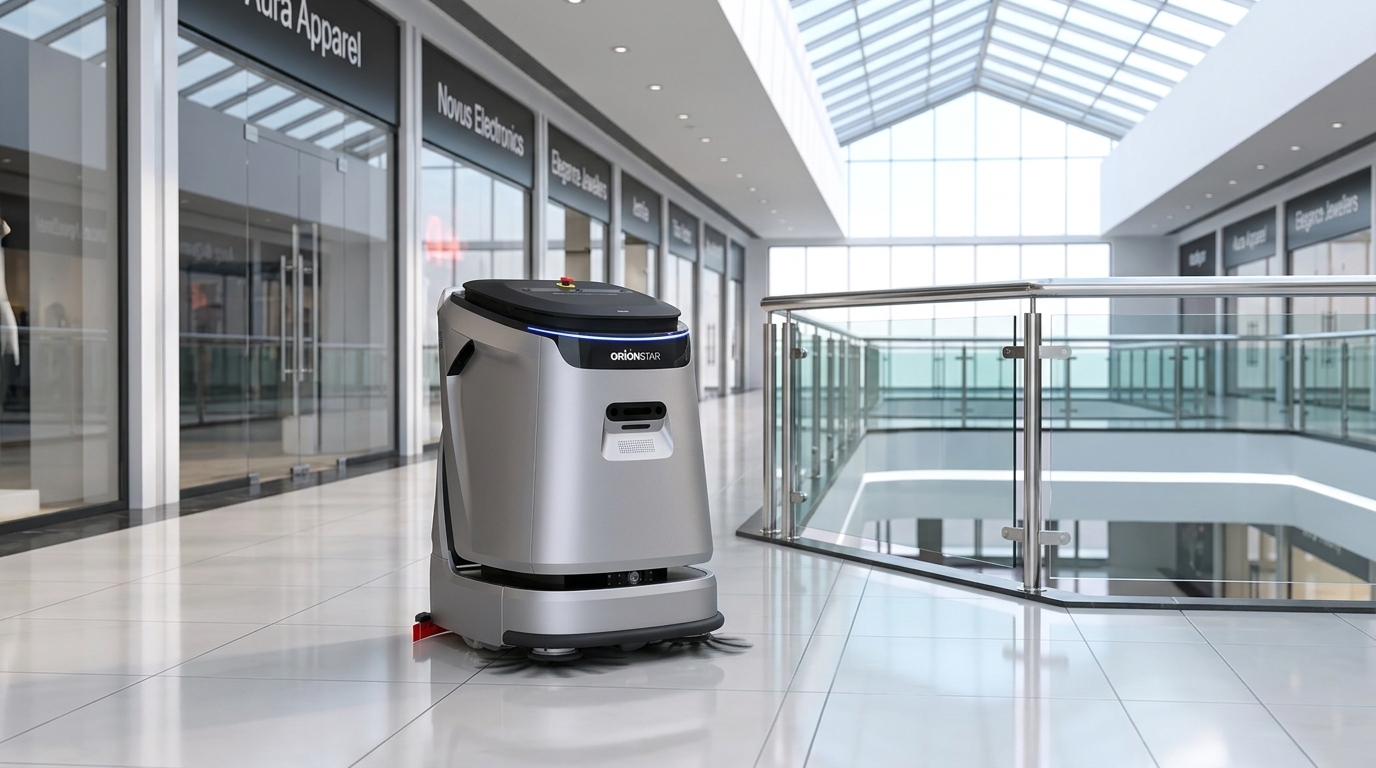
For mall routes, use our OrionStar CleaniBot C5’s 550mm main pass to plan repeatable open lanes, then recheck its body envelope and service return as kiosks and seasonal fixtures change. Trading windows and spot-response duties remain zone-specific.
A shopping mall is rarely one cleaning environment. An entrance may collect moisture and outdoor debris, a main corridor may face changing shopper density, and a food-court perimeter may need more frequent response to visible debris or spills. The practical buying question is therefore not whether one robot can cover the entire property. It is which zones have repeatable work, when those zones are accessible, and where a robot would create a useful addition to the operating plan.
We suggest dividing the property into working zones before comparing models. Mark public entrances, anchor-store approaches, main circulation corridors, atrium edges, food-court floor zones, display-adjacent areas, back-of-house transfer paths, and any location where the machine would need to pause, be moved, or return for service. This exposes whether the requirement is recurring route cleaning, a spot-response tool, or a mix of both.
Do not assume that the busiest area is automatically the first automation candidate. A corridor can have substantial cleaning demand but still be difficult to schedule during trading peaks. Conversely, a broad route with predictable access before opening, after closing, or between programmed activities may be a stronger candidate even if it is not the most visibly demanding area.
Floor type alone is not enough for a buying decision. The same nominal surface can behave differently at an entrance than it does in an interior corridor because of dirt load, moisture, finish condition, joints, ramps, edge details, and nearby operations. Create a short floor register that records the surface, visible soiling pattern, recurring task, restrictions, and the method currently used by the team.
Separate dry debris collection from wet floor-care work in the register. A zone may need sweeping or vacuuming for loose debris at one time and scrubbing or dust mopping at another. This prevents a common purchasing error: selecting around one desired task while overlooking the tasks that consume most of the operating window.
CleaniBot C5 supports scrubbing, vacuuming, sweeping, dust mopping, and wastewater recovery. That range can make it a candidate where the mall has clearly defined floor-care tasks across larger commercial areas, but it does not establish compatibility with every surface, floor finish, access constraint, or site routine. Confirm the chosen task against the actual zone and current cleaning requirements.
| Zone condition | Decision to make | What to verify on site |
|---|---|---|
| Dry debris near entrances or corridor edges | Determine whether recurring collection is needed or whether staff-led spot response remains the better fit. | Debris sources, mat boundaries, door activity, route continuity, and cleaning-window access. |
| Visible marks or tracked soil on hard flooring | Define whether the task calls for periodic floor care, not just a general cleaning route. | Surface and finish requirements, moisture controls, adjacent retail thresholds, and post-cleaning procedures. |
| Food-court circulation floor | Separate open paths from seating, queues, and frequently changing layouts. | Furniture movement, spill-response ownership, peak dining times, and access after tables are reset. |
| Large recurring commercial floor area | Consider C5 when the required tasks and service arrangement align with its large-commercial positioning and supported cleaning functions. | Floor suitability, route access, staging space, return-point practicality, and the operating window. |
| Tighter commercial area with changing route needs | Consider OrionStar CleaniBot S55 Pro when compact positioning and its six cleaning modes are relevant to the proposed work pattern. | Actual surface compatibility, route dimensions, fixture changes, task choice, and local operating constraints. |
Mall operating windows are usually more important than a generic claim of coverage. Access can change by the hour as stores open, food traffic rises, deliveries occur, housekeeping works around events, or marketing teams alter the public space. Build the selection around a zone-by-zone timetable rather than assuming that an overnight plan solves every requirement.
For each candidate route, identify an allowed window, a restricted window, and a contingency window. The allowed window is when the route is normally available. The restricted window captures predictable crowding, queue formation, maintenance activity, or display changes. The contingency window is the realistic alternative when a route is unavailable. This planning makes it easier to distinguish dependable recurring work from occasional opportunities.
A robot selected for main corridors should not force the team to treat every public hour as identical. If the route becomes fragmented during lunch, promotions, or seasonal footfall, the plan may need shorter segments, a different time of day, or manual handling for that interval. Avoid treating a proposed route as permanently fixed when tenant activity regularly changes the space.
Recurring routes are most practical when the area, task, and access pattern are reasonably repeatable. They are useful for broad corridors, stable open floor areas, and other zones where the cleaning team can define when the work should happen and where the route begins and ends. A recurring route should have a clear operating purpose, such as maintaining an agreed floor-care cycle during a lower-access period.
Spot response is different. It is driven by an incident, a local debris concentration, or a short-term operational need. It may happen near food courts, entrances, temporary displays, or changing tenant fronts. Do not buy a robot on the assumption that every spot issue should become a robotic task; instead, identify which responses are repeatable enough to prepare in advance and which still require a team member’s judgment and immediate action.
Use a simple route classification: stable, variable, or reactive. Stable routes are candidates for repeat planning. Variable routes may work only in selected windows after fixtures are checked. Reactive zones should be evaluated around response procedures, access, and the condition that triggers action. This classification also helps managers explain why one model or configuration may be appropriate for one mall area but not another.
Machine size should be evaluated as an operating-system choice, not only as a coverage choice. A larger commercial machine may suit a broad recurring area, but the site still needs an appropriate storage location, a practical route to and from the cleaning zone, a return point, and a process for preparation and follow-up. Narrow transitions, fixture changes, staff circulation, and shared back-of-house paths can all affect the workable setup.
CleaniBot C5’s 820 × 680 × 1130mm body and 550mm main cleaning width answer different mall questions: can the proposed route and return path accommodate the machine, and how should open-lane passes overlap? Recheck both after kiosks, displays or event layouts change. C5 is a candidate for repeatable open corridor work because the main pass can be laid out as a stable route with a planned return point. A seasonal fixture that breaks the return path changes the assignment, even if the cleaning task and floor finish stay the same.
For the C5 45L clean/45L wastewater service loop, walk the return path during tenant deliveries and event setup, not only after closing. Keep configured-station access in the zone calendar and assign a fallback when its approach is blocked. That service loop supports recurring mall work only when the back-of-house path is available during the zone’s actual window. Where tenant activity repeatedly blocks it, change the return arrangement or route timing rather than relying on product positioning.
CleaniBot S55 Pro is positioned as a compact commercial cleaning robot and supports six cleaning modes. Consider S55 Pro when the proposal involves a more compact commercial setting or a need to compare task approaches, then check the specific floor, route, available space, and operating limits rather than inferring all-floor suitability from the mode count.
A useful shortlist matrix compares the work rather than ranking products in the abstract. Give each zone a proposed task, a repeatability rating, an access window, a route condition, and a service-return requirement. Then review the matrix with facilities, cleaning operations, security, leasing or tenant coordination, and any team responsible for displays or events. The purpose is to reveal unresolved dependencies before a model decision is made.
Keep the matrix honest by recording unknowns as unknowns. For example, if a food-court route changes daily, do not label it stable because it appears open during one walkthrough. If a workstation location has not been confirmed, do not treat automatic charging or water-handling support as available. A conditional shortlist is more useful than an overly confident plan that cannot be run during normal mall operations.
| Selection factor | Questions for the mall team | Decision outcome |
|---|---|---|
| Floor and task | What work is needed: debris collection, dust mopping, floor scrubbing, vacuuming, or another defined task? | Match the candidate to the actual task and verify surface suitability. |
| Traffic and access | When is the space accessible, and what changes during trading peaks, dining periods, or events? | Assign a recurring route window, a limited window, or retain manual response. |
| Route stability | Do fixtures, displays, queues, or furniture change the route often? | Classify the route as stable, variable, or reactive. |
| Service return | Where will preparation, return, charging, water handling, and routine checks occur? | Confirm a workable service process before relying on configured support functions. |
| Candidate positioning | Is the requirement a larger recurring commercial floor-care area or a compact commercial cleaning situation? | Consider CleaniBot C5 for the former or CleaniBot S55 Pro for the latter only after site checks. |
Before discussing a candidate, assemble a floor plan marked with entrances, corridor widths, food-court boundaries, display areas, back-of-house access, proposed staging points, and potential service-return locations. Add a weekly access calendar that shows trading peaks, tenant deliveries, events, and recurring layout changes. These inputs make the discussion about an operating plan rather than an assumed machine capability.
Ask which zones need recurring cleaning, which need spot response, and which should remain outside the proposed scope. Ask what floor conditions and finishes apply in each zone, what route interruptions are normal, where the machine would be stored and returned, and who owns the daily preparation and follow-up steps. Ask which water-service alternatives are available for the exact quoted configuration and how filling, wastewater handling and daily inspection would work. Availability and inclusion need confirmation in the proposal.
For CleaniBot C5, ask whether the proposed location can support a suitable configured workstation if automatic charging, clean-water refill, wastewater discharge, or wastewater-tank self-cleaning are part of the intended workflow. For CleaniBot S55 Pro, ask which of its six modes is relevant to the planned task and whether the specific floor and route support that choice. These questions set a clear scope and help the mall team make a preliminary, zone-based shortlist.
There is no universal choice for every mall. Start with the zone, floor task, traffic pattern, access window, route stability, and service-return arrangement. CleaniBot C5 may be considered for larger recurring commercial floor-care work, while CleaniBot S55 Pro may be considered for compact commercial situations, subject to site checks.
Not automatically. These areas can have different debris sources, floor conditions, furniture patterns, and public-access windows. Build a zone plan first, then determine whether each area supports a recurring route, a limited-window task, or staff-led spot response.
C5 supports scrubbing, vacuuming, sweeping, dust mopping, and wastewater recovery. The relevant question is which task matches the proposed mall floor and operating window; those supported functions do not confirm suitability for every surface or route.
Confirm the proposed location, site utilities, access path, operating procedure, and responsibility for routine checks. With a suitable configured workstation, C5 supports automatic charging, clean-water refill, wastewater discharge, and wastewater-tank self-cleaning, but those functions should not be treated as zero maintenance.
No. S55 Pro supports six cleaning modes and is positioned as a compact commercial cleaning robot, but the mode count does not establish compatibility with every floor surface, layout, or mall operating condition. Check the specific zone and task before selecting it.
