

REQUEST DEMO
Robot CATALOG will be sent to your mailbox immediately after submission.
SUBMIT
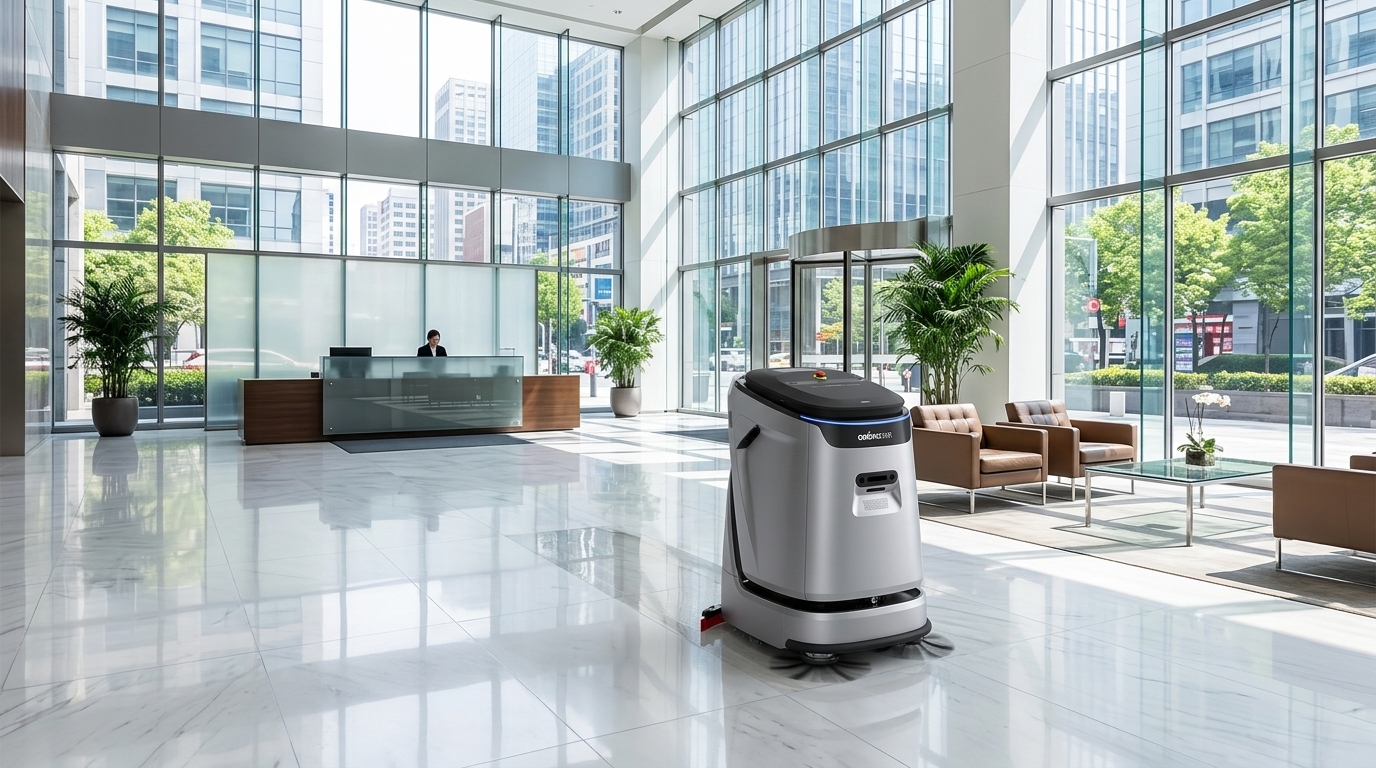
For our OrionStar CleaniBot C5 proposal, model who pays for and performs water service, configured-station upkeep and retained site work. Separate 45L tanks identify the workflow to measure—not a savings rate—and purchase, lease or RaaS terms must come from the actual quotation.
A robot quotation is easier to evaluate when the facility has first defined the work it is expected to change. Document the zones, floor types, cleaning tasks, service windows, traffic patterns, water access, waste-water handling, storage space, and human handoff points. This turns a broad question such as “How should I choose a commercial cleaning robot?” into a usable requirement: which recurring work can be assigned to a machine without creating new operational friction?
For large commercial settings, consider CleaniBot C5 when the planned scope includes large-area floor-care work and the site team can verify the route, floor condition, staging area, water workflow, and supervision plan. C5 supports scrubbing, vacuuming, sweeping, dust mopping, and wastewater recovery, but those supported functions do not establish that every floor, route, or operating schedule is suitable.
For a more compact commercial cleaning candidate, consider OrionStar CleaniBot S55 Pro when the facility needs to examine how a compact machine and its available cleaning approaches might fit the intended areas. CleaniBot S55 Pro supports six cleaning modes, but a mode count alone does not confirm surface compatibility, coverage quality, or site fit. Ask the supplier to relate the proposed mode to each planned surface and task.
ROI is only meaningful against a documented baseline. Begin with the current cleaning plan, not an assumed fully loaded labor figure. Separate the cost of work that is genuinely in scope from work that will continue after a robot is introduced. For example, a team may still need to prepare areas, clean edges, respond to spills, move obstacles, perform detail cleaning, and inspect outcomes.
Record recurring costs by category and identify the owner of each cost. Use the same categories for the current state and the proposed future state. This makes it easier to see whether a quoted service bundle replaces an existing cost, adds a new one, or merely moves responsibility from the facility to a provider.
| Baseline category | What to collect | How to use it in the model |
|---|---|---|
| Direct cleaning labor | Scheduled hours, labor rate assumptions, overtime rules, and work allocation by zone | Separate work that may be reallocated from work that could actually leave the budget. |
| Labor management and coverage | Supervisor time, training, absence coverage, and shift coordination | Include only costs that are expected to change under the proposed operating plan. |
| Consumables and utilities | Cleaning chemicals, pads or tools, water, electricity, and disposal practices | Compare the current process with the proposed process using facility-specific consumption assumptions. |
| Equipment and maintenance | Existing equipment payments, repairs, replacement plans, storage, and maintenance labor | Identify costs that end, continue, overlap temporarily, or transfer into a supplier fee. |
| Quality and service exceptions | Rework, complaints, missed-service response, and manual intervention | Treat these as operational inputs, not assumed savings, unless the facility can support the change. |
| Implementation and change management | Site preparation, training, workflow redesign, initial supervision, and internal project time | Capture these as one-time or temporary costs rather than hiding them in an ongoing estimate. |
This distinction is central to a credible business case. A robot may enable staff to move from repetitive floor work to higher-priority tasks, additional service coverage, or more consistent scheduling. That can be operationally valuable even when payroll does not decline. It should not be presented as cash savings unless a budgeted expense is expected to decrease and the responsible budget owner agrees with the assumption.
Create two benefit lines. The first is cashable impact: a reduction in an approved future expense, avoided outsourced spend, avoided planned hiring, or another budget change with a clear owner and timing. The second is capacity value: labor hours redirected to necessary work that otherwise would remain incomplete, require extra coverage, or create a service risk. Keep these lines separate in the approval document.
For facility service companies, this separation is especially important. A provider may use robot-supported cleaning to redesign labor deployment across client sites, protect service windows, or offer a different delivery model. The provider should model the contract terms, staffing obligations, client acceptance criteria, and any retained manual scope before treating capacity as margin improvement.
Purchase, lease, and RaaS can all be reasonable structures, but they distribute cost, responsibility, and flexibility differently. Do not compare an upfront purchase amount with a recurring fee in isolation. Normalize proposals into a common internal view that includes the same time period, implementation scope, included services, exclusions, renewal conditions, and end-of-term responsibilities.
A purchase model may place more responsibility for ownership, maintenance planning, replacement timing, and residual-value assumptions with the buyer. A lease may change the payment profile but still require clarity on support, insurance, damage, early termination, and end-of-term choices. A RaaS proposal may bundle equipment and services, but the buyer should identify exactly what is included, what triggers additional charges, who performs routine site tasks, and what occurs if the service level or site conditions change.
| Commercial model | Questions for the quotation | Decision input to document |
|---|---|---|
| Purchase | What is included at delivery? Which setup, training, maintenance, consumables, repairs, and support items are separate? | Upfront cash requirement, ownership responsibilities, expected replacement planning, and excluded costs. |
| Lease | What are the term, payment schedule, renewal conditions, end-of-term options, damage terms, and early-exit conditions? | Commitment length, accounting and procurement review needs, total contractual payments, and retained operating costs. |
| RaaS | Which machine, support, maintenance, software or service elements, consumables, and site responsibilities are included? What is excluded? | Recurring fee structure, service boundaries, adjustment mechanisms, minimum commitments, and transition options. |
| Any proposal | What assumptions define the proposed cleaning scope and expected utilization? What site changes are required? | A shared assumptions register signed off by operations, finance, procurement, and the service owner. |
Total cost of ownership is more than the equipment payment. It is the full set of costs required to put the proposed workflow into service and keep it operating through the comparison period. A useful TCO model shows both cash timing and responsibility: what the buyer pays, what the provider includes, and what the site team must still perform.
With CleaniBot C5’s separate 45L tanks, identify the costs and owners for water supply, wastewater handling, station installation where proposed, daily inspection and exception work. A configured station may change who performs service steps; include only measured time changes and quoted included/excluded costs. C5 may suit a repeated wet-floor program because cleaning and supply/recovery can be organized together. Financial value follows only if that organization changes a documented cost or releases useful staff capacity; tank capacity itself is neither a labor reduction nor a payback assumption.
Do not assume a universal no-plumbing workflow from an optional offering. Ask which water-service alternatives are available for the exact quoted configuration and how filling, wastewater handling and daily inspection would work. Availability and inclusion need confirmation in the proposal.
Keep baseline cost reductions, retained labor and new operating costs tied to site measurements and budget-owner approval. Count each workstation-related maintenance or support item once against the actual quotation; changed service tasks may release capacity without reducing cash payroll. A candidate with a workable service loop can free an operator for required detail work without reducing headcount. Recognize that capacity benefit separately so the approval remains useful even when payroll, provider fees or client staffing commitments do not change.
For a purchase comparison, model net ownership cost as the initial investment plus implementation, recurring site and support costs, and any planned replacement or exit costs, less only documented cost reductions. For lease or RaaS, replace the initial investment with the contractual payment stream while retaining implementation, site operations, exclusions, and transition costs. Use finance-approved treatment for discounting, tax, depreciation, and accounting treatment rather than inserting generic assumptions into an operational worksheet.
We suggest presenting a base case, a lower-utilization case, and a higher-utilization case. The purpose is not to manufacture an attractive result; it is to show decision-makers which assumptions matter most. A model that remains useful when assumptions move is more valuable than a single optimistic payback calculation.
| Sensitivity input | Lower case question | Base case question | Higher case question |
|---|---|---|---|
| Utilization | What if fewer planned cleaning windows are usable? | What schedule is operations prepared to run? | What additional usable scope is genuinely available? |
| Labor outcome | What work remains staffed and budgeted? | Which documented hours are reallocated or avoided? | What approved future cost can be reduced? |
| Operating effort | What routine site labor and consumables are required? | What does the agreed workflow require? | What process improvement is plausible but not yet committed? |
| Commercial terms | What exclusions, renewal, or exit costs apply? | What is included in the selected proposal? | What value follows only if optional scope is adopted? |
Before choosing a candidate, create a short assumptions register that links every material model input to an owner and evidence source. Operations should own workflow assumptions. Finance should own treatment of costs and savings. Procurement or legal teams should review commercial commitments. The site team should confirm practical access, storage, water, waste-water, traffic, and staffing conditions.
For large commercial spaces, the shortlist should be based on the actual cleaning map and operating workflow, not a broad positioning label. CleaniBot C5 is positioned as a large-capacity scrubber for large commercial settings, which can make it a candidate for evaluation, but the facility still needs to verify the planned task mix and site conditions. CleaniBot C5 and CleaniBot S55 Pro are OrionStar CleaniBot product-line models; model identity alone is not a financial or operational recommendation.
Give each cost one category, one owner, and one treatment in the comparison period. Do not add maintenance separately if it is already included in a service fee, count the same equipment payment as both upfront and recurring, or treat redeployed labor as both cash savings and capacity value. Reconcile the model to the quotation and baseline before approval.
Ask whether installation, training, consumables, site labor, routine cleaning, repairs, replacement, connectivity, support, and end-of-term transition are included or charged separately. Confirm usage limits, renewal and exit obligations, and any conditions that change fees. These are quotation questions, not a statement that this brand offers a particular RaaS package.
Fewer usable cleaning windows can reduce the amount of work displaced while contractual payments and some support costs remain. Recalculate the model using a lower measured scope, retained staffing, interruption effort, and the actual contract terms. If the case only works at an optimistic schedule, reduce the commitment or gather more evidence rather than promising payback.
Use the same comparison period and include all costs and responsibilities: implementation, payment stream, site labor, consumables, support, maintenance, exclusions, renewal conditions, and exit obligations. Then test the result under different utilization and labor-outcome assumptions.
It can be recorded as capacity value when staff move to necessary work, but it should be counted as cash savings only when a documented budgeted expense is expected to decrease. Keep the two benefit types separate for approval.
