

REQUEST DEMO
Robot CATALOG will be sent to your mailbox immediately after submission.
SUBMIT
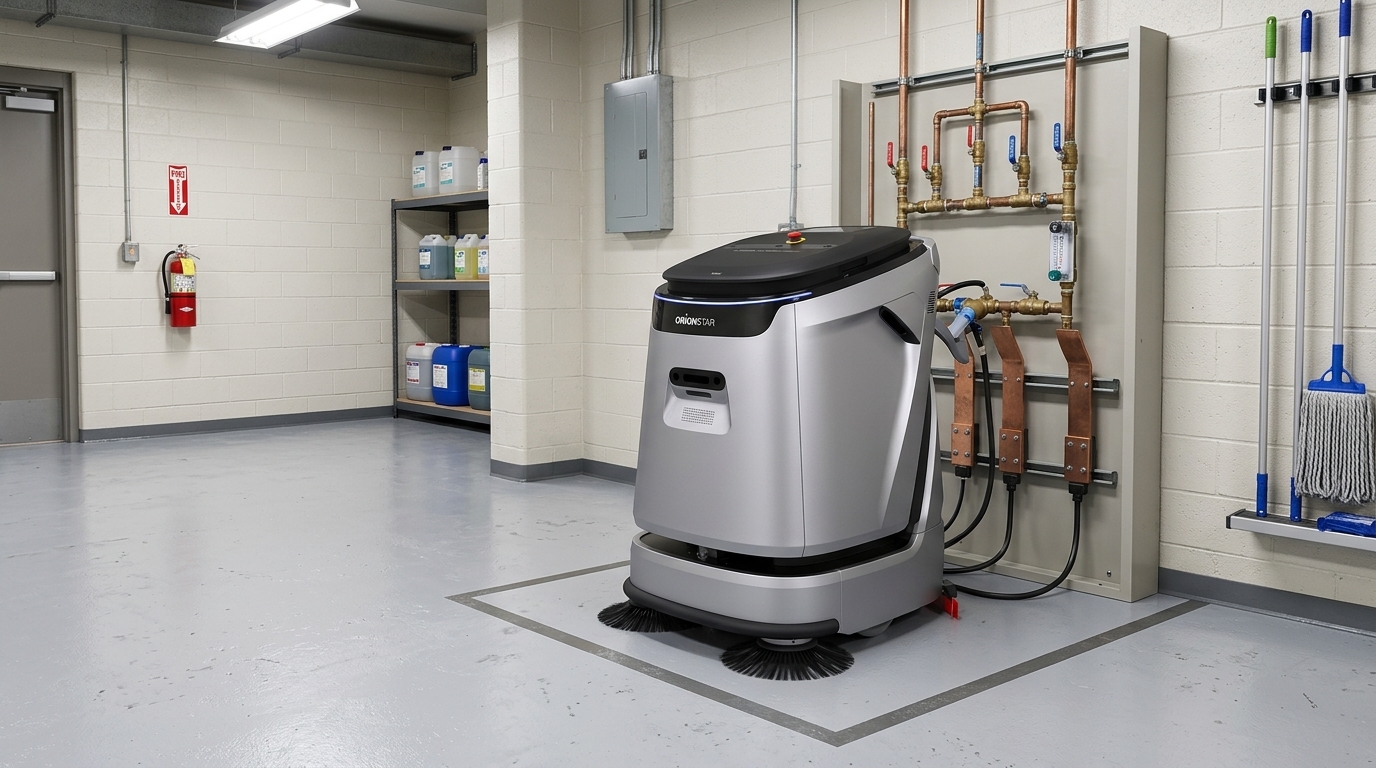
Our OrionStar CleaniBot C5 workstation discussion should start with its separate 45L onboard tanks and the configured refill/discharge/charging/self-cleaning sequence. The manual’s battery labels help frame scheduling questions, but they do not define a guaranteed station turnaround or remove daily care.
A workstation is the service point that helps a cleaning robot return to a repeatable operating routine. Rather than treating charging, water handling, and tank care as unrelated chores, facility teams can evaluate them as a single workflow: the robot finishes a task, returns for service, and becomes ready for the next assigned cleaning period when the needed conditions are available.
That workflow matters most in commercial environments where operators do not want routine water and charging tasks to interrupt every cleaning cycle. It is still important to separate automation from autonomy in the broadest sense: a workstation can automate supported service actions, while people remain responsible for preparing the area, checking machine condition, resolving interruptions, and maintaining the surrounding service point.
CleaniBot C5 has separate 45L clean-water and 45L wastewater tanks. A suitable configured station can refill one and discharge the other, as well as charge and support wastewater-tank self-cleaning; plan the supply, drainage, access and inspection handoff for that service loop. This makes C5 a candidate where recurring wet work benefits from a defined supply-and-recovery service sequence. A workstation is useful when the facility can maintain that sequence at the planned return times; the site still owns daily condition checks and exceptional residue or blockage.
The CleaniBot C5 manual lists 3h for scrubbing, 8h for dust mopping and 1.5h charging. Use those attributed labels to ask how the intended task and charge/refill/discharge timing fit a measured shift; they do not promise site runtime or say every service action finishes in 1.5h. The longer dust-mopping label is relevant to a different task from scrubbing, so it cannot be used to justify an eight-hour wet-cleaning shift. Public test conditions are not supplied; base the service schedule on observed task, travel, water handling and charging needs in the proposed configuration.
| Workstation function | Operational purpose | Site question to ask | Team responsibility that remains |
|---|---|---|---|
| Automatic charging | Restores power through the configured workstation so charging can be part of the return routine. | Can the proposed service location remain accessible during the periods when the robot is expected to return? | Keep the approach area clear, inspect the charging area, and handle missed or interrupted returns. |
| Clean-water refill | Adds clean water through the configured workstation to support the next planned cleaning task. | Is there a practical clean-water workflow at the intended service point, including responsibility for keeping that workflow ready? | Monitor water availability, inspect for leaks or contamination concerns, and respond when refill does not complete as expected. |
| Wastewater discharge | Removes recovered wastewater through the configured workstation instead of requiring every tank-emptying step to be handled manually. | Can the service point support the intended wastewater handling process without creating access conflicts for staff or other building activity? | Check the collection and discharge area, deal with abnormal residue or blockage, and follow the site's own cleaning procedures. |
| Wastewater-tank self-cleaning | Supports cleaning of the wastewater tank when C5 is paired with a suitable configured workstation. | Does the selected C5 configuration include the needed workstation arrangement, and who will inspect the result after routine use? | Perform daily condition checks and manually address residue, odor, debris, or irregular tank conditions. |
The workstation should be assessed as an operating location, not as an isolated accessory. The right questions concern access, the routine movement of people and materials around the area, the availability of the necessary utility workflow, and who can act when the normal sequence is interrupted. This is especially relevant for facility service companies, where the cleaning team and the building team may have different responsibilities.
We suggest documenting answers in plain operational terms. For example, identify the person who will inspect the service area at the start of a shift, the team that will respond if water handling needs attention, and the process for keeping the route back to the workstation usable. These decisions are more actionable than broad statements that a location is “robot ready.”
Some sites may not want to begin with a fixed water-handling assumption. Ask whether that option is available for the selected configuration and how the tank is filled and drained in the intended operating routine. Ask which water-service alternatives are available for the exact quoted configuration and how filling, wastewater handling and daily inspection would work. Availability and inclusion need confirmation in the proposal.
This inquiry is most useful when a team needs to compare operating flexibility against the work of moving, filling, draining, cleaning, and supervising a mobile water arrangement. A mobile option may change where service is performed, but it does not remove the need to assign ownership of water quality, wastewater handling, and daily inspection.
For large commercial spaces, a larger machine category may be worth considering when the floor-care plan includes broad-area scrubber work and the site can support the associated return-and-service routine. CleaniBot C5 supports scrubbing, vacuuming, sweeping, dust mopping, and wastewater recovery; its wastewater-tank self-cleaning support is conditional on a workstation. Those capabilities help frame the task discussion, but they do not by themselves establish that a specific building has the right service setup.
Compare service arrangements by walking the whole return-and-service loop. Check whether access remains open at the planned return times, whether staff can prepare clean water and manage wastewater, and whether the service point competes with storage, deliveries, or other equipment. A different machine category does not answer these questions: request the exact offered service arrangement and its installation and operating instructions rather than assuming that another model has equivalent workstation functions.
For warehouse buyers and service contractors, we suggest choosing a candidate only after the cleaning tasks, daily service ownership, return route, and workstation questions are written down. Product positioning can guide the starting point; the site routine determines whether the proposed configuration is practical.
A workstation is most valuable when it makes routine work more consistent, not when it encourages teams to skip inspection. Daily care should focus on whether the robot, its tanks, the service area, and the cleaning route are ready for the next operating period. The exact checklist can vary by building, but the owner and timing should be clear.
Before discussing a CleaniBot C5 workstation configuration, prepare a concise picture of the facility: the floor-care tasks to be covered, the approximate operating areas, the intended service location, the people and material traffic around it, the clean-water and wastewater workflow, and the team responsible for daily care. This keeps the conversation centered on an executable routine rather than a feature wish list.
Ask whether the proposed C5 configuration supports automatic charging, clean-water refill, wastewater discharge, and wastewater-tank self-cleaning at the intended workstation. C5's large-commercial positioning is a useful starting point, not proof of site fit. Ask which water-service alternatives are available for the exact quoted configuration and how filling, wastewater handling and daily inspection would work. Availability and inclusion need confirmation in the proposal.
No. A suitable configured workstation can support charging, clean-water refill, wastewater discharge, and wastewater-tank self-cleaning for CleaniBot C5, but teams still need to inspect the robot, tanks, route, and service area each day and handle exceptions.
Start with responsibility boundaries: who prepares the route, keeps the service point accessible, checks water and wastewater readiness, performs daily inspections, and responds when the routine does not complete normally.
C5 is positioned as a large-capacity scrubber for large commercial settings. Consider it when the planned floor-care work and the site's service routine align, then confirm the workstation configuration and practical access conditions.
Do not assume so. Ask which water-service alternatives are available for the exact quoted configuration and how filling, wastewater handling and daily inspection would work. Availability and inclusion need confirmation in the proposal.
Compare the exact alternatives in the quotation. Ask who supplies clean water and handles wastewater, where those tasks occur, how equipment is moved or installed where relevant, and who checks readiness. Include staff time, access dependencies and routine upkeep; do not assume either arrangement eliminates daily care.
