

REQUEST DEMO
Robot CATALOG will be sent to your mailbox immediately after submission.
SUBMIT
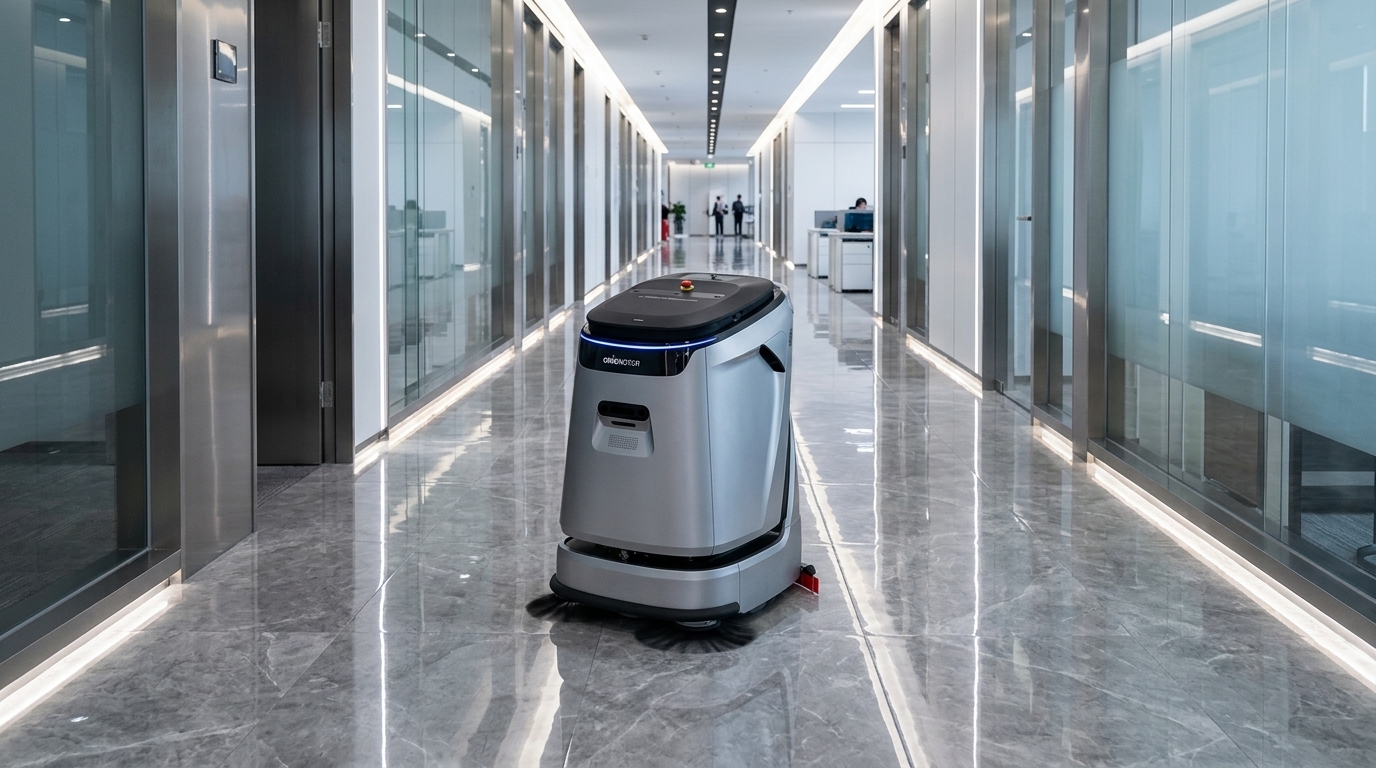
For a service contract, define who supplies and maintains the service point and who operates and inspects the machine. Our OrionStar CleaniBot C5’s separate 45L tanks and configured workstation functions make that responsibility split concrete; client acceptance remains site-specific.
Facility service companies procure equipment for work they must deliver in someone else’s building. That makes accountability more important than an attractive feature list. Before comparing candidates, identify the contracted cleaning outcomes, the areas included and excluded, the operating windows, the personnel available, and the client’s approval path for a new cleaning method.
A robot should sit inside a defined service model: it may perform a recurring floor-care task, support an operator on a larger route, or cover selected areas while the team handles detail work and exceptions. Procurement becomes clearer when the robot is treated as one component of the service scope rather than as a replacement for an entire cleaning program.
For large commercial areas, consider CleaniBot C5 when the proposed scope includes tasks it supports—scrubbing, vacuuming, sweeping, dust mopping, and wastewater recovery—and the site review confirms that those tasks are actually needed in the nominated zones. Its large-capacity scrubber positioning for large commercial settings is product positioning, not proof that a particular facility is suitable.
For constrained commercial locations, consider OrionStar CleaniBot S55 Pro when a compact commercial cleaning robot and its six supported cleaning modes align with the intended service scope. Confirm the applicable surface, route, access conditions, and mode choice during the trial; six modes do not establish compatibility with every floor or every client environment.
Many deployments become difficult because the service company, client, site manager, and equipment provider each assume someone else will resolve access, water, storage, or daily readiness. A procurement request should therefore include a responsibility schedule. It does not need legal language to be useful; it needs practical owners and escalation points.
The client or building representative usually needs to provide accurate site information, approved access arrangements, a suitable storage location, and timely notice of layout or operating changes that affect the agreed cleaning route. The facility service company should own staffing, operator training arrangements, daily checks, route selection within the agreed scope, service recovery, and communication with the client.
CleaniBot C5’s clean-water and wastewater tanks each hold 45L. If a configured workstation handles refill, discharge, charging and tank self-cleaning, separate the client’s approved supply/drainage and access responsibilities from the contractor’s readiness checks, inspection and exception response. C5 is a candidate for a contract with recurring wet-floor work when the client can provide the service environment and the contractor can sustain the remaining checks. Without that split, service automation can shift an unowned task rather than improve the delivery model.
| Decision area | Client or site duty to clarify | Facility service company duty | Procurement evidence to request |
|---|---|---|---|
| Access and operating window | Approve zones, entry rules, and permitted cleaning periods | Plan staffing, task timing, and escalation when access changes | Written zone list and approved operating window |
| Utilities and storage | Confirm available storage, water and wastewater arrangements where relevant | Define daily readiness checks and responsible operators | Site sketch, utility questions, and storage approval |
| Cleaning scope | State required areas and presentation expectations | Translate requirements into robot and manual tasks | Area schedule with inclusions, exclusions, and exceptions |
| Trial acceptance | Name the reviewer and acceptance concerns | Run the agreed workflow and record open issues | Trial plan and client sign-off record |
| Service continuity | Report site changes and access interruptions | Provide fallback cleaning process for agreed tasks | Exception and communication procedure |
Do not nominate every client property simply because it has hard floors or a recurring cleaning requirement. A site should pass a small set of gates before it becomes a trial candidate. This protects the service team from promising a workflow before it understands the physical environment and the client’s operating constraints.
Use CleaniBot C5’s 820 × 680 × 1130mm body dimensions to mark storage, approaches and route transitions in each nominated client site survey. Record unresolved turns or doors as site gates rather than assuming a successful account trial transfers to another account. A site that needs repeated furniture moves or unavailable access may be a poor first nomination even when its floor area is large. Use the resulting access record to accept a bounded route or leave the affected zone out of the contract trial.
The final gate is client readiness. The client should understand what task is being introduced, when it will occur, which work remains manual, and how issues will be raised. If any gate is unresolved, keep the location in discovery rather than presenting it as a deployment-ready site.
A trial should answer procurement questions, not become an informal demonstration. Select representative zones that reflect the proposed contract work and include the conditions most likely to affect routine service. Document the initial scope, the operating window, the assigned operator, the client contact, and the circumstances that will pause or alter the trial.
Set trial criteria in operational language. For example, confirm whether the proposed task can be completed within the intended workflow, whether the operator can prepare and recover the equipment as planned, whether the agreed service standard is understood by the client, and whether exceptions have a workable response. Avoid treating a short trial as evidence for untested floors, sites, or future client changes.
If CleaniBot C5 is a candidate, the trial can specifically check whether its supported scrubbing, vacuuming, sweeping, dust mopping, or wastewater-recovery functions correspond to the site’s nominated tasks. If a suitable configured workstation is proposed, test the intended charging, clean-water refill, wastewater discharge, and wastewater-tank self-cleaning workflow as part of the complete service process rather than as an isolated equipment feature.
If CleaniBot S55 Pro is a candidate, use the trial to select the relevant supported mode or modes for the agreed task and inspect the proposed commercial area in person. Its compact positioning and six modes are useful starting points for comparison, but they do not replace site-specific confirmation.
A successful trial is not the handover itself. Before regular service begins, issue a concise site operating pack that the account manager, supervisor, operator, and client contact can use. It should show the approved zones, service timing, preparation steps, recovery steps, routine care duties, exceptions, and contacts. This prevents knowledge from remaining with one trial participant.
The handover should also set boundaries. State the floors, areas, and tasks included; identify spaces that require manual cleaning; explain who can approve a change; and define what happens if the usual route, access, or utility arrangement is unavailable. A clear boundary is more valuable than an expansive promise that cannot be managed across multiple client-owned facilities.
For a CleaniBot C5 configuration involving a workstation, include the confirmed site workflow for charging, clean-water refill, wastewater discharge, and wastewater-tank self-cleaning only when a suitable configured workstation is part of the selected setup. Ask which water-service alternatives are available for the exact quoted configuration and how filling, wastewater handling and daily inspection would work. Availability and inclusion need confirmation in the proposal.
A procurement shortlist should remain conditional until each proposed site supplies the same core inputs. Gather the contract area schedule, cleaning tasks, floor and route observations, operating windows, storage and utility arrangements, client contacts, and the contractor’s staffing plan. This creates a consistent basis for comparing candidates across client-owned facilities without assuming that one successful site represents every account.
Ask candidate-specific questions only where they affect the proposed service scope. For CleaniBot C5, ask whether the large-commercial positioning and supported cleaning tasks align with the nominated area, and whether a suitable configured workstation is part of the intended workflow. For CleaniBot S55 Pro, ask which of its six supported modes are relevant to the intended task and confirm the physical site conditions before selection.
Use the following questions in internal reviews and client discussions: What exact task is being assigned? Which areas remain manual? Who prepares, oversees, and recovers the equipment? What site condition would interrupt the workflow? What does the client need to see before accepting the service? Answers to these questions create a practical procurement record without promising results beyond the reviewed site.
A suitable candidate is one that fits a defined contract task at a verified client site, with clear operator ownership and an agreed trial outcome. CleaniBot C5 can be considered for large commercial settings where its supported scrubbing, vacuuming, sweeping, dust mopping, and wastewater-recovery tasks match the required work. CleaniBot S55 Pro can be considered where a compact commercial cleaning robot and its six modes fit the planned scope, subject to site and surface checks.
Ownership and operation can be separated, but the contract should still name who approves the site, supplies access and utilities, operates the equipment, performs routine care, receives faults, and approves changes to the cleaning scope. Procurement should not leave these duties implied.
A trial should prove the proposed service workflow at representative zones: whether the required task can be performed within the agreed operating window, how exceptions are handled, what operator attendance is needed, and whether the client accepts the resulting service process. It should not be treated as proof of performance in every area or every future site.
With a suitable configured workstation, C5 supports automatic charging, clean-water refill, wastewater discharge, and wastewater-tank self-cleaning. These supported functions do not remove the need to assign routine oversight, cleaning, consumable checks, and exception handling in the service scope.
Do not assume that this option is universal or that it removes all site workflow requirements. Ask which water-service alternatives are available for the exact quoted configuration and how filling, wastewater handling and daily inspection would work. Availability and inclusion need confirmation in the proposal.
