

REQUEST DEMO
Robot CATALOG will be sent to your mailbox immediately after submission.
SUBMIT
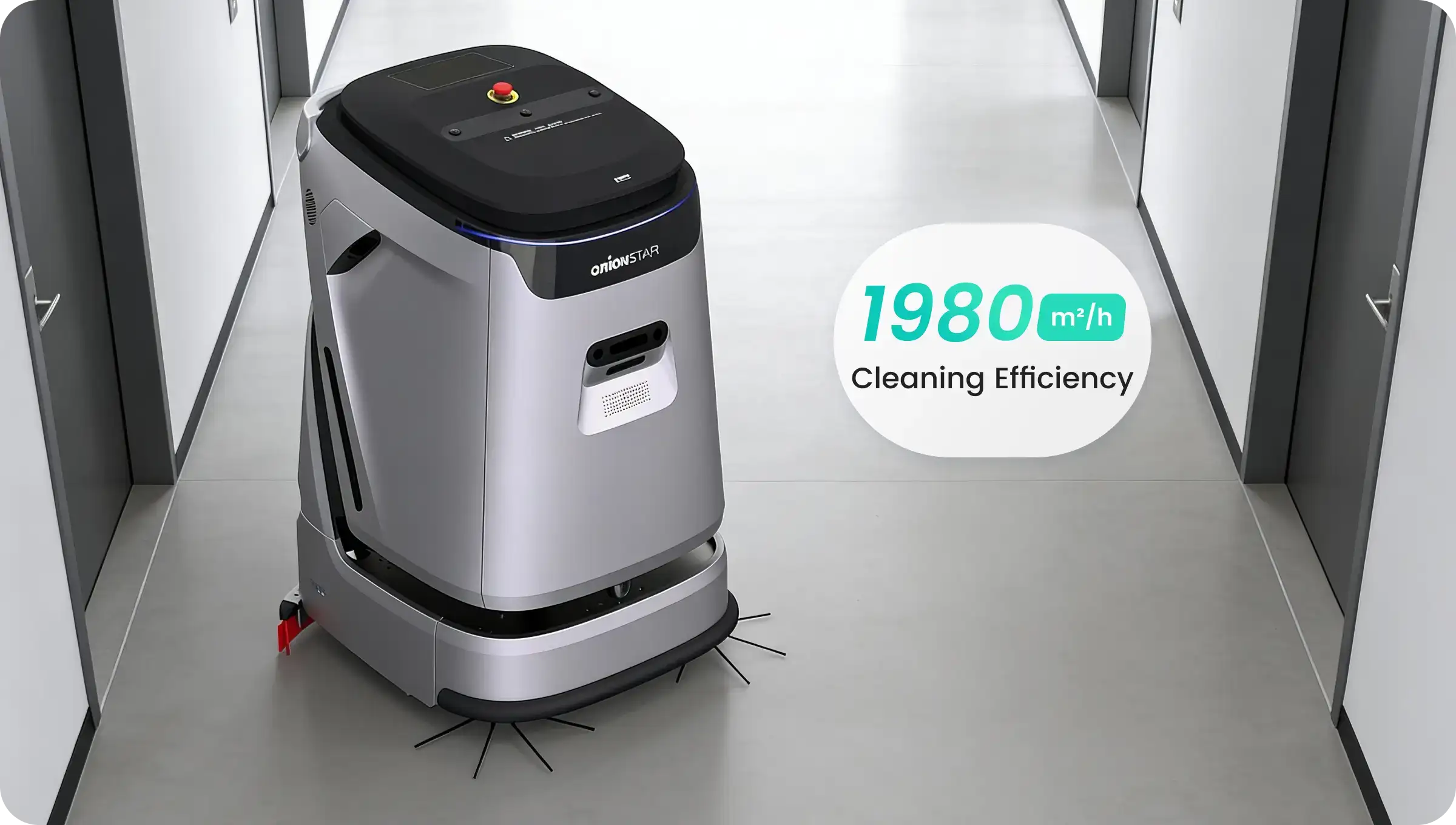
Choose our OrionStar CleaniBot C5 when a repeatable scrubber route needs the 550mm main cleaning width and a planned water-service loop; evaluate OrionStar CleaniBot S55 Pro when its 55cm height and six modes address a specific clearance or task requirement. Verify the complete route and cleaning outcome before choosing.
We suggest defining the cleaning outcome before choosing a machine. Map the actual floor surfaces, transitions, mats and excluded areas, then separate recurring dust, tracked-in moisture and wheel marks from spills or detail work. Record where soil accumulates and when each zone becomes available: different tasks may need separate routes or manual completion.
CleaniBot C5 supports scrubbing, vacuuming, sweeping, dust mopping and wastewater recovery, giving you several functions to evaluate for a recurring commercial route. Start with the tasks each zone needs, then check the cleaning result on its actual surfaces and soil. CleaniBot S55 Pro offers six cleaning modes, but mode choice alone does not establish compatibility with every floor surface or soil condition.
Usable capacity is the accepted cleaning coverage achieved in the facility's real operating window, not a theoretical maximum. It includes preparation, travel from the service location, cleaning, interruptions, charging, clean-water service, wastewater handling, inspection and staff handoffs. A useful buying question is therefore: can the proposed machine complete the required priority route to the agreed outcome before the window closes?
CleaniBot C5’s 550mm main cleaning width and separate 45L clean-water and 45L wastewater tanks make swath overlap, water use and the return-to-service loop concrete trial questions. Observe accepted coverage including service pauses; tank volume is not an area-per-fill claim. For broad, recurring scrub routes, the main pass provides a consistent unit for route planning, while separate supply and recovery capacity allows the water-service loop to be designed around repeat work. C5 is therefore a candidate when that combination matches the priority task and a workable return point—not simply because the property is large.
A scrubber route is only workable when its service cycle is workable. Identify where clean water is obtained, where wastewater is discharged, where charging occurs and how the machine travels between those points and the cleaning route. Check the path at the intended operating time, not only when the building is empty. Doors, shared corridors, storage activity and access permissions can determine whether an otherwise suitable route is practical.
With a suitable configured workstation, CleaniBot C5 supports automatic charging, clean-water refill, wastewater discharge and wastewater-tank self-cleaning. Treat these functions as inputs to service-cycle design rather than as a substitute for operating responsibility. Confirm the proposed workstation location, route access to it, utility arrangement, wastewater handling process and the staff work that remains before and after scheduled runs.
Do not assume that any configuration removes plumbing, installation, handling or inspection requirements. The relevant decision is whether the proposed service arrangement fits the facility's route, operating window and assigned staff process. Ask which water-service alternatives are available for the exact quoted configuration and how filling, wastewater handling and daily inspection would work. Availability and inclusion need confirmation in the proposal.
Walk the complete route from its service location through doors, turns, thresholds, ramps and shared corridors, then check the return path. Repeat those checks at the intended cleaning time, when deliveries, carts, displays or staged materials may change access. Assign responsibility for blocked routes and decide when work should be delayed, skipped or completed manually.
Our CleaniBot C5 measures 820 × 680 × 1130mm (L × W × H); CleaniBot S55 Pro has a 55cm body height. Use these as different geometric checks: inspect C5 approach and storage space, and measure overhead clearance for S55 Pro where relevant. Neither body dimensions nor height establishes door, turn or under-furniture access. That makes S55 Pro a useful candidate when vertical profile is the limiting constraint, while C5 deserves consideration where the complete service-to-route path can accommodate its larger body. Compare the actual constrained points rather than treating compactness as a verdict.
Name the staff member who inspects readiness, releases the route, handles water and recovery duties, reviews results and closes out the run. These responsibilities must fit the cleaning shift rather than depend on someone becoming available when an exception occurs.
A configured CleaniBot C5 workstation may support wastewater-tank self-cleaning, but that does not remove the need for inspection. Staff still need to check machine readiness, route conditions, cleaning outcome and any visible issue that affects the next run. The workstation should simplify the service design where appropriate, while the facility retains clear responsibility for daily operating decisions.
Assign a primary operator for routine interruptions and a supervisor or facilities contact for persistent cleaning issues, route changes and decisions about manual completion. Establish how missed work is recorded, how the next shift is informed and who decides whether a zone returns to autonomous operation. Clear escalation avoids leaving an exception unresolved simply because the machine completed part of a route.
Use this matrix to decide which product capabilities are relevant to your route, then test floor results, access and the service cycle before making a final choice.
| Decision | Product capability | Why consider it | Next check |
|---|---|---|---|
| Floor tasks and soil | C5: scrubbing, vacuuming, sweeping, dust mopping and wastewater recovery; S55 Pro: six cleaning modes | Match the available cleaning functions to each zone’s routine tasks. | Test the intended floor surfaces, soil conditions and accepted result by zone. |
| Large recurring route | C5: large-capacity scrubber for large commercial settings | Consider C5 when recurring route scope drives the buying decision. | Observe useful coverage on a complete shift route, including service and charging pauses. |
| Refill, recovery and charging | C5 with a suitable configured workstation: automatic charging, clean-water refill, wastewater discharge and wastewater-tank self-cleaning | Consider a workstation when scheduled routes need a defined refill, recovery and charging cycle. | Check workstation location, route access, utilities, remaining staff tasks and timing. |
| Constrained route access | S55 Pro: compact commercial cleaning robot | Consider S55 Pro when constrained access needs closer evaluation. | Verify actual clearance, turns, thresholds, changing conditions and return travel. |
| Daily service responsibility | C5 workstation self-cleaning support when suitably configured | It may reduce part of the wastewater-tank service process. | Confirm daily inspection, readiness, exception escalation and manual duties. |
A pilot should represent normal operation closely enough to expose real constraints. Select routes with the floor conditions, soil patterns, access points, traffic levels and service workflow that matter to the buying decision. Avoid accepting a short demonstration in a cleared area if the proposed daily route includes narrow transitions, changing traffic, service returns or multiple priority zones.
Agree the acceptance outcome before the pilot begins. Define the required route scope, expected cleaning result by zone, permitted staff interventions, handling of interruptions and the process for missed work. Assign observers from facilities and cleaning operations so both route practicality and cleaning outcome are reviewed. Evaluate cleaning quality and completed scope together; record a pass only when the required work and staff process are both workable. An unresolved priority zone remains a hold point.
Prepare a concise route brief before discussing a potential CleaniBot C5 or CleaniBot S55 Pro configuration with OrionStar. Include floor types, priority zones, recurring soil, cleaning windows, route sketches, service locations, doors and transitions, changing access conditions and the staff roles that will support daily operation. Photos of difficult turns, thresholds and service areas can make the discussion more specific.
For C5, ask how the proposed workstation supports charging, clean-water refill, wastewater discharge and tank self-cleaning on your route. Ask which water-service alternatives are available for the exact quoted configuration and how filling, wastewater handling and daily inspection would work. Availability and inclusion need confirmation in the proposal.
For S55 Pro, ask which of its six cleaning modes match your defined tasks and how to check clearance along constrained parts of the route. For either model, identify the floor zones, service steps and access conditions to include in a site trial.
Start with C5 when a large recurring commercial route needs scrubbing, vacuuming, sweeping, dust mopping or wastewater recovery. Evaluate S55 Pro when space constraints and varied cleaning tasks make its compact design and six modes relevant. Choose between them after checking floor results, access and service workflow in a representative pilot.
Usable coverage is the route completed to the agreed cleaning outcome within the real operating window. It includes preparation, travel, access delays, charging, refill, wastewater handling, inspection and staff handoffs rather than only active cleaning time.
Define the surface, soil type and required cleaning outcome for each zone, then test the proposed task under representative conditions. CleaniBot C5’s cleaning functions and CleaniBot S55 Pro’s six modes help you choose what to test; they do not confirm compatibility with every surface or soil condition.
No. With a suitable configuration, a CleaniBot C5 workstation supports automatic charging, clean-water refill, wastewater discharge and wastewater-tank self-cleaning. Staff still need to inspect readiness, confirm route access, review cleaning results and manage exceptions.
A pilot should verify the cleaning outcome, full-route access, usable coverage, refill and charging workflow, daily responsibility and missed-work process under representative operating conditions. Include a full shift cycle rather than only a short demonstration run.
