REQUEST DEMO
Resources > Blogs > Streamlining Guest Service: How Serving Robots Transform Operations in Banquet Halls and Event Spaces

Streamlining Guest Service: How Serving Robots Transform Operations in Banquet Halls and Event Spaces

2026-09-30 02:30 OrionStar

Streamlining Guest Service: How Serving Robots Transform Operations in Banquet Halls and Event Spaces

Introduction

Banquet halls operating in event spaces face persistent overlapping pressures, including post-pandemic structural labor shortages that leave front-of-house teams understaffed during peak large events, labor costs that absorb 25% to 35% of total catering revenue, elevated post-pandemic hygiene and food safety compliance requirements, and inconsistent guest experiences when overstretched staff cannot attend to all guest requests in a timely manner, making scalable, low-friction serving robots a practical, proven solution to absorb repetitive front-of-house tasks without sacrificing service quality.

The Growing Need for Smarter Service in Event Spaces

  • Banquet operations leaders are navigating a persistent structural labor squeeze, with the U.S. food service sector still 728,000 jobs short of its pre-pandemic peak as of June 2022 and projected 9% labor demand growth over the next decade outpacing the cross-occupation average.
  • Catering operations managers face mounting cost pressure, as labor typically absorbs 25% to 35% of total catering revenue, even as 60% of corporate food buyers plan to increase their catering budgets in 2025 to drive higher event volume.
  • Event coordinators regularly struggle to deliver consistent, timely service during peak large events, when existing FOH staff are stretched thin across setup, food running, guest interaction, and post-event clearing tasks.
  • Hospitality directors and venue operators are required to meet rising post-pandemic hygiene, food safety, and data compliance standards, while also meeting client expectations for seamless, high-quality event experiences.

How Serving Robots Can Help

  • Visual SLAM navigation and 3D obstacle recognition capabilities that allow the robot to map unique venue layouts, move autonomously around guests, furniture, and unexpected dropped items without dedicated staff oversight.
  • Multi-tray delivery functionality that lets a single unit transport multiple orders of food, beverages, or used tableware across different points in the venue in one single trip, reducing redundant staff travel.
  • Auto-charging design that supports all-day continuous operation without manual intervention, automatically returning to a dock when battery levels run low to avoid unplanned downtime during peak events.
  • Real-time order tracking that logs every delivery, collection, and service trip to a centralized digital record, giving operators full visibility into service speed and task completion across events.
  • Multi-mode interaction features that let the unit switch seamlessly between delivery, guest greeting, venue guidance, and scheduled cruise patrol use cases to match dynamic event needs.
  • All operators deploying serving robots with on-board cameras, depth sensors, or audio recording features are required to verify full GDPR compliance for any data processing activities, to adhere to data minimization, lawfulness, and security requirements for personal data captured in the venue.

A Closer Look: OrionStar LuckiBot Pro in Action

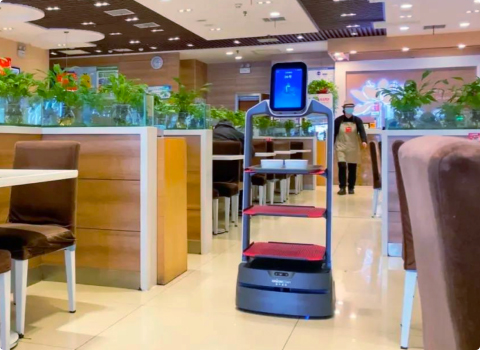
The OrionStar LuckiBot Pro operationalizes these generic serving robot capabilities for high-demand banquet and event use cases, with a 240-degree 3D all-around obstacle recognition stack (under defined test conditions) that supports reliable navigation even in crowded, fast-moving event spaces where guests and staff frequently shift positions. According to manufacturer data, the unit offers up to 12 hours of continuous runtime on a single charge to cover full-day multi-shift events without mid-event charging breaks, and supports a total payload of up to 60 kg across 3 to 4 adjustable trays to carry multiple full plated dinners, beverage rounds, or stacks of used tableware per trip. Its multi-mode functionality also lets operators toggle between fast delivery for hot food, stable low-vibration transport for liquid beverages, and guidance mode to lead guests to their assigned tables, aligning directly with the flexible operational needs of busy banquet venues.

Benefits for Banquet Managers, Catering Operations Managers, Event Coordinators, Hospitality Directors, FOH Staff

  • Reduced front-of-house workload: Deployments of comparable serving robots in banquet settings have recorded an average 30% reduction in repetitive food running and table clearing tasks for FOH teams, per vendor reported operational metrics.
  • Higher event setup and service speed: In verified banquet deployment cases under standardized test conditions, serving robots have recorded up to 55% improvement in event setup speed and 45% reduction in guest waiting time, vs. all-manual operation groups with equivalent staffing, as staff no longer need to spend time transporting supplies and refreshments across large venue spaces.
  • More consistent resource utilization: Catering operators using serving robots see a 30% to 35% improvement in overall labor and venue resource utilization, as staff can be reallocated to high-value guest interaction tasks that cannot be automated.
  • Helps lower cross-contamination exposure risks during food delivery: Robotic delivery reduces redundant human touchpoints between kitchen prep areas and guest tables, helping venues meet HACCP-aligned food safety management requirements when deployed in line with venue's existing food hygiene protocols and aligning with post-pandemic hygiene expectations for event guests.
  • Reclaimed high-value staff time: In verified 1000+ person banquet deployment cases under standardized test conditions, each FOH team can free up an average of 104 minutes per day for high-value guest interaction tasks, time that can be redirected to resolving guest requests, managing event logistics, and refining on-site experiences.
  • Lower peak-hour staffing pressure: The additional throughput provided by serving robots lets banquet operations teams handle 2025's projected higher corporate event volume without requiring corresponding increases to temporary peak-event staffing headcount.

Real-World Applications

Plated-Dinner Halls

Large plated-dinner banquets often require dozens of staff to transport hundreds of hot meals from the kitchen to guest tables within a narrow 15 to 20 minute service window, a task that frequently leads to rushed service, spilled food, and overworked staff. Serving robots can be loaded with full trays of plated meals at the kitchen exit, then navigate to pre-mapped table waypoints to drop off meals, cutting down the number of trips staff need to make across the large hall by more than half.

Kitchen Pass-Throughs

Kitchen pass-throughs are high-traffic, narrow zones where FOH staff, bussers, and kitchen staff frequently collide during peak service, creating bottlenecks that slow down food delivery and raise spill risk. Autonomously navigating serving robots are programmed to follow consistent, predictable paths through these zones, and their obstacle recognition systems automatically pause to avoid moving staff or hot serving trays, eliminating unplanned collisions and reducing bottlenecks.

Buffet and Beverage Stations

Buffet and beverage stations often see long lines of guests waiting for drinks, appetizers, or refills during large events, which creates crowding and slows down the overall event flow. Serving robots can be loaded with pre-plated appetizers, full trays of water glasses, or pre-poured wine rounds at the stations, then roam the event space to deliver these items directly to seated guests, reducing crowding at station areas and cutting down guest wait times.

Narrow Side Corridors Between Tables

Many banquet halls use dense table layouts to maximize guest capacity for large events, leaving only narrow side corridors for staff to move through that become easily blocked by serving carts or moving guests. Compact serving robots with high passability can move through these tight corridors without disrupting seated guests, and their 3D obstacle recognition lets them navigate around guests stepping out of their seats to avoid unplanned stops or collisions.

Integration With Other Smart Systems

Serving robots are designed to operate as connected mobile endpoints rather than standalone devices, and integrate seamlessly with existing banquet and event operational stacks: order data from point-of-sale and kitchen display systems can be synced directly to the robot's task list to trigger delivery and collection trips automatically when a ticket is marked complete, while pre-loaded banquet event orders and floor plans from venue room management systems define custom waypoints, restricted zones, and table-turnover logic for each individual event. Robots equipped on-board displays and audio output can also plug into the venue's AV and content management system to display sponsor branding, event announcements, or seating information for guests, while their real-time mapping data can be shared with smart building management systems to provide a live occupancy layer for the event space, and aggregated service telemetry feeds directly into analytics dashboards to support ESG and sustainability reporting requirements aligned with ISO 20121 standards.

Supporting ESG and Sustainability Goals

  • Serving robots support ISO 20121 sustainable event management system requirements by reducing unnecessary human travel across large event spaces, lowering overall per-guest energy consumption compared to repeated staff trips carrying heavy food and beverage loads.
  • Digital trip and delivery logs generated by serving robots provide granular, auditable operational data that can be used to track food waste, optimize portion routing, and meet the traceability requirements of GRI and CSRD ESG reporting frameworks, eliminating the need for manual paper-based record keeping.
  • Consistent, standardized robotic delivery routes reduce food spoilage and spillage by ensuring hot food is transported to guests in predictable, consistent timelines, directly cutting down on food waste that counts against a venue's overall sustainability metrics.

When combined, these functionalities let banquet operators meet both client and regulator ESG requirements without adding extra manual administrative work for their existing operations teams.

Closing

Serving robots are fundamentally reshaping how banquet halls deliver consistent, high-quality service to guests in event spaces, by absorbing the repetitive, physically demanding front-of-house delivery and clearing tasks that have long stretched staff thin during peak event periods. The OrionStar LuckiBot series offers multiple models calibrated to suit different venue sizes and operational requirements, for operators to evaluate as they build out their own automation roadmaps for event operations.