

REQUEST DEMO
Robot CATALOG will be sent to your mailbox immediately after submission.
SUBMIT
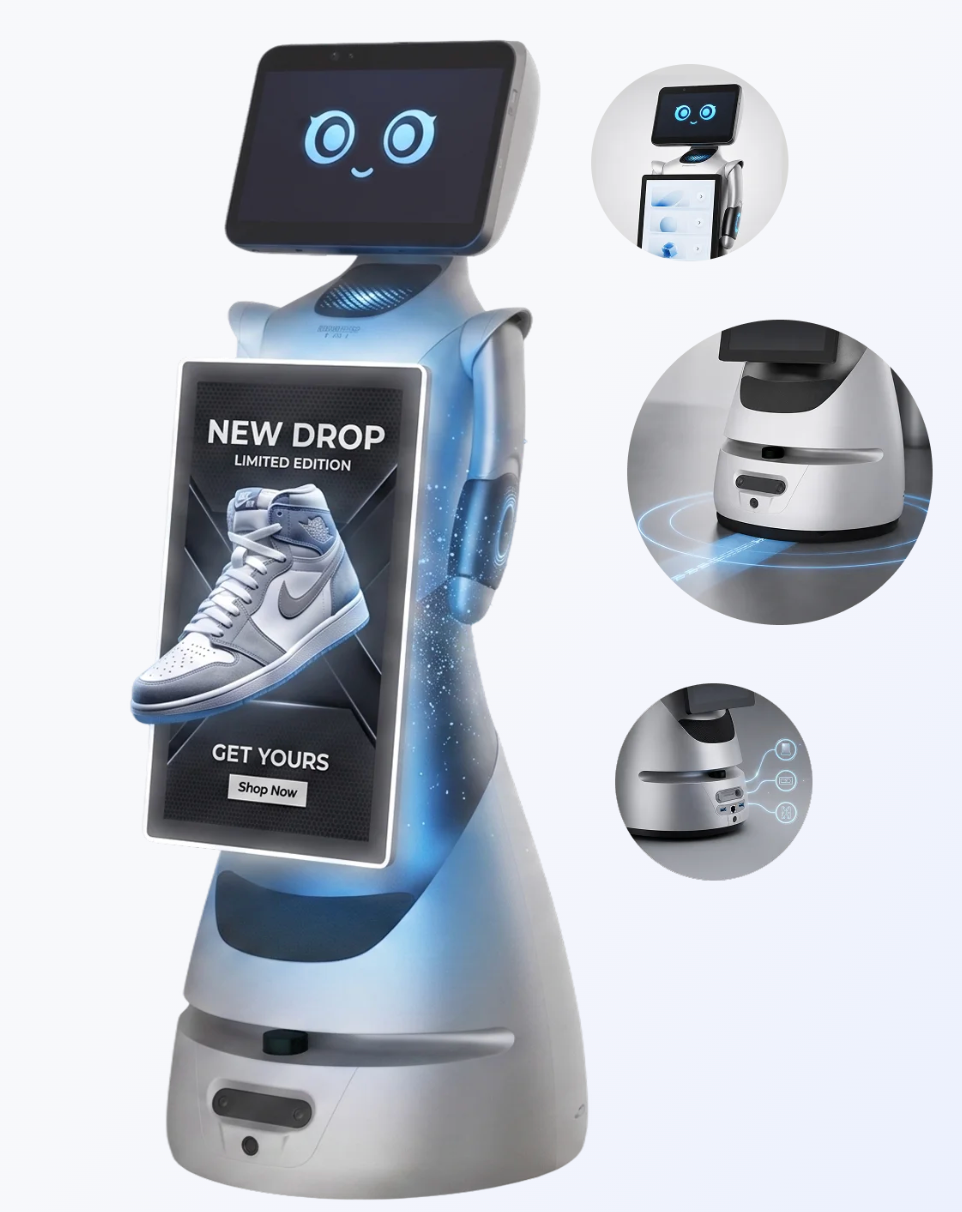
Hardware stores operating sprawling building materials aisles face persistent operational and customer experience headwinds, including widespread retail labor shortages that leave limited on-floor staff to assist shoppers, lengthy, SKU-dense aisles that make locating specific lumber, fastener, or masonry products unnecessarily time-consuming, and high demand for specialized product guidance that general floor associates cannot always deliver consistently. As foot traffic remains the core driver of hardware retail revenue, these frictions frequently lead to abandoned purchases and eroded customer loyalty, making purpose-built greeting robots a practical, cost-effective solution to fill critical service gaps across these high-traffic, complex aisle zones.
The OrionStar GreetingBot AD is engineered to deliver all of these core greeting robot capabilities specifically for high-footfall retail environments, with a hardware design optimized for long shifts and high-visibility customer interaction. According to manufacturer data, the unit supports mapping coverage up to 50,000 m², making it suitable for large-format big-box hardware store locations with sprawling building materials sections, and it offers up to 10 hours of continuous runtime on a single 20 Ah battery charge to cover full store operating hours without frequent mid-shift recharging. It also features a 21.5-inch FHD chest display, paired with 360-degree sound source localization via a 6-mic circular array, to deliver clear, visible wayfinding prompts and accurate voice interaction even in the wide, open layout of building materials aisles.
Lumber aisles in hardware stores typically carry hundreds of long, heavy SKUs ranging from standard dimensional lumber to custom cut specialty wood products, and shoppers often struggle to locate specific grades or lengths without staff assistance. The greeting robot can navigate along the wide corridors between lumber stacks, greet approaching shoppers, and display the exact bay location and current in-stock count of the lumber product a customer is searching for, before optionally leading them directly to the correct stack if required.
Cement and masonry aisles hold dense assortments of concrete mix, mortar, tile adhesive, and related supplies that vary significantly by intended project use, and many DIY shoppers lack the background knowledge to select the correct product for their job. The robot can pull up product specification sheets directly on its large chest display to show shoppers key details like cure time, coverage area, and recommended use cases for each masonry product, reducing the number of customers who select the wrong material and need to return it later.
Fasteners aisles often hold thousands of tiny, visually similar SKUs including nails, screws, bolts, anchors, and specialty hardware that are organized across dozens of small bins, making it one of the most frequently asked-about sections of the building materials zone. The greeting robot can pull up a visual reference photo of the exact fastener a shopper needs on its display, alongside the bin number and aisle location, to cut down the time shoppers spend searching for the correct item from several minutes to under 30 seconds in most cases.
Drywall and insulation aisles carry bulky, high-value SKUs that shoppers often need to compare by thickness, fire rating, noise reduction score, and R-value, and staff are frequently pulled away to assist with loading heavy materials into customer vehicles. The greeting robot can stay stationed or patrol this section to answer routine product comparison questions while staff are occupied with loading tasks, ensuring no shopper in this high-margin aisle waits more than a few seconds for basic assistance.
Greeting robots deployed in building materials aisles are designed to connect to existing in-store hardware infrastructure via standard dual-band Wi-Fi 6 and 4G connectivity, allowing seamless integration with the store’s existing inventory management, point-of-sale, CRM, and digital signage systems. This integration lets the robot pull live, real-time SKU inventory data directly from the store’s inventory platform, display matching promotional content for building materials products that are currently on sale, and flag complex customer queries that require expert support to automatically send a notification to the nearest available department associate. For multi-unit hardware store locations that deploy multiple greeting robots across their full building materials footprint, ESP32-based multi-robot scheduling supports coordinated, collision-free operation across the entire zone, with all devices connected to a single shared content management system for consistent updates.
This combination of efficiency gains aligns directly with the labor optimization and operational sustainability targets that hardware retail operators are increasingly required to report as part of global ESG disclosure frameworks.
Greeting robots are steadily redefining how hardware stores deliver customer service and support across sprawling, SKU-dense building materials aisles, closing longstanding gaps between stretched frontline staffing levels and growing shopper expectations for fast, accurate in-store support. As the retail robotics market moves past pilot deployments to widespread commercial rollout, the OrionStar GreetingBot series offers multiple configurable models tailored to different venue sizes, customer interaction priorities, and aisle layouts for operators looking to explore this category of in-store automation.