

REQUEST DEMO
Robot CATALOG will be sent to your mailbox immediately after submission.
SUBMIT
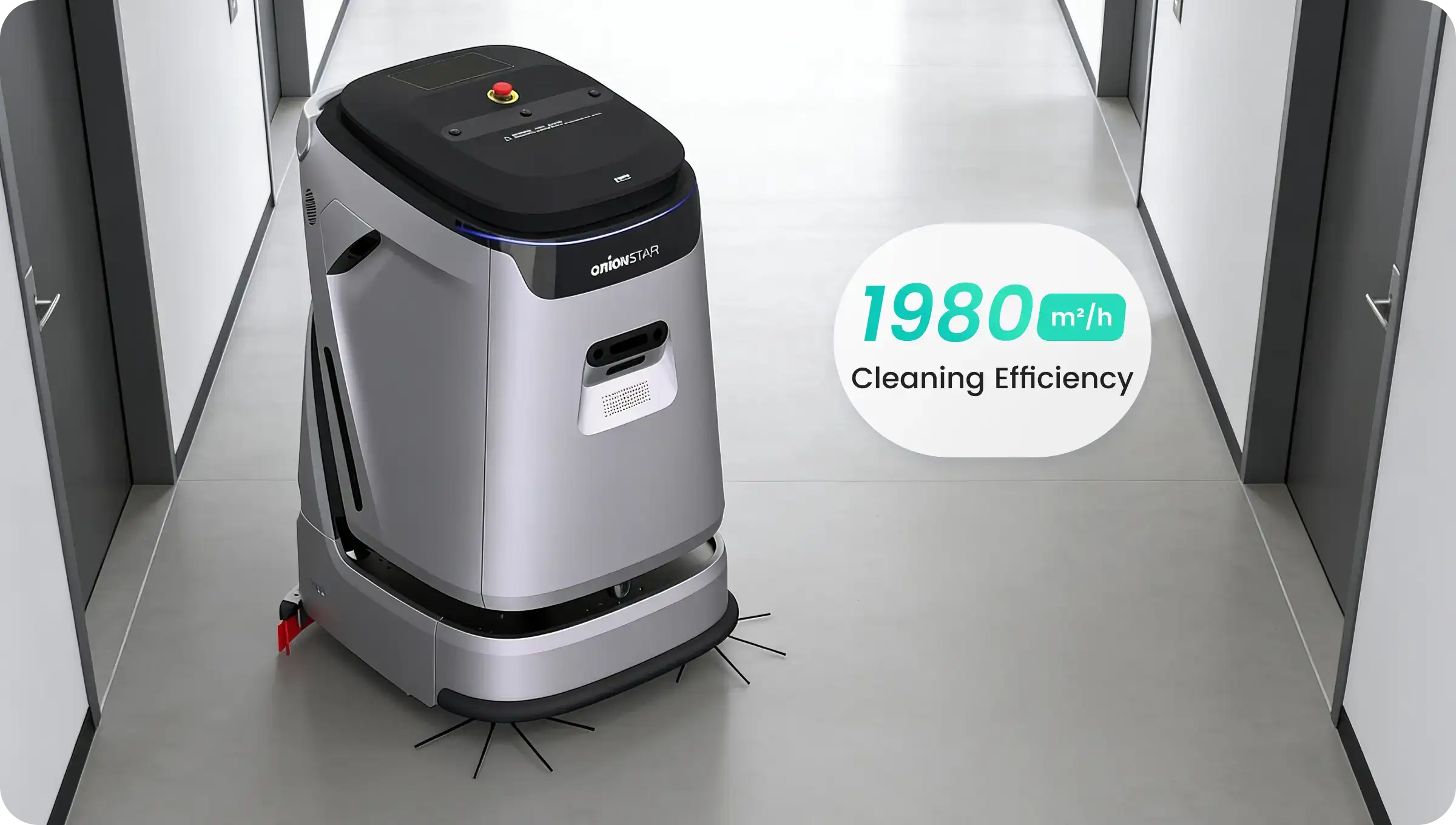
Against a backdrop of persistent labor shortages, rising operational costs, and increasingly strict global data and labor compliance rules, facility management teams face growing pressure to maintain consistent, high cleaning standards across public hallway spaces, even as staffing gaps make traditional manual cleaning schedules harder to execute reliably. Professional cleaning robots have emerged as a practical, scalable solution to ease this operational burden, shifting repetitive, high-volume floor cleaning work away from overstretched manual teams while delivering auditable, consistent cleaning results.
The OrionStar CleaniBot S55 Pro embodies these core category capabilities for hallway cleaning use cases, with a multi-sensor system that unifies LiDAR, stereo cameras, ultrasonic sensors, and line lasers to support independent navigation, dynamic obstacle avoidance, and accurate edge cleaning along corridor walls. *Per manufacturer standard lab test data under unobstructed indoor environments, the unit supports up to 10,000 m² of map construction from a single LiDAR setup, and delivers maximum cleaning efficiency of up to 1,368 m² per hour across sweep, vacuum, and dust mopping modes, with an ECO vacuum runtime of up to 19.5 hours to cover long corridor stretches across multiple floors without frequent recharging. Actual performance may vary by site conditions.
Long, high-traffic main corridors are typically the largest contiguous cleanable surface in most facility layouts, where manual cleaners often spend excessive time covering repeated back-and-forth routes. Professional cleaning robots can run scheduled overnight or low-occupancy daytime cycles across these stretches, delivering consistent floor scrubbing or vacuuming without pulling staff away from other priority tasks. The robot’s wide cleaning width ensures full coverage across the full corridor path, with no missed patches that would be visible to tenants or visitors.
Elevator lobbies see constant foot traffic throughout operating hours, leading to frequent scuffs, tracked-in debris, and visible floor soiling that creates a poor first impression for building occupants. Low-noise cleaning modes allow professional cleaning robots to operate in these zones during normal business hours without disrupting foot traffic, removing surface dust and light debris on demand between full deep cleaning cycles. The unit’s multi-sensor obstacle detection also ensures it can safely navigate around people waiting for elevators without causing disruptions.
Interconnecting hallways that link different building wings often have uneven foot traffic patterns, with some sections seeing far more use than others on a daily basis. Professional cleaning robots can be scheduled to prioritize higher-traffic segments of these hallways, rather than following a fixed manual cleaning route that wastes time on low-usage sections. This targeted cleaning approach reduces unnecessary wear on cleaning consumables and ensures high-use zones stay consistently presentable.
Transitional zones near stairwell entrances, ramp access points, and wing entryways often accumulate higher volumes of dirt and moisture tracked in from adjacent areas, which manual teams frequently miss during rushed routine rounds. The robot’s edge cleaning functionality allows it to get within 5 cm of walls and entryway thresholds to remove debris that accumulates in these hard-to-reach transition spots, reducing slip risk for building occupants. The compact footprint of most modern professional cleaning robots also lets them navigate narrow transition thresholds that older, bulkier cleaning equipment cannot access.
Modern professional cleaning robots for hallway use are designed to operate as connected nodes within a facility’s existing smart building stack, rather than as isolated standalone hardware. These units can exchange data natively with Building Management Systems (BMS) to pull occupancy, foot traffic, and CO₂ sensor data that informs dynamic, demand-based cleaning scheduling, aligning cleaning runs with low-occupancy windows to avoid disrupting building operations. They also integrate with Computerized Maintenance Management Systems (CMMS) to auto-generate work orders for routine brush changes, battery servicing, and sensor recalibration, treating the robot fleet the same as any other core building asset for streamlined maintenance workflows. Telemetry from the cleaning robots can also be published to a facility’s digital twin platform, where coverage data is correlated with foot traffic, indoor air quality, and space utilization metrics to deliver a unified view of building performance for facility management teams.
As more facilities align their operations with global net zero and ESG targets, automated hallway cleaning has become a practical, measurable addition to broader built-environment sustainability strategies alongside smart HVAC, lighting, and waste optimization systems.
Professional cleaning robots are steadily reshaping how facility management teams maintain clean, consistent hallway spaces, addressing longstanding structural labor challenges while delivering more predictable, auditable operational performance than traditional manual cleaning workflows. The OrionStar CleaniBot series includes a range of purpose-built autonomous cleaning units that are calibrated to fit different hallway sizes, floor types, and operational requirements, for facility teams that want to explore automation options aligned with their specific site parameters.