Introduction
Supercenter main aisles represent one of the most demanding large-format retail floor care environments, with operators across Europe, the U.S., and Asia facing overlapping challenges of persistent cleaning labor shortages, high slip-and-fall liability costs, and layered regulatory requirements including GDPR for data processing and regional food safety standards that raise the bar for consistent, documented hygiene, making commercial cleaning robots an increasingly practical, widely adopted solution to align operational performance with these rising demands.
The growing need for smarter cleaning in main aisles
- Persistent 200% to 300% annual cleaning staff turnover across U.S. retail supercenters creates recurring recruitment, onboarding, and retraining costs that eat into facility operations budgets.
- Unpredictable spill response windows in high-foot-traffic main aisles raise slip-and-fall liability risks, with same-level falls costing U.S. businesses $10.26 billion annually per the Liberty Mutual Workplace Safety Index.
- Poor floor cleanliness erodes shopper loyalty, as 99% of U.S. adults report negative perceptions of retail locations with unkempt floors, and 64% of shoppers have left a store early due to poor physical appearance.
- Large supercenter scenarios with store areas ranging from 10,000 to 30,000+ square meters that can achieve full cleaning coverage through the collaborative deployment of multiple CleaniBot C5 units make it extremely difficult to maintain consistent cleaning quality across all main aisles, especially during unmonitored overnight shifts.
How commercial cleaning robots can help
- LiDAR navigation enables autonomous mapping of large supercenter floor plans to support precise, repeatable cleaning path execution, with all navigation data processed locally by default to support GDPR compliance for EU deployments, requiring operators to conduct full Data Protection Impact Assessments if visual tracking features are activated.
- Autonomous path planning adjusts cleaning routes dynamically to avoid temporary obstacles such as restocking pallets, shopping carts, and strollers that frequently appear in main aisles.
- Multi-mode cleaning functionality supports scrubbing, dust mopping, and water absorption to address different residue types across food and general merchandise aisles.
- Auto-charging and docking allows units to return to base stations independently when battery levels are low, which can minimize the need for manual intervention in routine cleaning processes and greatly reduce the repetitive workload of operation and maintenance staff.
- Multi-sensor obstacle avoidance combines proximity, vision, and motion sensors to ensure units operate safely around moving shoppers and in-store staff at all times.
- Wi-Fi/4G/LoRa connectivity transmits anonymized operational and cleaning log data to centralized fleet dashboards, with all data retention settings configurable to align with GDPR data minimization requirements.
- Auto water refill and waste water discharge removes the need for staff to manually handle heavy water tanks, cutting down on unproductive downtime between cleaning cycles.
A closer look: OrionStar CleaniBot C5 in action
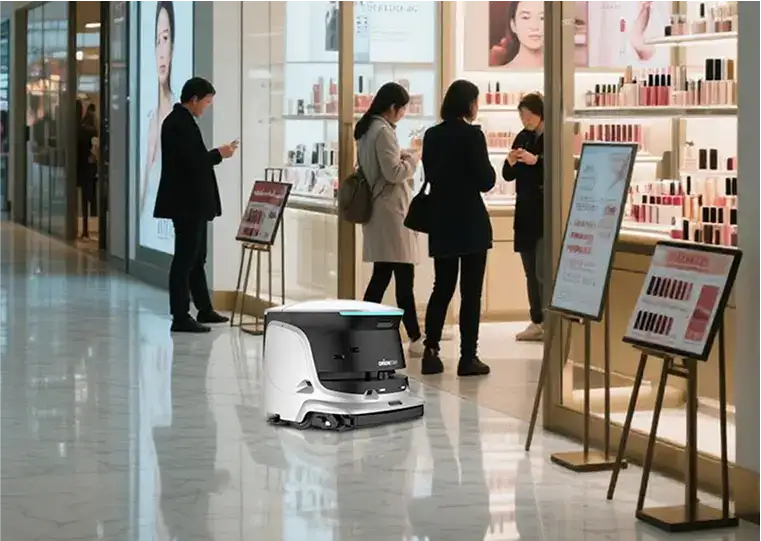
The OrionStar CleaniBot C5 embodies these universal commercial cleaning robot capabilities for supercenter main aisle use, with its integrated sensor stack and autonomous workflow designed to reduce manual staff intervention for routine floor care. According to manufacturer data, the unit supports up to 8 hours of continuous dust mopping runtime, and can independently map cleanable areas of up to 10,000 square meters to cover even the largest supercenter floor layouts in a small number of scheduled shifts. The dual-rolling-brush scrubbing system delivers up to 25 kg of downward pressure to remove sticky residues from produce and beverage spills, with a maximum hourly cleaning capacity of up to 1,980 square meters to outpace manual mopping productivity significantly. All operational data can be configured to meet regional GDPR requirements for markets in Europe, the U.S., and Asia, with no mandatory cloud transmission of visual sensor data unless explicitly enabled by the store operations team.
Benefits for supercenter operations managers, store facility managers, and in-store cleaning crews
- Reduced Labor Burden: A single autonomous cleaning robot can offset approximately one full-time floor technician position, addressing persistent staffing shortages and eliminating the high costs associated with 200% to 300% annual cleaning staff turnover.
- Lower Overall Cleaning Costs: Industry aggregated data from 100 grocery store deployments shows robotic cleaning fleets can deliver up to 21% reduction in total cleaning and maintenance costs, for chain hypermarket deployment scenarios with more than 10 stores each covering an area of over 10,000 square meters, the cumulative annual operating cost savings verified by customers can exceed 2 million US dollars.
- Consistent, Documented Cleaning Quality: The cleaning process that meets the factory calibration standards can increase the removal rate of visible residues on the ground to 95%, and meet the hygiene acceptance requirements of mainstream food retail venues after ATP compliance testing, while timestamped cleaning logs provide verifiable proof of completed work for health inspections and liability audits.
- Faster Hazard Response: Automated cleaning runs reduce the average time spills remain unattended in main aisles, cutting slip-and-fall risk that costs U.S. retail businesses more than $10 billion annually in disabling injury expenses.
- Improved Staff Allocation: In-store cleaning crews are freed from repetitive, physically demanding mopping tasks to focus on higher-value work such as targeted spot cleaning, customer spill response, and hard-to-reach zone maintenance that cannot be completed by autonomous units.
- Quiet, Unobtrusive Operation: Units running at under 68 dB(A) can operate during regular shopping hours without disrupting customer experiences, eliminating the need to restrict floor care exclusively to overnight off-shift windows.
Real-world applications
Fresh Produce Aisles
Fresh produce aisles are regularly exposed to sticky fruit and vegetable residues, spilled water from misting systems, and condensation from adjacent refrigeration units that create persistent slip hazards. Commercial cleaning robots with multi-mode scrubbing functionality can run scheduled passes multiple times per day to remove thin layers of sticky produce residue, without requiring staff to pause other critical restocking tasks.
Frozen Food Aisles
Frozen food aisles accumulate consistent condensation from open and closed freezer cases, as well as occasional dropped frozen product debris that melts into small wet spots across hard floor surfaces. Robots with continuous water absorption modes can traverse these aisles regularly to pull up residual moisture, reducing the risk of slips for both customers navigating narrow freezer access zones and staff restocking inventory.
Checkout Approach Lanes
Checkout approach lanes see the highest volume of foot traffic across all supercenter main aisles, with accumulated dry debris from unpackaged goods, spilled beverage containers, and discarded shopping receipts that accumulate rapidly during peak shopping hours. Robots programmed to run during low-traffic windows between checkout rushes can clear debris and wet spots without disrupting customers waiting in line, maintaining a consistently clean appearance for the point-of-sale zone.
Promotional Endcap Zones
Promotional endcap zones are rearranged on a daily basis to accommodate new seasonal displays, leading to constantly shifting floor layouts that can disrupt pre-planned manual cleaning routes. Commercial cleaning robots with real-time obstacle adjustment capabilities can navigate around newly placed display pallets and promotional stands without additional reprogramming, ensuring full cleaning coverage even as endcap configurations change.
Integration with other smart systems
Commercial cleaning robots for supercenter main aisles are designed to function as mobile data nodes that integrate seamlessly with existing facility management and smart retail systems, via API or CSV export functionality that feeds cleaning coverage logs, utilization metrics, and operational telemetry directly into Computerized Maintenance Management Systems (CMMS) and Building Management Systems (BMS) used by facility teams. These units can also sync with in-store IoT and customer heatmap analytics platforms to automatically adjust scheduled cleaning routes to run during confirmed low-foot-traffic windows or scheduled inventory restocking lulls, minimizing disruption for shoppers and staff. Real-time hazard detection sensors on the robots can also send location-tagged spill alerts directly to store staff mobile dashboards, cutting average response times for unexpected wet or dirty spots in main aisles.
Supporting ESG and sustainability goals
- Automated cleaning units use precise, controlled detergent dosing systems that Under standard test conditions, the precise quantitative dispensing design of the autonomous cleaning robot can reduce the consumption of cleaning chemicals by up to 70% compared with the traditional manual mopping mode, supporting compliance with EPA guidelines for reduced volatile organic compound (VOC) and aquatic toxicity output.
- Timestamped, exportable operational data for water, energy, and cleaning chemical usage from robotic fleets creates fully auditable records that simplify corporate ESG reporting and help supercenters meet requirements for LEED Retail certification and ISO 14001 environmental management standards.
- Consistent, documented floor hygiene routines align with BRCGS and FSSC 22000 food safety standards for supercenter retail environments that handle unpackaged fresh food, reducing cross-contamination risks across main aisles that connect food and general merchandise departments.
Taken together, these measurable improvements to environmental performance, hygiene compliance, and resource efficiency make commercial cleaning robots a high-impact addition to any supercenter’s formal ESG roadmap.
Closing
As supercenters continue to navigate persistent labor pressures, rising customer expectations for in-store cleanliness, and layered regulatory requirements for hygiene and data privacy, commercial cleaning robots are becoming a standard part of main aisle floor care operations that deliver consistent, verifiable results across large retail footprints. The OrionStar CleaniBot series includes a range of purpose-built models calibrated for different venue sizes, throughput levels, and cleaning use cases, allowing facility and operations teams to evaluate options that align with their specific supercenter layout and operational priorities.