

REQUEST DEMO
Robot CATALOG will be sent to your mailbox immediately after submission.
SUBMIT
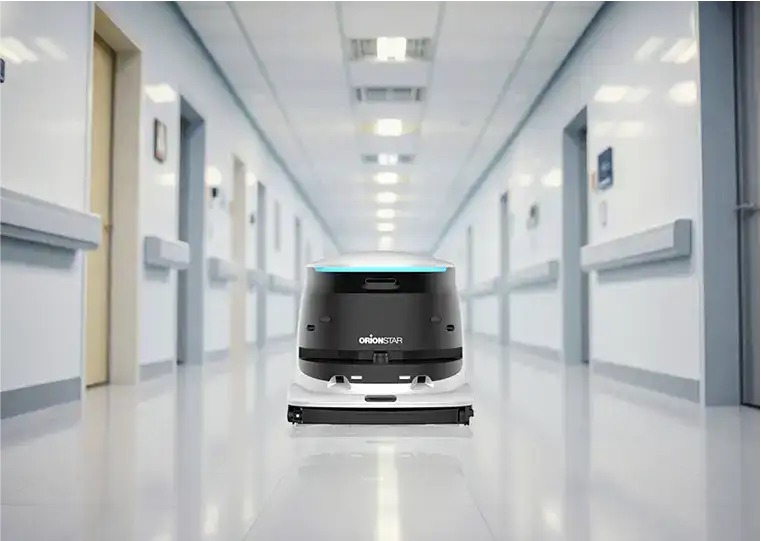
Hospital building management teams are navigating unprecedented operational strain amid widespread janitorial labor shortages, persistent upward pressure on cleaning-related operating costs, and layered regulatory requirements for verifiable, consistent sanitation across 24/7 healthcare facilities. Traditional manual cleaning workflows often struggle to keep pace with growing foot traffic, mandatory audit trails for infection control, and patient experience targets that directly impact facility funding, leaving operations teams overstretched and at risk of non-compliance. Commercial cleaning robots have emerged as a practical, scalable solution that automates repetitive high-volume floor care tasks, reducing the burden on frontline staff while delivering consistent, documented cleaning results for regulated hospital environments.
The OrionStar CleaniBot S55 Pro is built to deliver all the core general capabilities of modern commercial cleaning robots for hospital public zone use, with design choices tailored to high-traffic, mixed-surface healthcare environments. According to manufacturer data, the robot supports map construction for areas up to 10,000 m² via its integrated LiDAR system, making it suitable for mapping the full public footprint of most mid-sized hospital facilities. Up to 28 hours of runtime in dust mopping mode, per official product specifications, allows extended low-noise cleaning shifts during daytime visiting hours without frequent interruptions for charging. The robot is equipped with a perception system composed of 15 multi-type sensors, which can realize 360° all-directional obstacle detection under the official defined test environment, providing safety support for operation in personnel-dense scenarios, and can reliably avoid moving people, rolling medical carts, and temporary public area furnishings common in hospital public spaces, while its integrated cleaning log output can be configured to meet local documentation requirements for facility audits.
Hospital lobbies see extremely high daily foot traffic from patients, visitors, and staff, leading to constant accumulation of tracked-in dirt, spills, and debris that can create slip hazards and reduce perceived facility cleanliness. Commercial cleaning robots can arrange designated light supplementary cleaning cycles at 15-30 minute intervals during peak visiting hours for high-traffic areas such as hospital lobbies and elevator lobbies, and the specific operation frequency can be flexibly adjusted according to the actual area of the hospital area and task planning. The robot’s ability to clean close to walls and reception desk edges ensures no visible debris is left in high-visibility areas that shape first impressions for incoming patients.
Long, high-volume public corridors across hospital wings often require multiple cleaning passes per day to maintain acceptable floor hygiene, a task that takes manual staff hours of repetitive walking and mopping. Autonomous robots can run full corridor cleaning routes overnight or during low-traffic periods without supervision, covering far more linear floor space per hour than manual cleaning teams. They also automatically log full corridor coverage for each run, so operations teams do not need to conduct post-shift spot checks to confirm work completion.
Patient and family waiting areas are sensitive spaces where loud cleaning equipment can cause unnecessary distress for people with pre-existing health conditions or heightened anxiety related to upcoming medical appointments. Low-noise cleaning modes on commercial cleaning robots can run unobtrusively in waiting areas during operating hours, removing dust and light soil without disrupting conversations or rest for waiting visitors. The consistent, visible presence of automated cleaning also reassures patients that the facility is prioritizing public hygiene to reduce infection risk.
Elevator banks are high-traffic, constrained spaces that accumulate dirt quickly from the soles of hundreds of people moving between different hospital floors every day, but their narrow layout often creates bottlenecks for manual cleaning teams working during peak hours. Commercial cleaning robots with compact footprints can navigate in and out of elevator lobbies and even ride connected elevators to clean elevator banks on multiple floors without manual intervention. Scheduled cleaning runs for elevator banks can be set to occur between peak traffic windows, so the work never blocks elevator access for staff or patients carrying medical equipment.
Modern commercial cleaning robots are designed to function as mobile IoT endpoints that integrate seamlessly with existing hospital intelligent building ecosystems. Through standardized communication protocols, these robots can sync schedules with Building Management Systems to align cleaning cycles with HVAC setbacks, lighting zone activation, and automated door controls to reduce unnecessary energy use during cleaning operations. When linked to a facility’s CMMS platform, robots can automatically generate work orders for persistent unaddressed spills, send predictive maintenance alerts for worn cleaning components, and feed real-time foot traffic and floor condition data back to the facility’s centralized digital twin for broader operational planning. Many models also support direct integration with hospital elevator control software, allowing a single robot to access and clean multiple floors across a facility without manual escort from staff.
When combined, these three pillars of ESG support help hospital building management teams align routine day-to-day cleaning operations with broader organizational sustainability and social responsibility targets.
Commercial cleaning robots are steadily redefining how hospital building management teams maintain consistent, compliant floor care across high-traffic 24/7 healthcare facilities, shifting operational models from labor-heavy, inconsistent manual workflows to hybrid human-robot systems that deliver better results with less operational strain. The OrionStar CleaniBot series offers multiple purpose-built models that are calibrated to match different hospital sizes, floor layouts, and cleaning volume requirements, for teams exploring automation options that align with their specific facility operational priorities.