

REQUEST DEMO
Robot CATALOG will be sent to your mailbox immediately after submission.
SUBMIT
Hospital elevator lobbies serve as critical convergence points for patients, visitors, staff, and medical equipment, operating 24/7 as high-traffic, high-touch zones that pose persistent infection control, staffing, and operational challenges. With healthcare-associated infection (HAI) risks linked to contaminated floors, ongoing EVS staffing shortages that reduced teams by 25% post-pandemic, and the need for constant re-cleaning to maintain compliance with accreditation standards, manual cleaning methods struggle to keep pace. Robotic floor cleaners emerge as a data-driven, efficient solution to address these gaps, combining automation with advanced technology to elevate cleanliness, reduce operational burdens, and support regulatory requirements.
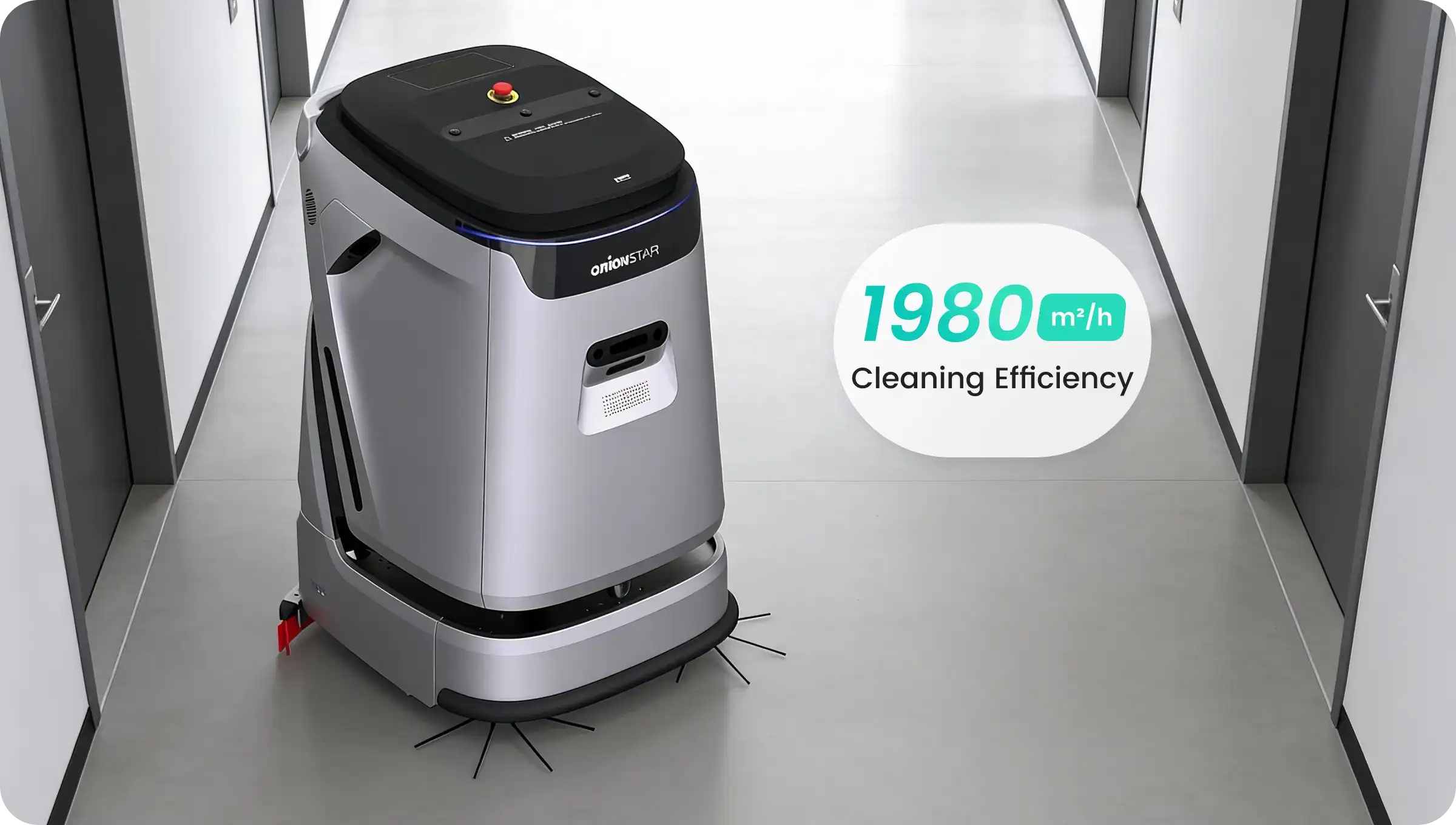
The OrionStar CleaniBot C5 embodies the core capabilities of robotic floor cleaners, leveraging autonomous path planning to map areas up to 10,000 m² and optimize cleaning routes for elevator lobbies and adjacent zones. According to manufacturer data, it delivers a maximum cleaning area capacity of up to 1,980 m² per hour, making it significantly faster than manual mopping, and operates at a noise level of less than 68 dB(A), allowing it to clean during busy hours without causing disruption. Its auto-charging and docking system supports multi-shift operation, with a mopping runtime of up to 8 hours on a single charge and fast charging in around 1.5 hours to minimize downtime between cleaning cycles.
These high-traffic zones see constant foot traffic from patients, staff, and visitors, leading to frequent re-soiling and pathogen accumulation. The OrionStar CleaniBot C5’s autonomous path planning ensures full coverage of the entrance area, while its 25 kg scrubbing pressure removes stubborn dirt and stains in a single pass. Its low-noise operation allows cleaning during peak hours without disrupting elevator usage or patient flow.
Thresholds between elevator lobbies and corridors are prone to dirt buildup from wheelchairs, stretchers, and service carts, creating infection risks. The robot’s obstacle avoidance system navigates tight spaces with a minimal passing width of approximately 880 mm, ensuring it cleans along threshold edges effectively. Its ability to pick up debris up to 3 cm in height addresses larger dirt particles tracked into the lobby.
These zones experience heavy soil and potential fluid spills from patient transfers, requiring immediate and thorough cleaning. The CleaniBot C5’s multi-mode cleaning (scrubbing, dust-mopping, water absorption) handles both dry debris and wet spills efficiently, while its 90 L combined water tank reduces the need for frequent refills during extended cleaning cycles. Its fast-charging capability ensures it can return to service quickly if needed for emergency cleaning.
Waiting areas near elevators are high-touch zones where patients and visitors spend extended time, making cleanliness critical for patient satisfaction. The robot’s low-noise operation (less than 68 dB(A)) ensures it cleans these areas without disturbing waiting individuals. Its real-time monitoring provides data on cleaning frequency, helping teams maintain consistent cleanliness to improve HCAHPS scores.
Robotic floor cleaners like the OrionStar CleaniBot C5 can integrate seamlessly with hospital elevator lobby systems to optimize cleaning efficiency and alignment with operational workflows. Integration with Building Management Systems (BMS) allows cleaning schedules to be synced with low-traffic windows, avoiding peak patient transfer periods and elevator usage. Computerized Maintenance Management Systems (CMMS) can receive automated cleaning logs, including coverage maps and chemical dispensing records, to support infection prevention audits and compliance reporting. IoT and fleet management platforms enable remote monitoring, over-the-air software updates, and centralized control of multiple robots across hospital sites. In advanced deployments, integration with elevator control APIs can signal the robot to pause when an elevator call is imminent, reducing traffic conflicts at elevator thresholds and ensuring smooth patient flow.
These automated solutions contribute to hospitals’ ESG goals by reducing resource waste, lowering operational costs, and creating safer, more sustainable working environments for EVS teams.
Robotic floor cleaners are transforming how hospitals maintain cleanliness and safety in high-stakes elevator lobbies, addressing longstanding staffing, infection control, and operational challenges with data-driven automation. The OrionStar CleaniBot series offers a range of models tailored to different healthcare environments, from compact elevator lobbies to large hospital campuses, providing flexible solutions to meet diverse cleaning needs. As hospitals continue to prioritize patient safety, compliance, and sustainability, these robotic systems will play an increasingly vital role in elevating hygiene standards across critical facility zones.